Agricultural Well Service in Fallbrook
Southern California Well Service provides complete agricultural well services to Fallbrook farmers, ranchers, and growers. From irrigation wells to livestock watering systems, we have the expertise and equipment to keep your operation running.
📋 In This Guide
Agricultural Wells in Fallbrook, the Avocado Capital
Few communities in San Diego County depend on private groundwater the way Fallbrook does. Tucked into the rolling hills of the county's northwest corner, between the Santa Margarita River and the granite ridges that climb toward De Luz and Rainbow, Fallbrook earned its nickname as the "Avocado Capital of the World" because growers here learned to farm steep, well-drained slopes that hold heat and shed frost. Avocados, citrus, cut-flower nurseries, and a growing number of small vineyards all draw on wells when the cost of imported district water makes irrigation from the meter impractical.
That economic pressure is the real story behind agricultural wells in Fallbrook. Rainbow Municipal and Fallbrook Public Utility District water is some of the most expensive agricultural water in the state, and growers who can put in a reliable irrigation well often cut their per-acre-foot water cost dramatically. Southern California Well Service has drilled, repaired, and rehabilitated farm wells across these hills for more than 30 years, and we size every system to the specific crop, slope, and aquifer rather than dropping in a generic pump and hoping it holds up through a dry October.
Fallbrook Well Data and Local Geology
628'
Average Depth
5–2110'
Depth Range
969
Wells on Record
San Diego
County
Based on California DWR well completion reports. Fallbrook's average well depth of 628 feet runs about 178 feet deeper than the San Diego County average of 450 feet.
With 969 wells on record and an average depth of 628 feet, Fallbrook sits among the deeper-drilling communities in the county. The reason is geology. Beneath the orchards lies the Santiago Peak Volcanics and a complex of metasedimentary and granitic bedrock, overlain by thin alluvium only along drainages like the Santa Margarita and Live Oak Park creeks. Water here is stored in fractures within hard rock rather than in a thick, easy sand-and-gravel aquifer, so productive wells often have to reach deep to intersect enough water-bearing fractures to sustain irrigation flows. That is also why the depth range is so wide, from shallow drainage wells under 50 feet to a handful past 2,000 feet on the ridgelines.
How an Agricultural Well System Works on a Fallbrook Grove
A working irrigation well on a Fallbrook hillside is more than a pump in a hole. Most groves run a submersible pump set well below the standing water level, wired to a control box at the surface and protected against the rapid drawdown that fractured-rock wells are prone to. Because grove irrigation demands steady volume during summer heat, we frequently pair the pump with a variable frequency drive (VFD) that matches output to demand and protects the well from being pumped down faster than the fractures can recharge.
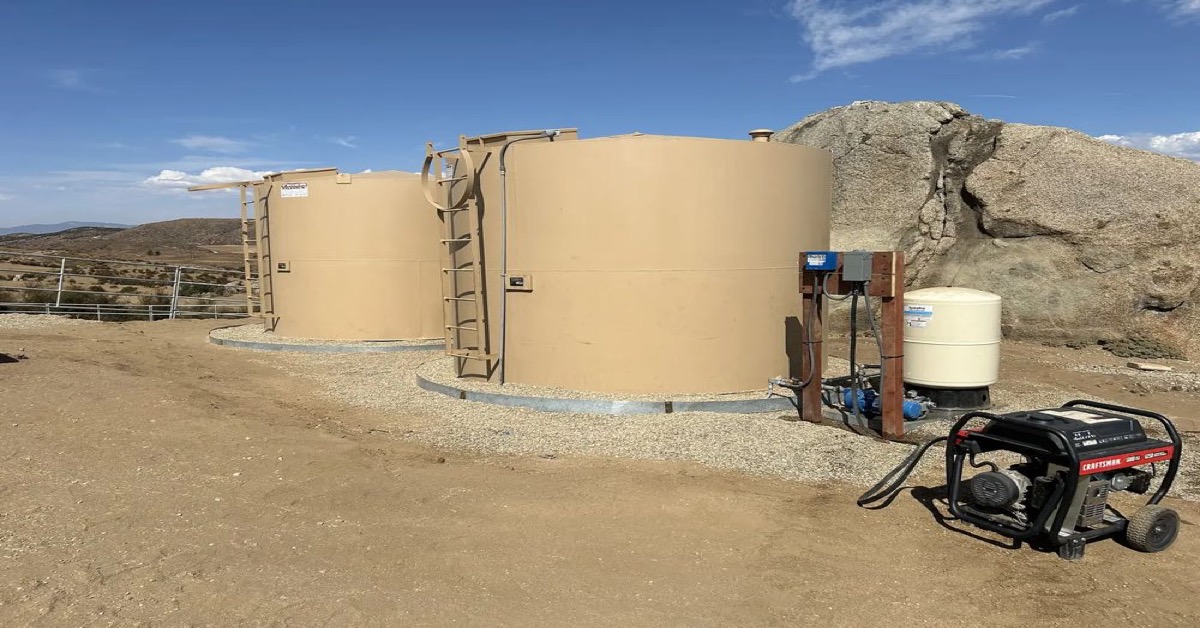
From there the water typically flows to a storage tank, then through a booster or constant-pressure system that holds the steady 40 to 60 PSI a drip or micro-spray system needs across sloping terrain. Storage matters in Fallbrook specifically because many wells here yield modestly, perhaps 8 to 25 gallons per minute. A 2,500- or 5,000-gallon tank lets a grower pump slowly around the clock and irrigate in short, high-volume cycles, getting far more usable water out of a low-yield well than direct pumping ever could.
Common Well Problems on Fallbrook Farms
The local conditions that make Fallbrook good for avocados also create predictable well headaches. The most common calls we get from area growers include:
- Declining yield in late summer. Fractured-rock wells can lose production as the dry season draws down the water table; a well that flowed fine in May may struggle by September.
- Sand and grit from decomposed granite. Weathered granite produces fine sand that wears pump impellers and clogs the tiny emitters on drip systems.
- Iron and manganese staining. Bedrock groundwater here often carries enough iron to stain hardscape and plug filters, a frequent issue on older Fallbrook groves.
- Pump short-cycling. A waterlogged pressure tank or failing pressure switch makes the pump start and stop rapidly, a fast track to a burned-out motor.
- Wells damaged by wildfire. After fires move through the De Luz and Rainbow corridors, wellheads, wiring, and control boxes frequently need inspection and repair.
What to Check Before You Call
If your Fallbrook irrigation well is acting up, a few quick checks can tell you whether it is a simple fix or something that needs a pump truck:
- Confirm the breaker and any disconnect at the well or pump panel haven't tripped, then reset once and listen for the pump.
- Check your pressure tank gauge. If pressure swings wildly or the pump cycles every few seconds, suspect a waterlogged tank or bad switch.
- Look at the water itself. Sudden sand, air spitting from emitters, or a drop in flow can mean the water level has fallen below the pump intake.
- Note whether the problem is whole-grove or just one block, which helps separate a well problem from an irrigation-line failure.
Avoid repeatedly resetting a breaker that keeps tripping or running a pump that is sucking air; both can destroy an expensive motor in minutes.
When to Call a Professional
Call us when the pump won't start and the breaker trips again, when yield has dropped enough to stress your trees, when you see persistent sand or staining, or any time you smell something burning at the control box. For a working grove during summer, well downtime is measured in damaged trees, so we offer same-day emergency response across the Fallbrook area. Our diagnostic visit is $125 and is credited toward any repair we perform.
Because Fallbrook straddles the boundary of several small groundwater sub-basins, we also help growers understand how their well fits into local water management and what a new permit through San Diego County entails. Whether you are bringing a long-idle grove well back to life, adding storage to stretch a modest yield, or planning a new bore before the next planting, getting the well right the first time protects both your trees and your investment for decades.
Agricultural Well Service Costs in Fallbrook
Every well is different, but these ranges reflect typical Fallbrook-area pricing so you can budget realistically:
- Pressure switch replacement: $150–$350
- Pressure tank replacement: $600–$1,500
- Submersible pump replacement: $2,500–$5,500 (more for the deep settings common here)
- Sediment / sand filtration: $300–$900
- Iron & manganese or softening treatment: $1,500–$3,500
- Constant-pressure / booster system: $2,000–$4,500
- Well hydrofracturing to boost yield: $3,000–$8,000
- New agricultural well, turnkey: $18,000–$42,000
For deep fractured-rock wells that have lost production, hydrofracturing is often worth considering before drilling new. By using water pressure to open and clear existing fractures, it can restore meaningful yield to a Fallbrook well at a fraction of the cost of a new bore.
Serving Fallbrook and Surrounding Growing Areas
From our Ramona and Anza offices we cover Fallbrook and the surrounding agricultural communities throughout northwest San Diego County, including the neighboring grove and ranch areas of:
Frequently Asked Questions
How deep are agricultural wells in Fallbrook?
Fallbrook wells average about 628 feet, deeper than the San Diego County average of 450 feet. Depths on record range from under 50 feet near drainages to more than 2,000 feet on the ridges, because water here is held in bedrock fractures rather than a thick sand aquifer.
Is a well cheaper than district water for a Fallbrook grove?
For many growers, yes. Fallbrook PUD and Rainbow Municipal water is among the most expensive agricultural water in the region, so a reliable irrigation well frequently pays for itself over several seasons, especially on larger avocado or citrus operations.
Why does my Fallbrook well produce sand?
The decomposed granite common around Fallbrook sheds fine sand that a well can draw in, especially as the pump ages or the water level drops. We diagnose the cause and install proper screening or sediment filtration so the grit doesn't damage pumps or clog drip emitters.
My well's flow dropped over the summer—can it be restored?
Often yes. Late-season decline is common in fractured-rock wells. Depending on the cause, options include lowering the pump, rehabilitating the well, or hydrofracturing to reopen water-bearing fractures, which can restore yield for far less than drilling a new well.
Do you handle wells damaged by wildfire?
Yes. After fires in the De Luz, Rainbow, and Fallbrook backcountry we regularly inspect and repair scorched wellheads, wiring, and control boxes, and we test water quality and pump function so growers can get irrigation back online quickly.
How fast can you respond in Fallbrook?
We offer same-day emergency service to the Fallbrook area. Because a down well in summer can stress an entire grove within days, we prioritize agricultural calls. A diagnostic visit is $125 and is credited toward the repair.
Our Locations
Related Articles
Continue learning about agricultural wells and water systems