Well Inspection Services in Oceanside
Buying a property with a well in Oceanside? Need an annual well checkup? Southern California Well Service provides thorough well inspections with detailed reports on well condition, water quality, and system performance.
📋 In This Guide
Need Well Inspection in Oceanside?
We serve Oceanside and all of San Diego County. Licensed C-57 contractor (CSLB #1086994), founded 2020.
Call: (760) 440-8520Coastal Well Inspections in Oceanside
Oceanside anchors the northern coast of San Diego County, where the San Luis Rey River meets the Pacific. City water reaches most neighborhoods, but the agricultural back-country and older estate parcels inland — around Whelan Lake, the river valley, and the edges toward Bonsall and Fallbrook — still draw from private wells. Coastal and river-valley wells carry a unique set of concerns that inland wells do not, which makes a knowledgeable inspection especially valuable in Oceanside.
Whether you are closing on a property, refinancing, or maintaining a well you already rely on, our inspection evaluates every part of the system and screens the water for the specific issues that show up near the coast. You get a written report ready for a buyer, seller, lender, or title company.
Our Well Inspection Services
- Pre-purchase and real-estate well inspections
- Annual well health checkups
- Flow rate (GPM) and recovery testing
- Static and pumping water-level measurement
- Water quality sampling, including salinity screening
- Pump, pressure tank, and pressure-switch assessment
- Wellhead, casing, and sanitary-seal evaluation
- Electrical and control-wiring inspection
- Written reports accepted by lenders and title companies
Well Data: Oceanside, California
148'
Average Depth
3–1517'
Depth Range
546
Wells on Record
San Diego
County
Based on California DWR well completion reports. Oceanside's shallower wells tap the San Luis Rey River alluvium; deeper wells reach the granitic Peninsular Ranges batholith.
With 546 wells on record, Oceanside has a well-established well infrastructure. The wide depth range of roughly 3 to 1,517 feet reflects the contrast between the shallow coastal plain and the harder rock inland. Near the San Luis Rey River, shallow wells draw from sand and gravel alluvium; farther from the coast, deeper wells penetrate the granitic and metamorphic rock of the Peninsular Ranges batholith to reach more reliable water. That coastal-to-foothill gradient is exactly why local knowledge matters when inspecting an Oceanside well.
At an average depth around 148 feet, an Oceanside well inspection should always include a static water-level reading, a pumping-level and flow measurement, and a water-quality screening. Because shallow coastal aquifers are vulnerable to seawater intrusion, we place extra emphasis on salinity and chloride levels here.
What We Inspect in Oceanside Wells
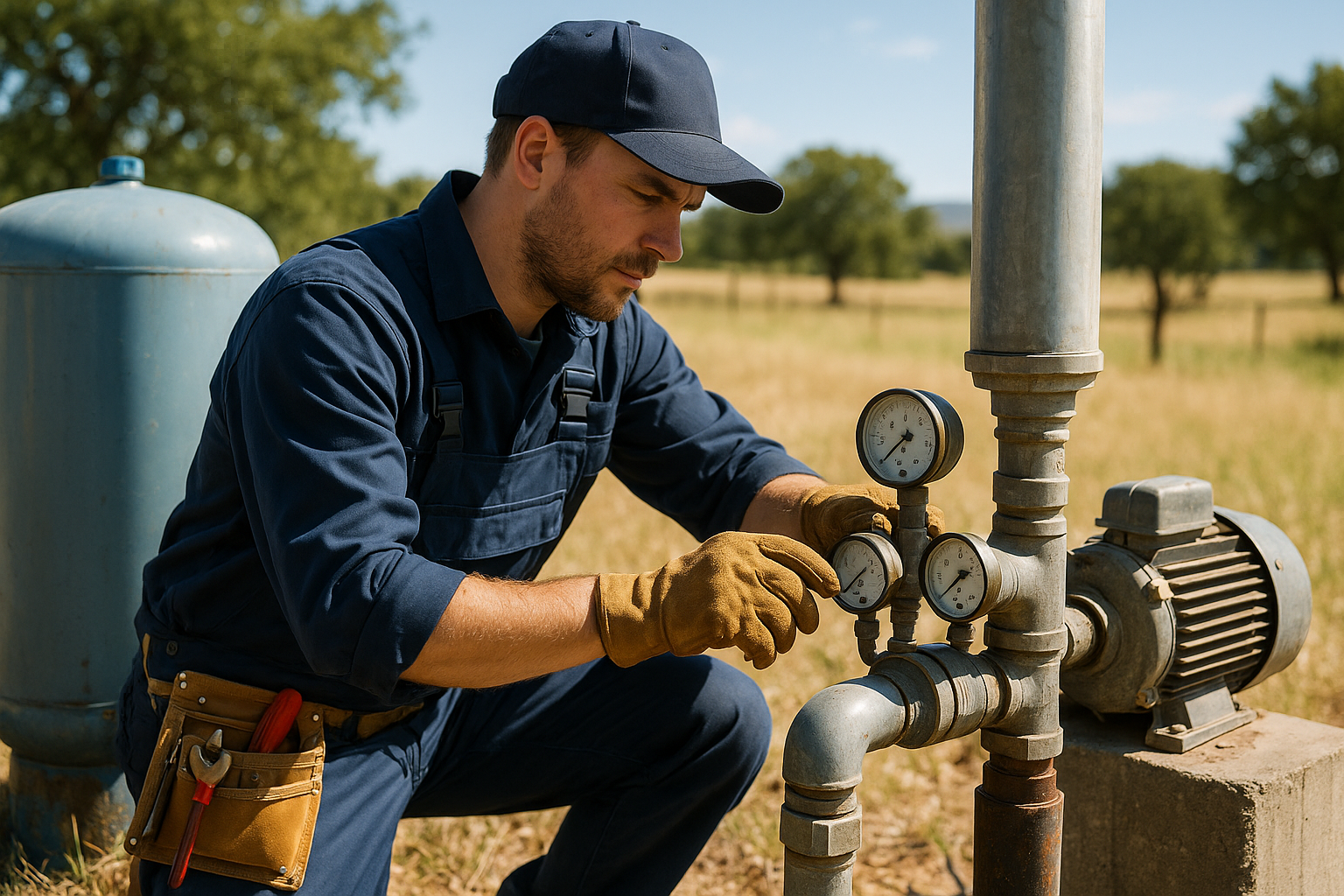
A complete inspection covers the wellhead and sanitary cap, casing integrity, static and pumping water levels, pump performance in gallons per minute along with system pressure, the pressure tank and switch, and the electrical wiring and controls. In the river-valley alluvium, we watch for sediment and screen wear; in deeper granitic wells, we assess recovery rate and casing condition.
Water quality gets special attention in Oceanside. We screen for salinity and chlorides — the signature of seawater intrusion in coastal aquifers — alongside hardness, iron, manganese, nitrates, and bacteria. When treatment is warranted, we lay out realistic options: sediment filtration ($300-$900), a water softener ($1,500-$3,500), UV disinfection ($800-$1,800), or reverse osmosis ($300-$1,200) for salinity and drinking-water polishing. If a pump has failed, submersible replacement runs $2,500-$5,500 depending on depth, and a worn pressure switch or tank is $150-$350 or $600-$1,500 respectively.
How a Well Inspection Works, Step by Step
Understanding the sequence helps you see the value of the service. We start at the wellhead, checking casing, the sanitary cap, and the seal that keeps surface water and contaminants out of the borehole — critical in a coastal city where the water table can sit close to the surface. Next we measure the static water level, then run the pump to record the drawdown level and flow rate in gallons per minute. How far the water level drops and how quickly it recovers tells us whether the aquifer can meet household demand.
We then evaluate the pressure tank's pre-charge and condition, the pressure switch settings and contacts, and the electrical wiring, breakers, and controls. Finally we draw a water sample. In Oceanside that sample is especially important, because a rising chloride trend can signal seawater intrusion long before the water tastes salty. Only after every component is checked do we assemble the findings into your report.
What Your Inspection Report Delivers
Our report documents flow rate and pressure, static and pumping levels, recovery performance, the condition of the wellhead, casing, pump, pressure tank, and switch, and the water-quality results including salinity. Any deficiencies are rated by severity with realistic repair estimates attached. San Diego County requires well inspections for many real estate transactions, and our reports are accepted by all major title companies and lenders, so buyers, sellers, and financing can move forward on solid documentation.
For existing Oceanside owners, an annual inspection builds a year-over-year record that reveals trends — a dropping water level, a weakening pump, or creeping chlorides — well before they become an emergency. That early warning, and the ability to budget for maintenance rather than react to a failure, is the real reason to schedule an inspection every year.
Serving Oceanside and Surrounding Areas
Beyond Oceanside, we provide well inspection services across coastal and inland San Diego County, including Vista, Carlsbad, Bonsall, Fallbrook, and San Marcos. From shallow river-valley wells to deeper foothill wells, our crews understand the coastal geology and the water that moves through it.
When to Schedule Your Oceanside Inspection
Timing an inspection well protects both your wallet and your water. Book a pre-purchase inspection whenever you are buying or selling an Oceanside well property, so buyers are not surprised by a failing pump or salty water after closing, and sellers can prove the well is sound. For existing owners, an annual visit is the wise choice, particularly on shallow coastal wells where water-quality conditions can shift from one year to the next. If you already notice sputtering faucets, sandy or discolored water, a salty taste, or a pump that seems to run constantly, do not wait for the annual date on the calendar, call us right away and we will diagnose the problem before it becomes a no-water emergency.
Why Oceanside Chooses SCWS
✓ Local Expertise
We know San Diego County coastal geology and wells
✓ Fast Response
Same-day service for Oceanside
✓ Fair Pricing
Honest quotes, no surprises
✓ Quality Work
CSLB #1086994 · founded 2020
Frequently Asked Questions
What is checked during an Oceanside well inspection?
We check the wellhead and sanitary cap, casing integrity, static and pumping water levels, pump flow rate (GPM) and system pressure, the pressure tank and switch, and the electrical wiring and controls. A water sample is collected for quality screening, with particular attention to coastal concerns like salinity. You receive a detailed written report.
How much does a well inspection cost in Oceanside?
Well inspections typically run $150-$400 depending on scope and whether laboratory water testing is included. If a repair is found, our $125 diagnostic fee is credited toward the work, and we provide a written estimate before starting.
Is a well inspection required for real estate in Oceanside?
San Diego County requires well inspections for many real estate transactions, and our reports are accepted by all major title companies and lenders. Even when not strictly required, a pre-purchase inspection protects buyers from inheriting a failing well or poor water quality.
Should coastal Oceanside wells be tested for saltwater intrusion?
Yes. Wells near the coast and the San Luis Rey River corridor can be affected by seawater intrusion and elevated chlorides. Our water screening checks for salinity along with hardness, iron, nitrates, and bacteria, and we recommend treatment such as reverse osmosis ($300-$1,200) where appropriate.
How often should an Oceanside well be inspected?
An annual inspection is recommended for existing well owners. Checking flow, water level, pressure, and water quality each year catches issues like a weakening pump or rising chlorides early, before they become expensive emergencies.
How long does the inspection take and when do I get the report?
On-site inspection usually takes one to two hours. If water is sent to a lab, results add turnaround time, but we deliver the written report promptly so your transaction or maintenance decision can proceed without delay.
Our Locations
Related Articles
Continue learning about well maintenance and troubleshooting