Well Inspection Services in San Jacinto
Buying a property with a well in the San Jacinto Valley, or maintaining an agricultural or domestic well in the San Jacinto groundwater basin? Southern California Well Service provides thorough well inspections with detailed reports on well condition, water quality, and system performance.
📋 In This Guide
Wells in the San Jacinto Valley
We serve San Jacinto and all of Riverside County. Licensed C-57 contractor founded in 2020, with 60+ years of family heritage on valley wells.
Call: (760) 440-8520San Jacinto sits in one of Riverside County's most well-dependent landscapes. The San Jacinto Valley is a sediment-filled graben dropped down within the San Jacinto fault zone, and over the ages it has filled with deep alluvium that forms the San Jacinto groundwater basin. That basin has been pumped hard for generations of agriculture, and the wells that dot this valley, from Hemet and Valle Vista across to Winchester and out toward Perris and Moreno Valley, are the backbone of the water supply for farms, ranchettes, and rural homes alike. If you own or are buying a well here, it deserves a professional set of eyes.
Southern California Well Service is a licensed C-57 water well contractor with founded in 2020 of work throughout Riverside County . We inspect San Jacinto Valley wells the way this valley demands: measuring water levels that regional pumping keeps pushing down, watching for the effects of documented land subsidence, and testing water in a basin with a long agricultural history. Below is how we approach it.
When You Need an Inspection
There are a few clear triggers. Call before you buy any property here that relies on a well. Call when you are about to bring a seasonal or fallow irrigation well back online. Call once a year for any well you count on, ideally ahead of the summer irrigation peak. And call the moment you notice trouble: no water or falling pressure, a pump short-cycling on and off, sand or grit in the water, unusual pump noise, a water level that keeps dropping, or a power bill that climbed with no other explanation. In this valley, a slowly declining static level is a signal worth chasing rather than ignoring, because both basin-wide pumping and subsidence can quietly pull your water table down year over year.
Buying, Selling, or Keeping a Well Healthy
A pre-purchase or real-estate inspection is the highest-stakes version of this work. On a San Jacinto Valley property the well is frequently the sole water source for a home, a herd, or irrigated acreage, and a deep alluvial well is not cheap to replace. Buyers use our report to understand exactly what they are inheriting and to negotiate accordingly. Sellers commission one before listing to keep the transaction from stalling. Lenders and escrow officers usually want at least a bacteria and nitrate result in hand before closing, and a documented, functioning well removes a common source of last-minute friction.
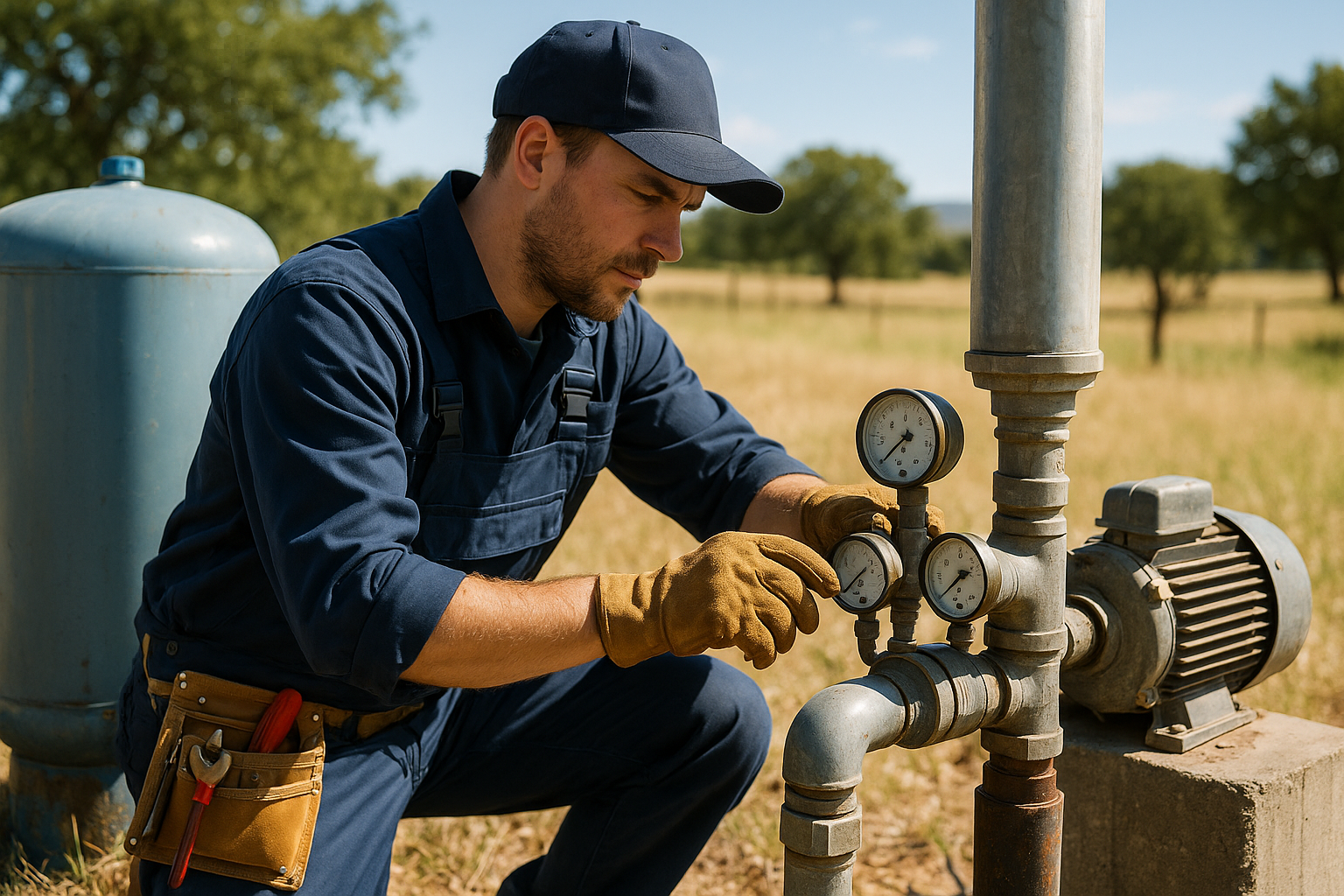
The annual or preventive inspection is quieter but just as valuable. A yearly visit catches the pressure tank losing its charge, the pump creeping up in amperage, or the yield sliding as a screen fouls with the fine sediment common in alluvial wells. For agricultural and landscape wells we time these before the heavy demand season so the system is proven before the crops need it. A well that has been idle through a fallow season should always be checked before you rely on it again.
The Full Checklist
Every San Jacinto well inspection covers the whole system, surface to aquifer. Here is what we test and record:
- Static and pumping water level, recovery, and yield. In a basin under this much pumping stress, the water-level story comes first. We log the resting level, draw the well down, watch the pumping level, and time recovery to establish the real, sustainable yield rather than a rated figure.
- Pump performance. We measure delivered flow in gallons per minute, working pressure, and motor amperage. On deep alluvial wells a pump set several hundred feet down works hard, and amp readings outside the nameplate range are an early warning of trouble.
- Pressure tank and switch. We verify the tank pre-charge, check for waterlogging, and confirm the pressure switch cuts in and out at the right set points, since a bad tank or switch drives the short-cycling that wears out pumps fast.
- Electrical, control box, and wiring. We inspect the control box, disconnect, breaker, and wiring for corrosion, loose connections, moisture, and proper grounding.
- Water quality sampling. We collect samples for nitrate, bacteria (total coliform and E. coli), and a mineral panel covering hardness, iron, manganese, total dissolved solids, and sulfate.
- Wellhead, sanitary seal, and casing. We examine the above-grade casing, well cap, and sanitary seal. In a subsiding basin, casing integrity gets special attention because ground compaction can stress a casing over time.
Water Testing in a Farmed Basin
Water quality in the San Jacinto groundwater basin carries the fingerprints of its agricultural past. Nitrate is the headline concern: decades of fertilizer application and irrigation return flow can push nitrate up, and it matters most for households with infants and for anyone drinking straight from the tap. We pair the nitrate test with bacteria testing for total coliform and E. coli and a full mineral panel that captures hardness, iron, manganese, total dissolved solids, and sulfate. For irrigation wells we pay particular attention to TDS and sodium, which influence crop tolerance and soil health over the long haul.
Because the alluvium here has a specific yield on the order of 5 to 15 percent and holds a lot of fine material, sediment and mineral content are worth tracking year to year. We collect every sample with proper sterile technique and route it through an accredited laboratory, since a bacteria result is only trustworthy if the sample was pulled correctly.
Well Data: San Jacinto, California
564'
Average Depth
24–1810'
Depth Range
184
Wells on Record
Riverside
County
Based on California DWR well completion reports. San Jacinto's average well depth of 564 feet reflects the deep alluvium of the San Jacinto groundwater basin.
With 184 wells on record and an average depth of 564 feet, San Jacinto has substantial, mature well infrastructure. The wide range from 24 to more than 1,800 feet reflects a valley where shallow wells tap near-surface alluvium along drainages while the deepest borings push through the graben's sediment fill toward the crystalline basement of the Peninsular Ranges. Deeper wells and a basin under pumping stress make careful water-level measurement and yield testing the heart of any honest inspection here.
Your Report and What It Costs
You finish every inspection with a written report built to be used. It presents our findings by system, includes photographs of the wellhead, casing, control box, and anything we flagged, and lists recommendations in priority order with itemized cost estimates attached. For a buyer it is leverage. For a seller it is proof. For an owner it is a baseline to compare against next year, so a slow decline shows up as a trend on paper before it becomes a dry tap in the field.
On price, a standard inspection runs $150 to $400, with the deeper valley wells landing toward the upper end. Laboratory water testing adds $100 to $300, and a dedicated flow or yield test is $150 to $350. If you book a diagnostic visit and then hire us for the repair, the $125 diagnostic fee is credited toward the job. Simple tasks like resetting a tripped breaker or adjusting a pressure switch are fine to do yourself. But anything that means pulling a pump set hundreds of feet down, opening the casing, or chasing an electrical fault is work for a licensed contractor, both for safety and to avoid dropping equipment or damaging the casing in a deep alluvial well.
We service all major pump brands including Franklin Electric, Grundfos, Goulds (Xylem), and Sta-Rite (Pentair). Our trucks carry common parts and components so many repairs happen the same day.
Serving San Jacinto and the Surrounding Valley
Beyond San Jacinto itself, we cover the well country across this part of Riverside County, including:
- Hemet and Valle Vista
- Winchester
- Perris
- Moreno Valley
Get a Free Estimate
Call or text for a well inspection anywhere in the San Jacinto Valley
(760) 440-8520Frequently Asked Questions
How deep are wells in the San Jacinto Valley?
It varies widely. Local completion records put the average around 564 feet, but the range runs from roughly 24 feet in shallow alluvium to over 1,800 feet in the deepest borings. Most working agricultural and domestic wells tap the alluvial San Jacinto groundwater basin at a few hundred feet, where the sediment's specific yield sits around 5 to 15 percent. We size the inspection to your actual well, not an average.
Does groundwater pumping really cause land subsidence here?
Yes. The San Jacinto Valley has documented land subsidence tied to decades of heavy agricultural groundwater withdrawal. When water levels drop, the fine-grained clay layers in the graben compact, and the ground surface can sink measurably. For well owners this shows up as declining static levels, casing that can be stressed or damaged over time, and pumps that have to be set deeper. It is one more reason a periodic inspection matters in this valley.
What water tests do you recommend for a San Jacinto ag or domestic well?
For a heavily farmed basin like this we prioritize nitrate, total coliform and E. coli bacteria, and a full mineral panel covering hardness, iron, manganese, total dissolved solids, and sulfate. Nitrate is the one to watch closely given the valley's long agricultural history and fertilizer use. For irrigation supply we also look at TDS and sodium, which affect crops and soil.
What does a well inspection and testing cost in San Jacinto?
A standard inspection runs $150 to $400 depending on depth and access, which matters in this valley because many wells are several hundred feet deep. Laboratory water testing is $100 to $300, and a flow or yield test is $150 to $350. Book a diagnostic and hire us for the repair and the $125 diagnostic fee is credited toward the job.
My well's water level keeps dropping. Should I be worried?
A falling static level is worth investigating, especially in the San Jacinto basin where regional pumping and subsidence both pull levels down. We measure static and pumping levels, time the recovery, and calculate the real sustainable yield. Sometimes the fix is lowering the pump; sometimes it points to a fouling screen or a basin-wide decline. Either way, measuring it early beats discovering it when the pump sucks air in July.
Do I need an inspection before buying a farm or rural home here?
Strongly recommended. On a San Jacinto Valley property the well is often the entire water supply for a household, livestock, or irrigated acreage, and a deep alluvial well is expensive to replace. Our pre-purchase report documents pump performance, water levels and yield, water quality, and casing condition so buyers, sellers, lenders, and escrow all know what they are dealing with before funds move.
Related Articles
Continue learning about well maintenance and troubleshooting