
Well Services for Blue Jay Avocado Groves
Blue Jay is a mountain community in the San Bernardino Mountains, perched around 5,000 feet above sea level just west of Lake Arrowhead. At this elevation, with hard winters and regular snow, commercial avocado growing simply is not viable, and pretending otherwise would do a local property owner no favors. What Blue Jay does have is forested mountain parcels, cabins, and homes that depend on fractured-rock wells drilled into the granite of the range. Southern California Well Service has spent more than 30 years drilling and servicing exactly these kinds of high-elevation mountain wells, and we understand the freeze risk, the low yields, and the access challenges that come with them.
📋 In This Guide
- Mountain Wells, Not Avocado Groves
- How a Mountain Fractured-Rock Well Works
- Common Local Scenarios
- What to Check First
- When to Call a Professional
- Realistic Cost Ranges
- Our Blue Jay Service Area
- Frequently Asked Questions
Avocado Water Demands
Avocados are thirsty trees:
- Mature tree: 40-70 gallons per day in summer
- Per acre: 4-6 acre-feet per year
- Critical periods: Fruit set and sizing
A reliable well is essential where avocados are grown across Southern California.
Well Systems for Avocado Groves
- High-capacity agricultural wells
- Storage tanks for peak demand periods
- Drip irrigation systems for efficiency
- Micro-sprinklers for young trees
- Pressure regulation for uniform coverage
Chloride Sensitivity
Avocados are highly sensitive to chloride in irrigation water. If your Blue Jay well has elevated chloride:
- Blending with lower-chloride water source
- Leaching irrigation to flush salts
- Rootstock selection for salt tolerance
- Regular soil and leaf testing
We test well water for avocado-critical parameters.
Partnering with Blue Jay Well Owners
Reliable water is essential for success in San Bernardino County. Contact us for well services designed for your property.
Need Help With Your Well in Blue Jay?
Our expert technicians serve Blue Jay and all of San Bernardino County with professional well services.
Related Articles
Continue learning about well maintenance and troubleshooting

Signs Your Well Pump Is Failing
Catch pump problems early before you lose water completely.
Low Water Pressure From Well
Diagnose and fix pressure problems before they get worse.
Well Maintenance Guide
Keep your well running smoothly with regular maintenance.
Our Locations
1077 Main St, Ramona, CA 92065
57174 US Highway 79, Anza, CA 92539
Blue Jay Is Mountain Well Country, Not an Avocado Belt
Honesty first: you cannot grow avocados in Blue Jay. At roughly 5,000 feet in the San Bernardino Mountains, the community gets cold winters, freezing nights, and snow, which is fatal to avocado trees. The genuine avocado regions of Southern California are in the frost-protected coastal foothills far to the south and west. So if your reason for reading this is a mountain property with a private well, the relevant topic is not grove irrigation; it is keeping a fractured-rock mountain well reliable through hard winters and dry summers.
Blue Jay and the neighboring Lake Arrowhead communities sit on the granitic and metamorphic bedrock of the San Bernardino range. There is no thick valley aquifer up here. Water moves through fractures and fault zones in the rock, which makes yields modest and highly variable from one parcel to the next. Mountain wells in this terrain are often drilled several hundred feet, sometimes 300 to 700 feet or more, chasing productive fractures. A well that produces only a few gallons a minute is normal and perfectly workable for a home when paired with storage, but it means the system has to be designed around slow, steady recovery rather than high instantaneous flow.
How a Mountain Fractured-Rock Well Works
A Blue Jay well system almost always benefits from storage. A submersible pump lifts water from deep in the casing and fills a storage tank over time, taking advantage of the well's slow recovery. A booster or constant-pressure pump then draws from that tank to deliver usable household pressure. This two-stage design is the key to living comfortably on a low-yield mountain well, because it decouples your peak demand from the well's limited instantaneous output. Without it, a small well that recovers slowly will run dry every time the household and irrigation draw at the same time.
The other defining feature of a mountain system is freeze protection. Wellheads, pressure tanks, exposed piping, and pump houses all need insulation, heat tape, or burial below the frost line, because a single hard freeze can split a pipe or crack a tank and leave you without water in the worst possible weather. We design and service systems with cold-climate hardware specifically because we work these mountains. Pressure switches and properly charged pressure tanks still do their usual job of protecting the pump from short-cycling, but everything is built to survive winter at elevation.
Common Local Scenarios We See in Blue Jay
- Frozen or burst components. Inadequately protected wellheads and pipes fail in cold snaps; this is the number-one winter emergency up here.
- Low yield and slow recovery. Fractured-rock wells can struggle to keep up, especially after a dry winter with little snowpack recharge.
- Sediment after seasonal shifts. Fractures can release grit, clouding the water after storms or seismic activity.
- Pump set too high. When the water level drops seasonally, a shallow-set pump starts pulling air.
- Seasonal cabins needing startup. Properties that sit empty over winter often need the system recommissioned in spring.
What to Check Before You Call
- Check for freezing. In cold weather, no water often means a frozen line or wellhead rather than a pump failure. Look for insulation gaps and inspect heat tape.
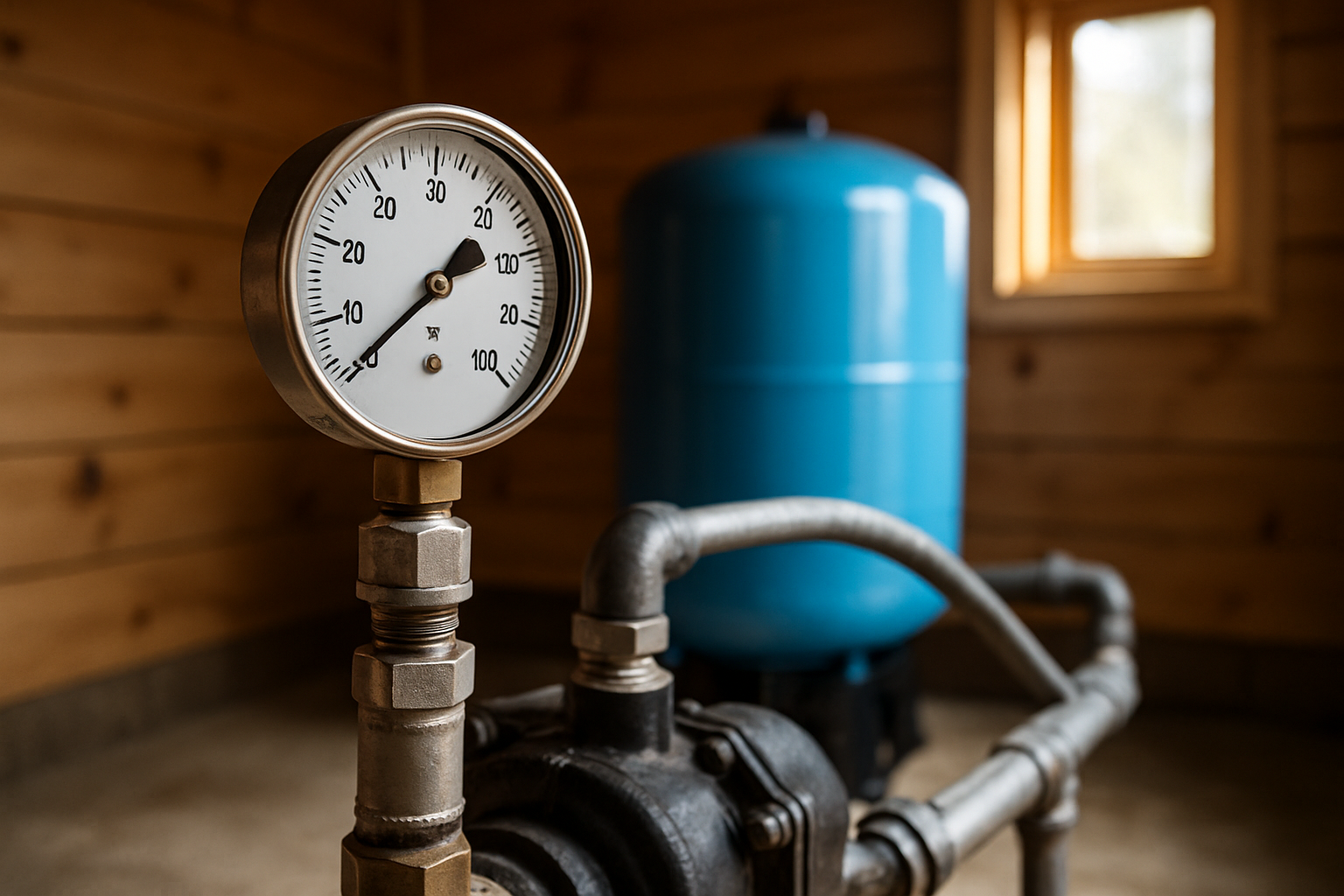
- Read the pressure gauge. An erratic on/off pressure band points to a pressure-tank charge problem.
- Listen to the pump cycle. Rapid clicking suggests a tank or switch issue, not the pump itself.
- Check storage tank level. If the storage tank is empty mid-day, the well may not be recovering fast enough for current demand.
- Verify power. Mountain power flickers; a tripped breaker can mimic a dead pump.
Winterizing and Spring Startup
Living well at elevation means working with the seasons. Before the first hard freeze, we recommend confirming that heat tape is functional, insulation is intact, and any vulnerable above-ground plumbing is protected or drained. For cabins that close up over winter, properly draining and isolating the system prevents the most expensive cold-weather failures. In spring, a recommissioning visit checks for freeze damage, confirms the pump and tank are healthy, restores pressure, and tests the water before you rely on it again. Owners who follow this rhythm spend far less on emergency repairs than those who simply hope the system survived another winter. Because Blue Jay can be hard to reach in a storm, prevention is genuinely cheaper than a January emergency call.
Water Quality and Mountain Access
Granite-fed mountain water is often clean and pleasant, but it is not automatically problem-free. Fractured-rock wells can carry iron, manganese, or sediment released from the rock, and they can pick up surface influence after heavy snowmelt if the well is not properly sealed. A periodic water test is the only way to know what is actually coming out of your tap, and it lets us recommend the right sediment filter or treatment rather than guessing. For seasonal owners especially, testing after a long closure is a smart precaution before the first glass of water.
Access is the other reality of mountain work. Steep driveways, narrow forest roads, snow, and tight cabin lots all shape how we approach a job, and they are part of why out-of-area companies often quote high or simply decline to come up the hill. Because we work the San Bernardino Mountains regularly, we bring the right equipment for the terrain and we plan around the weather. That experience matters most in winter, when a poorly timed repair can strand you without water for days. We would rather help you prevent that with seasonal maintenance than rescue you in a storm, though we will do both. Decades of mountain repairs have taught us which fixes hold up at elevation and which ones quietly fail the next winter, and we stand behind our work.
When to Call a Professional
Pulling a pump several hundred feet, working on wellhead wiring, thawing and repairing frozen systems, and rehabilitating a low-yield well are jobs for a licensed contractor with mountain experience. We are a licensed C-57 water well drilling contractor, not a general plumber, and we have decades of experience in the San Bernardino Mountains. If you lose water in winter, suspect a frozen burst, or your well no longer keeps up, call us. We provide same-day emergency service when conditions allow, and our $125 diagnostic is credited toward the repair.
Realistic Cost Ranges
- Pressure switch replacement: $150-$350
- Pressure tank replacement: $600-$1,500
- Submersible pump replacement: $2,500-$5,500 (deep mountain sets trend toward the high end)
- Sediment filtration: $300-$900
- Constant-pressure / booster system: $2,000-$4,500
- Well hydrofracturing to improve yield: $3,000-$8,000
- New turnkey well: $18,000-$42,000
- Diagnostic visit: $125 (credited to the job)
Our Blue Jay Service Area
We serve Blue Jay and the surrounding San Bernardino Mountain communities including Lake Arrowhead, Twin Peaks, Crestline, Cedar Glen, and Running Springs. Operating from our Ramona and Anza offices, Southern California Well Service covers San Bernardino, Riverside, and San Diego counties. We hold a 4.9-star rating and bring real high-elevation, cold-climate know-how to every mountain well we touch.
Frequently Asked Questions
Can avocados grow in Blue Jay?
No. At around 5,000 feet with freezing winters and snow, Blue Jay cannot support avocado trees. The real avocado regions are in frost-free coastal foothills well to the south. Our work here focuses on reliable mountain well water for homes and cabins.
Why does my mountain well produce so little water?
Mountain wells draw from fractures in granite rather than a deep aquifer, so yields are naturally low and depend on which fractures the well intersects. We design around that with storage tanks and booster pumps so a low-yield well still serves your home comfortably.
How do I keep my well from freezing in winter?
Freeze protection means insulating the wellhead, tank, and exposed pipe, using heat tape, and keeping vulnerable lines below the frost line. We build and service systems specifically for cold-climate mountain conditions.
How deep are wells around Blue Jay?
Fractured-rock mountain wells in this range are often drilled several hundred feet, commonly in the 300-to-700-foot range, to find productive fractures. Depth alone does not guarantee yield.
My cabin sat empty all winter. What should I do before using the well?
Have the system recommissioned: check for freeze damage, inspect the pump and tank, confirm pressure, and test the water. We handle spring startups for seasonal mountain properties.
Do you respond to winter well emergencies in Blue Jay?
Yes, same-day when road and weather conditions allow. Call (760) 440-8520 or text (619) 259-0410 and we will get to you as fast as the mountain lets us.