


If you draw your household water from a private well anywhere in the La Jolla area or the broader inland reaches of San Diego County, brown, rusty, or cloudy water is one of the more frustrating surprises you can find at the tap. It is worth being honest about geography first: the seaside village of La Jolla itself sits within the City of San Diego, and the overwhelming majority of homes here are connected to municipal water rather than to a private well. If your La Jolla home is on city water and the tap runs brown, the cause is almost always in your own plumbing or water heater, or a temporary disturbance in the public main, not a well. For the many well owners across the surrounding San Diego region, however, discolored water is a real and recurring issue, and the guidance below is written for you.
The La Jolla coastline is built on the marine sedimentary rock of the La Jolla Group, including the Eocene-age Mount Soledad Formation, with its reddish-brown cobble conglomerate and interbedded sandstone, overlain in places by the younger San Diego Formation. Move inland and east from the coast and the picture shifts toward weathered granitic bedrock, decomposed granite, and the alluvial fill of valleys and canyons. That blend of iron-bearing sandstone, fractured crystalline rock, and loose sediment is precisely the combination that produces discolored well water throughout the region.
The encouraging news is that brown water almost always has an identifiable, fixable cause. Below we explain what is happening in a well, how to narrow it down, and what a fix typically costs.
What Causes Brown Well Water in La Jolla
There is rarely a single answer, but nearly every case we encounter in the San Diego region traces back to one of a handful of culprits.
Dissolved Iron and Manganese
This is the most common cause across inland San Diego County. As water moves slowly through iron-bearing sandstone, conglomerate, and decomposed granite, it picks up dissolved iron and manganese. While the water is underground and starved of oxygen, those minerals stay invisible and dissolved in the ferrous form. The moment the water reaches a tap and meets air, it oxidizes into rust-colored ferric particles that stain sinks, laundry, and toilet tanks brown or reddish-brown. Manganese leans toward a darker brown or black stain and a metallic taste.
Sediment and Turbidity
Fine clay, silt, and sand are abundant in the sandstone formations and the alluvial canyons of the region. If a well screen is worn, damaged, or improperly sized, those particles get drawn up with the water and produce a cloudy, gritty, brown appearance. You may notice grit settling at the bottom of a glass or collecting in faucet aerators.
Rusting Steel Casing or Old Galvanized Pipe
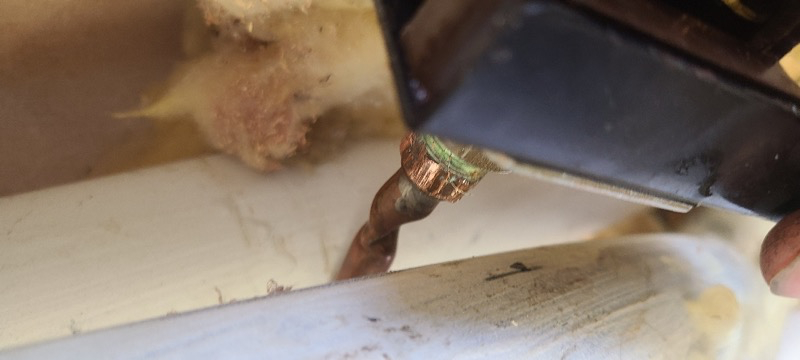
Many older wells in the region were finished with steel casing, and plenty of long-established homes still run galvanized supply lines. As that metal corrodes from the inside out it releases rust into the water, which is why corrosion-related discoloration is often worst on the hot-water side, where heat speeds up the reaction.
A Stirred-Up Well After Heavy Pumping or Storms
When a pump runs hard during a dry stretch, or when winter rains raise the water table and flush loose material through the aquifer, sediment that normally lies undisturbed gets pulled into the water column. That is why many well owners see brown water appear suddenly after a big storm or a long irrigation run, then partly clear on its own.
Iron Bacteria
These naturally occurring, non-pathogenic bacteria feed on iron in groundwater and leave behind a slimy, reddish-brown buildup. They are notorious for clogging screens and plumbing and producing a swampy or oily sheen alongside the color.
Tannins
Tannins are organic compounds from decaying leaves and roots that can tint water a yellow-to-brown tea color. They are most likely where a well sits near a creek bed, canyon, or wooded slope with shallow groundwater and heavy vegetation.
How to Diagnose the Problem
Before spending a dollar on equipment, it pays to narrow down what you are dealing with. A few simple observations tell us a great deal.
- Hot side or cold side? If only the hot water is brown, suspect your water heater rather than the well. If both are discolored, the source is the well or the main plumbing.
- One fixture or the whole house? A single brown faucet usually points to a localized issue such as a corroded fixture or a clogged aerator. Discoloration everywhere indicates a well or whole-house problem.
- Did it follow rain or heavy pumping? Brown water that appears right after a storm or a long irrigation run points to stirred-up sediment or surface intrusion.
- Sudden or gradual? A slow change over months often means corrosion or rising mineral levels. An abrupt change can signal a failed screen, a casing breach, or contamination that needs prompt attention.
- Run a clear-glass test. Fill a clean clear glass and let it stand. If particles settle to the bottom, you have sediment. If the water clears from the bottom up, you likely have ferric iron. If it stays uniformly tinted, you may have tannins or dissolved color.
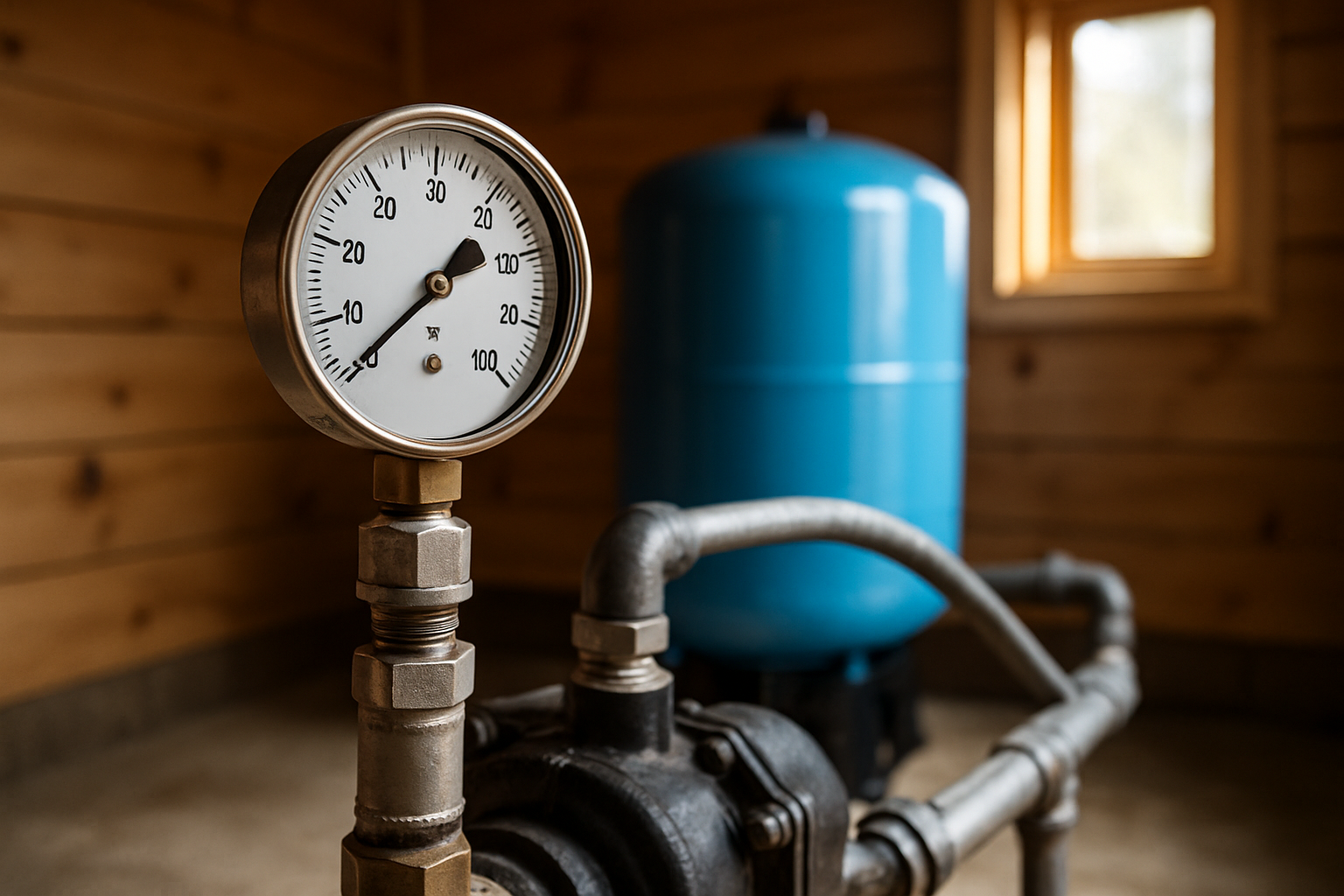
- Check your filters and pressure tank. A sediment cartridge that loads up quickly, or a waterlogged pressure tank, can both contribute to or reveal the problem.
- Get a water test. The only way to know for certain is to test for iron, manganese, and turbidity, and to distinguish ferric (already oxidized) from ferrous (still dissolved) iron. That result determines which treatment will actually work.
Treatment Options
The right fix depends entirely on the cause, which is why we always diagnose before recommending hardware.
Sediment Filtration
For clay, silt, and sand, a whole-house sediment filter, often a spin-down screen followed by a cartridge or a backwashing media filter, captures particles before they reach your fixtures. This is the standard solution for turbidity coming out of sandy formations and canyon alluvium.
Iron and Manganese Oxidizing Filters
When dissolved iron and manganese are the problem, an oxidizing filter is the workhorse. Manganese greensand and modern air-injection systems convert the dissolved minerals into solid particles, then trap them in the media, which periodically backwashes itself clean. These systems handle the rust staining that iron-bearing geology so often produces.
Chlorination or Aeration
For heavy iron, manganese, iron bacteria, or sulfur odor, a chlorination or aeration step ahead of filtration oxidizes the minerals and knocks back bacterial growth. This is the most reliable approach when iron bacteria have taken hold in a well.
Water Softener
Groundwater in the San Diego region is frequently hard as well as discolored. A softener removes hardness and can capture small amounts of dissolved iron, and it is often paired with an iron filter rather than asked to do the job alone.
Casing or Pipe Repair and Replacement
If a camera inspection shows corroded steel casing, or the home still runs on galvanized pipe, no filter will permanently solve a problem being generated inside the plumbing itself. Repairing or replacing the failing component is the durable fix.
Prevention & Maintenance
A well is a working system, and a little routine care prevents most brown-water surprises. We recommend an annual water test so you can catch rising iron, manganese, or bacteria before they become visible. Service your water heater on schedule and flush the tank to clear settled sediment, which is the single most common cause of brown water in homes on city water as well. Change sediment cartridges before they clog and start bypassing. Keep treatment equipment backwashing on its proper cycle, and have your pressure tank and pump checked periodically so the well is not being over-pumped. If your well is decades old with original steel casing, budget ahead for an inspection so corrosion does not catch you off guard.
When to Call a Professional
Some brown-water situations call for prompt professional attention rather than a wait-and-see approach. Call us right away if the discoloration appears suddenly with no recent work on the well, if it follows flooding or heavy rain, if there is a foul or sewage-like odor, if you see sand or grit in the water, or if neighbors on nearby wells report the same thing. These can point to a compromised casing, a failing screen, or surface-water intrusion that needs immediate diagnosis. Even for gradual discoloration, a professional water test and, where needed, a downhole camera inspection take the guesswork out and keep you from buying equipment that does not match the actual cause. And if you are on city water in La Jolla, a plumber or your water provider, rather than a well contractor, is usually the right first call.
What It Costs in La Jolla
Pricing depends on what is actually wrong, but here are realistic ranges for the area so you can plan.
- Water test and diagnostic: $125, credited toward your service if you proceed with the recommended work.
- Sediment filtration: $300 to $900, depending on flow rate and media type.
- Iron or manganese filter: $1,500 to $3,500, depending on system size and oxidation method.
- Water softener: $1,500 to $3,500, depending on capacity and configuration.
- Pump replacement: $2,500 to $5,500, depending on depth, horsepower, and wiring.
Because brown water can have several overlapping causes, the final price always depends on the specific problem found during diagnosis. We give you a clear, itemized quote before any work begins.
Serving La Jolla and Nearby Communities
Southern California Well Service is a licensed C-57 water well drilling contractor with more than 30 years of experience and a 4.9-star rating from the well owners we serve. We work out of two offices, our Ramona office at 1077 Main St, Ramona, CA 92065, and our Anza office at 57174 CA-371 (US Hwy 79), Anza, CA 92539, that let us cover the inland San Diego region and the well-dependent communities around the coast. From those locations we serve La Jolla and the surrounding San Diego region, including the rural pockets toward Poway, Scripps Ranch, Rancho Santa Fe, Del Mar, Ramona, and the inland valleys where private wells are common. We offer same-day emergency service when you are out of water or facing a sudden water-quality problem. Call us at (760) 440-8520 or text (760) 219-5877.
Frequently Asked Questions
Do homes in La Jolla even have private wells?
Most La Jolla homes are connected to municipal water from the San Diego Public Utilities Department, so brown water there is usually a plumbing or water-heater issue rather than a well problem. However, plenty of properties in the broader San Diego region and the inland areas we serve do rely on private wells, and that is where our brown-water guidance applies. If you are on a well anywhere in San Diego County, we can help.
Why is my well water suddenly brown in the San Diego region?
A sudden change usually means sediment was stirred up by heavy pumping, a storm, or a problem with the well screen or casing. Dissolved iron and manganese from the region's sedimentary and granitic geology can also oxidize and turn water brown when it meets air. A clear-glass test plus a water test for iron, manganese and turbidity will pinpoint the cause.
Is brown well water safe to drink?
Iron and manganese mostly cause staining and bad taste rather than an immediate health hazard, but brown water can also signal surface-water intrusion or bacterial contamination, which is not safe. Until your water is tested we recommend not drinking it, and we can run a diagnostic test to confirm what is present.
Will a water softener remove the brown color from my well water?
A softener can remove modest amounts of dissolved ferrous iron along with hardness, but it is not designed for heavy iron, manganese, or sediment. Those call for an oxidizing iron filter or a sediment filter. We match the equipment to your actual test results rather than guessing.
Could a rusting casing be causing my brown water?
Yes. Older steel casing and galvanized plumbing common on long-established wells can corrode and shed rust, giving water a brown or reddish tint that is often worse on the hot side. A downhole camera inspection of the casing confirms whether corrosion is the source.
How much does it cost to fix brown well water?
A diagnostic water test is $125 and is credited toward service if you proceed. Sediment filtration typically runs $300 to $900, an iron or manganese filter $1,500 to $3,500, a water softener $1,500 to $3,500, and a pump replacement $2,500 to $5,500. The final price depends on the specific cause found during diagnosis.
Brown water from a well in the La Jolla area does not have to be a mystery or a long-term headache. With an accurate diagnosis and the right treatment, the vast majority of our customers are back to clear, clean water quickly. Call Southern California Well Service today at (760) 440-8520 or text us at (760) 219-5877 to schedule your water test and get a straightforward plan to fix it for good.