
Cloudy or Milky Well Water in Ocean Beach
Noticing cloudy, milky, or white-colored water from your Ocean Beach well? This issue has several possible causes—some harmless, others requiring attention.
📋 In This Guide
Causes of Cloudy Well Water
- Air Bubbles: Tiny air bubbles (harmless, clears in minutes)
- Hard Water: High mineral content causing cloudiness
- Methane Gas: Natural gas dissolved in groundwater
- Bacteria: Bacterial growth in well or pipes
- TSS (Total Suspended Solids): Fine particles in water
The Glass Test
Fill a clear glass with water and let it sit:
- Clears from bottom up: Likely air bubbles (harmless)
- Clears from top down: Sediment settling (filtration needed)
- Stays cloudy: Dissolved minerals or bacteria (testing needed)
Treatment Options
- Aeration System: Removes dissolved gases
- Sediment Filtration: Removes suspended particles
- Water Softener: Reduces mineral hardness
- UV Disinfection: Kills bacteria without chemicals
- Shock Chlorination: One-time bacteria treatment
When to Be Concerned
While air bubbles are harmless, persistent cloudiness warrants investigation. Bacterial contamination or methane require professional attention for your family's safety.
Need Help With Your Well in Ocean Beach?
Our expert technicians serve Ocean Beach and all of San Diego County with professional well services.
Related Articles
Continue learning about well maintenance and troubleshooting

Signs Your Well Pump Is Failing
Catch pump problems early before you lose water completely.

Low Water Pressure From Well
Diagnose and fix pressure problems before they get worse.
Well Maintenance Guide
Keep your well running smoothly with regular maintenance.
Our Locations
1077 Main St, Ramona, CA 92065
57174 US Highway 79, Anza, CA 92539
Cloudy or Milky Well Water Around Ocean Beach and Greater San Diego County
Ocean Beach sits at the western edge of the City of San Diego, where the San Diego River meets the Pacific near Mission Bay and the Point Loma peninsula. It is a dense, walkable coastal neighborhood built on sandy coastal soils, and the honest truth is that almost every home here draws from city water rather than a private well. We have written this guide for the broader audience of San Diego County well owners who search for answers about cloudy water — the families just inland and out in East County who rely on their own wells every day. If you live in OB itself, you are almost certainly on a municipal connection, and cloudy water at your tap is a question for the City of San Diego Public Utilities Department. But if you own land in the surrounding county, from the inland mesas to the foothills, the milky or white water you are seeing is something we diagnose constantly.
Cloudy water has a handful of common causes in our region. Some are completely harmless and clear on their own. Others point to a sediment problem, a gas in the groundwater, mineral chemistry, or a well that is starting to struggle. The good news is that you can narrow it down in a few minutes at your kitchen counter before you ever pick up the phone.
Start With the Glass Test
Before anything else, run the simplest diagnostic there is. Fill a clear glass straight from the tap, set it on the counter, and watch it for a few minutes.
- If the cloudiness clears from the bottom up, like a tiny snowstorm rising and vanishing, you are looking at trapped or dissolved air. This is harmless.
- If particles settle to the bottom and leave clear water on top, you have suspended sediment or turbidity that filtration can fix.
- If the water stays uniformly cloudy and refuses to clear, you may be dealing with dissolved minerals or, less often, bacteria. That one warrants a water test.
This single test tells you which of the causes below you are most likely facing.
Trapped or Dissolved Air
The most common reason well water looks milky is simply air. When water is pushed through the system under pressure, tiny bubbles get suspended in it and give the whole glass a cloudy, white appearance. Within a minute or two the bubbles rise and the water turns crystal clear from the bottom up. This is completely harmless and needs no treatment. Air entrainment often increases after pump service, when the water table is low, or when a small leak on the suction side of a jet pump lets air into the line.
Fine Sediment, Silt, and Clay Turbidity
If the cloud settles into a layer at the bottom of the glass, you have turbidity — fine sand, silt, or clay carried up from the aquifer. Across inland San Diego County, decomposed granite and weathered rock shed fine particles that a tiring pump or a cracked screen can pull into your plumbing. Turbidity is the most common problem we actually filter for, and the fix is usually straightforward once we confirm the particle size.
Methane Gas
Some wells produce water carrying dissolved methane, a naturally occurring gas. It can make water look fizzy or milky and may cause sputtering at the faucet. Methane is less common in our coastal and granitic settings than in sedimentary basins, but it does appear, and because it is flammable when it accumulates in an enclosed space it should always be evaluated by a professional. An aeration system vents it safely.
Precipitating Minerals Like Calcium
San Diego County groundwater is often hard, meaning it carries dissolved calcium and magnesium. When that water warms or its pressure drops at the tap, those minerals can come out of solution and leave a faint, milky haze that does not fully settle. Hard water is a nuisance rather than a health hazard, but it scales pipes and water heaters over time. A water test confirms it.
A Stirred-Up Well From a Failing Pump or Low Water Level
If your water turned cloudy suddenly and stays gritty, the well itself may be the culprit. A pump set too deep, a worn pump pulling harder than it should, or a dropping water table during a dry stretch can all stir up sediment that normally rests below the intake. Overpumping a low well churns the bottom and sends silt straight to the house. When cloudiness arrives alongside lower pressure or air spitting from the faucet, the pump and water level deserve a close look.
What You Can Check Yourself
Run the glass test on both a cold tap and a hot tap. Note whether the cloudiness is new or constant, whether it follows heavy use, and whether pressure has changed. Check whether a single fixture or the whole house is affected — a single cloudy faucet often points to an aerator or a water heater rather than the well. Write down what you observe so a technician can move straight to the likely cause.
How We Fix Cloudy Water
Sediment and turbidity filtration. For particle problems we step the water down in stages: a spin-down filter catches the coarse grit, then cartridge or Big Blue housings with progressively finer micron ratings polish out the fine silt. A typical sediment or turbidity filtration setup runs from $300 to $1,500 depending on flow rate and how fine the filtration must be.
Well rehabilitation. When the well itself is shedding sediment, we start with a downhole camera inspection to see the casing and screen. From there we may surge and redevelop the well to pull fines out, or repair damaged casing and screen. Well rehabilitation generally falls between $1,500 and $5,000 based on depth and condition.
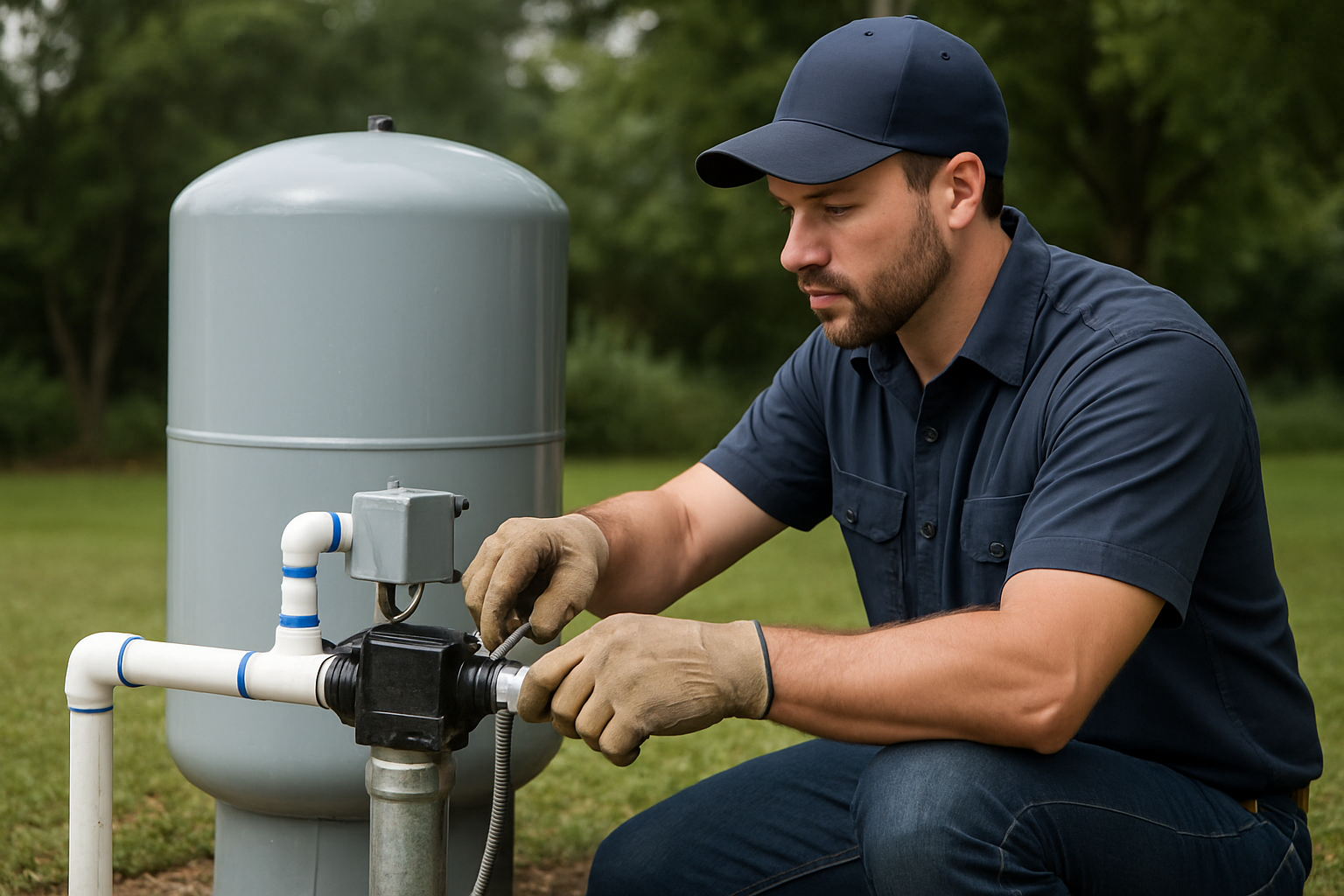
Pump depth, air leaks, and the pressure tank. If air or stirred sediment is the issue, we correct the pump setting, seal suction-side leaks, and check the pressure tank and switch so the system stops drawing air or overpumping. Pump service typically runs $800 to $2,500.
Water testing. When water stays cloudy with no settling, a lab test for hardness, minerals, and bacteria tells us exactly what treatment fits — softening, aeration, or disinfection.
When to Call a Professional
Call us if the water stays cloudy after the glass test, if you smell gas or rotten eggs, if cloudiness comes with falling pressure, or if a bacteria test comes back positive. Our diagnostic visit is $125, and we credit that toward any repair we perform. Catching a sediment or pump problem early almost always costs less than waiting until the well chokes off entirely.
Local Service Across San Diego County
Southern California Well Service supports well owners throughout the greater San Diego region — from the coast near Ocean Beach, Point Loma, and Mission Beach to the inland and East County communities of Alpine, Lakeside, El Cajon, and Ramona where private wells are the norm. We run two offices to keep response times short: our Ramona office at 1077 Main St, Ramona, CA 92065, and our Anza office at 57174 US Highway 79, Anza, CA 92539. We are a licensed C-57 water well contractor with more than 30 years of experience and a 4.9-star reputation, and we offer same-day emergency service. Reach us at (760) 440-8520 or text us at (619) 259-0410.
Frequently Asked Questions
Is cloudy well water safe to drink?
If the cloudiness clears from the bottom up within a couple of minutes, it is trapped air and perfectly safe. If it settles into sediment or stays uniformly cloudy, hold off and have it tested, since persistent cloudiness can indicate turbidity, minerals, or bacteria.
Do many homes in Ocean Beach actually have private wells?
No. Ocean Beach is a dense coastal neighborhood of the City of San Diego and is served by municipal water. Private wells are essentially absent in OB itself, but the surrounding San Diego County and East County areas have a great many private wells, which is who this guide is written for.
Why did my water suddenly turn milky?
A sudden milky look is usually air entering the system after pump service, a low water table, or a small suction-side leak. If it is gritty rather than airy and comes with lower pressure, the pump or water level may be stirring up sediment.
What does the glass test prove?
It separates the three main causes. Clearing bottom-up means harmless air, settling to the bottom means filterable sediment, and staying cloudy means dissolved minerals or possible bacteria that need a lab test.
How much does it cost to fix cloudy well water?
It depends on the cause. Sediment filtration runs $300 to $1,500, pump service $800 to $2,500, and well rehabilitation $1,500 to $5,000. Our diagnostic visit is $125 and is credited toward the repair.
Can a water softener fix cloudy water?
A softener helps only when the haze comes from dissolved calcium and magnesium hardness. It will not remove sediment or air, so it is important to confirm the cause with a glass test and, if needed, a water test before installing equipment.
If your San Diego County well is producing cloudy or milky water, don't guess — let us pinpoint the cause and fix it right the first time. Call (760) 440-8520 or text (619) 259-0410 for same-day help from a local, licensed team that knows the region's geology.