
Emergency Well Repair in Cherry Valley, CA – 24/7 Rapid Response Service
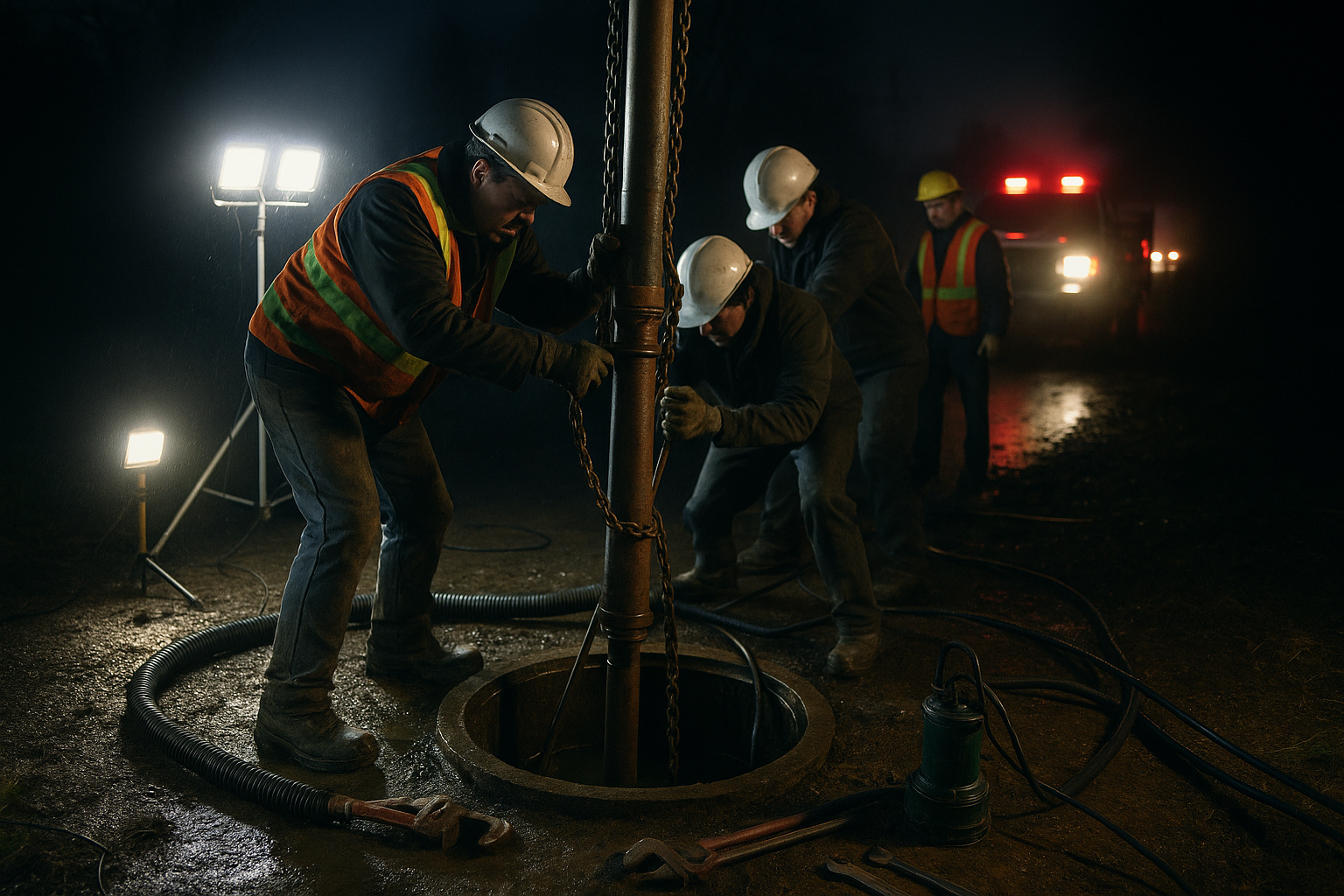
When your well stops working in Cherry Valley, every minute without water feels like an hour. Whether it's the middle of the night, a holiday weekend, or the hottest day of summer, Southern California Well Service (SCWS) provides immediate emergency well repair services to Cherry Valley residents and property owners. Our experienced technicians are available 24 hours a day, 7 days a week, because we understand that well emergencies don't wait for convenient business hours.
📋 In This Guide
For immediate emergency well repair in Cherry Valley, call SCWS at (760) 440-8520. We respond to urgent calls day and night.
Well Emergencies in the San Gorgonio Pass
Cherry Valley is an unincorporated Riverside County community perched at the northwest end of the San Gorgonio Pass, sitting at roughly 2,980 feet, the highest ground on the pass between San Bernardino and Palm Springs. Named for the cherry orchards once planted across its slopes, it is now a landscape of one-acre lots, horse properties, and rural homesteads tucked above Beaumont, Banning, and Calimesa. Many of these parcels draw their water from private wells reaching into the upper aquifer of the Beaumont groundwater basin, where water levels commonly sit well below 150 feet and often deeper on the higher ground.
That combination of elevation, deep water, and long runs from wellhead to house makes a Cherry Valley well failure especially disruptive. There is no municipal main to switch to. When the pump quits during a hot-summer Mediterranean afternoon, the horses still need water, the household still needs to function, and every hour matters. We respond to those calls day and night, throughout Riverside County.
Our Diagnostic Approach
We treat every emergency as a diagnosis first, not a parts sale. When you call, our technician tries to resolve it over the phone, walking you through the breaker, disconnect, and pressure switch, since a surprising number of no-water calls end there. If water does not return, we dispatch a stocked truck and work through the system in order of likelihood and cost.
At the wellhead we check line voltage and the amperage the motor draws, comparing both to the pump's nameplate to see whether it is running, straining, or dead. We inspect the pressure switch and its cut-in and cut-out settings, then tap and gauge the pressure tank to confirm it still holds an air charge. Because Cherry Valley pumps are often deep-set, we do not pull a pump until the electrical and pressure components are cleared, and we use a well sounder to read the static and pumping water levels. That single measurement often separates a genuinely dropped water table from a mechanical pump that has simply worn out.
Common Cherry Valley Failures
Burned-out submersible pump. Deep settings and long summer duty cycles wear motors and bearings. When the pump finally quits, you get no water even though the breaker holds. Deeper wells here mean a longer pull, so we plan the job before we arrive.
Pressure switch failure. Pitted or welded contacts leave the pump running nonstop or refusing to start. It is the cheapest common fix and often the first thing we test.
Waterlogged pressure tank. A failed bladder makes the pump cycle every half-minute. On deep wells that rapid cycling is brutal on the motor, so tank replacement is often what protects your bigger investment.
Control box and capacitor damage. Monsoon lightning and grid surges through the pass regularly cook the surface control box on three-wire pumps. Replace the box or capacitor and the pump comes back to life without a pull.
Stuck check valve. A check valve that fails lets the water column fall back down the well or dead-heads the pump, producing erratic pressure and hammering.
Dropped water level. Heavy irrigation on horse and orchard properties, plus long-term basin decline, can pull the water table below a shallow pump. It draws air and runs dry. When water remains deeper, we reset the pump lower.
Safe Checks While You Wait
Before our truck arrives, these checks are safe and sometimes solve the issue:
- Look at the breaker and pump disconnect. Reset a tripped well breaker one time. If it trips again at once, leave it off; that usually means a shorted motor or cable.
- Knock on the pressure tank. A dull, solid sound high on the tank suggests it is waterlogged.
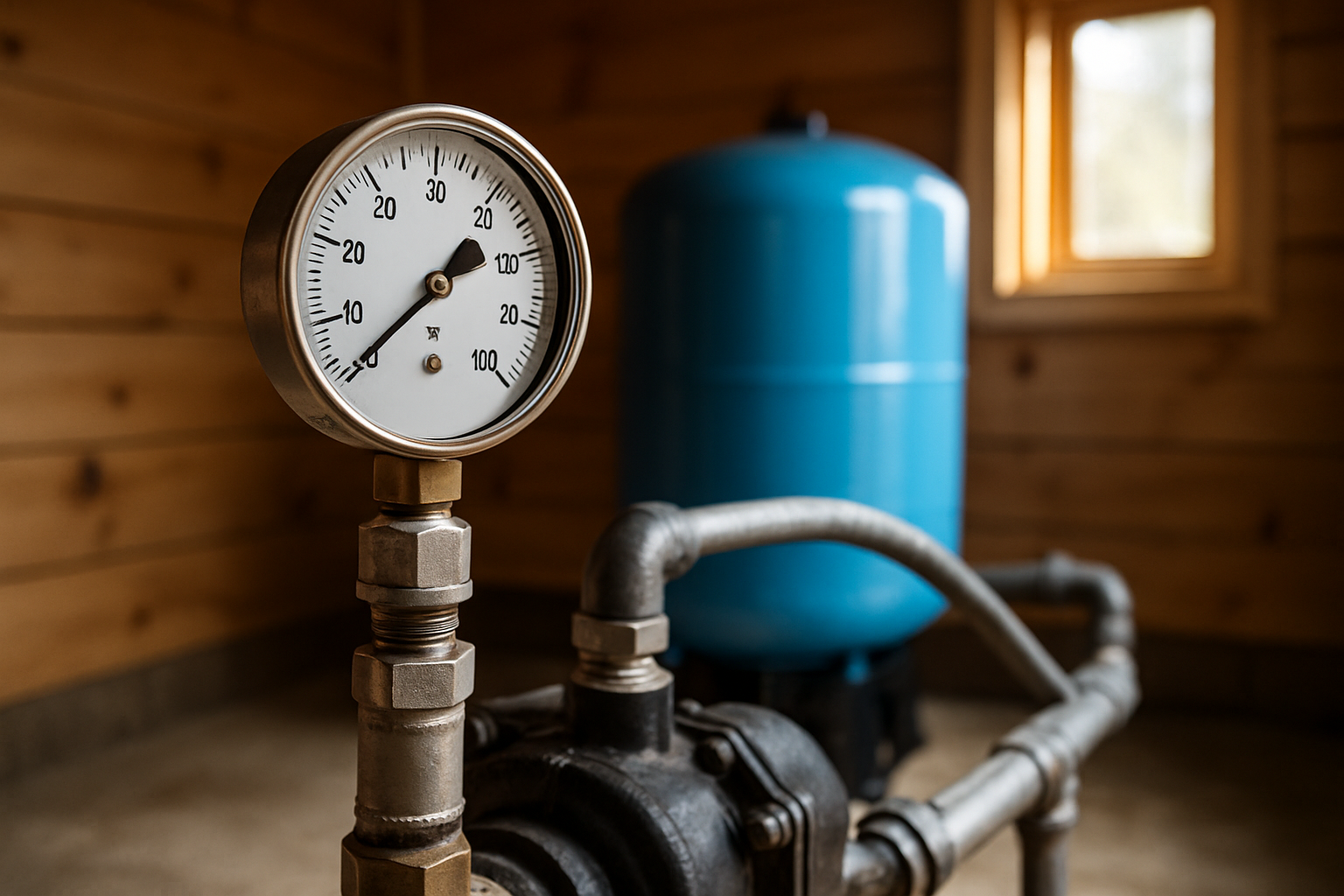
- Read the pressure gauge. Stuck at zero, or bouncing rapidly, tells us a lot before we drive out.
- Listen at the pressure switch. Frantic clicking or dead silence both point somewhere specific.
- Turn off irrigation and stock-tank floats. Preserve whatever water is left in the tank for the house and animals.
Do not open the control box, pull the pump, or touch live wiring. These systems carry 230 volts and are best left to a licensed technician.
When It's Time to Call Us
A single breaker reset is fair game. Beyond that, if you still have no water, the breaker trips twice, or anything points to the control box, the pump, the wiring, or a low water level, call a professional. Cherry Valley's deep, high-elevation wells punish trial-and-error: dry-firing a pump or running a burned motor can escalate a modest repair into a full replacement. We are licensed C-57, carry founded in 2020 of Southern California well experience, and hold, so we would rather get it right the first time than clean up a guess.
What Emergency Repairs Cost
Costs vary with well depth and the failure, but Cherry Valley emergencies generally fall in these ranges:
- Diagnostic: $125, applied to the repair once approved.
- Pressure switch: $150 to $350 installed.
- Control box or capacitor: $400 to $900.
- Pressure tank: $600 to $1,500 by size.
- Submersible pump replacement: $2,500 to $5,500, higher for deep-set pumps.
- After-hours emergency call: $150 to $250 plus parts and labor.
You get a firm price before we begin, every time.
Serving Cherry Valley and Nearby Towns
We provide emergency well repair across Cherry Valley and the surrounding San Gorgonio Pass, including Beaumont, Banning, Calimesa, Cabazon, Banning Bench, and the rural stretches along Beaumont Avenue and Cherry Valley Boulevard. From the orchard lots on the high northwest rim down toward the valley floor, our trucks reach Riverside County pass communities quickly because this is territory we work regularly.
Frequently Asked Questions
What makes Cherry Valley wells different from wells down in Beaumont?
Cherry Valley sits at the highest point of the San Gorgonio Pass, around 2,980 feet, on the northwest rim above Beaumont and Banning. Groundwater in the upper basin here is often deeper, and many parcels are one-acre horse properties with the wellhead a long way from the house. That elevation and distance mean pressure losses and deeper pump settings, so an emergency here frequently involves a deeper pull than a comparable failure on the valley floor.
The pump won't shut off and my water is low. What's happening?
A pump that runs continuously while pressure stays low is a textbook sign of either a stuck-open or failing pressure switch, a waterlogged pressure tank, or a well level that has dropped below normal during heavy summer irrigation. On the horse and orchard properties common in Cherry Valley, sustained irrigation can pull the water table down enough that the pump struggles to build pressure. We measure the level and test the switch and tank to find the true cause fast.
How deep are wells in Cherry Valley, and does that change the repair?
Groundwater in the Beaumont storage unit of the pass often sits well below 150 feet, and Cherry Valley wells commonly run deeper still because of the higher ground. A deeper pump setting means more pipe and wire to pull during a pump replacement, which adds labor time. It also means we take extra care checking the drop cable and torque arrestor so the new pump lasts.
Can lightning or a summer storm really kill my well?
Yes. The pass funnels weather, and monsoon-season lightning and grid surges are a real cause of burned control boxes and fried submersible wiring in Cherry Valley. If your well went dead right after a storm, suspect the control box, capacitor, or wiring splice before assuming the pump itself failed. Those electrical repairs are usually faster and cheaper than a pump pull.
Do I have to be home for emergency service?
It helps, but it isn't always required. We need access to the wellhead, the pressure tank, and the electrical panel. If you can't be there, arrange gate access and point us to those three locations. We always call with our findings and an upfront price before doing any billable repair, so you approve the work either way.
Is it cheaper to catch the problem early instead of waiting for a full failure?
Almost always. Warning signs like sputtering faucets, creeping electric bills, or a pump that cycles too often usually mean a component is on its way out. A scheduled diagnostic at $125, credited toward the repair, is far less than an after-hours emergency call plus the collateral damage a failing part can cause to your pump. If you notice symptoms, don't wait for the well to quit.
Restore Your Water — Call Now
When a Cherry Valley well goes down, Southern California Well Service is ready around the clock. We diagnose accurately, carry the common parts, and fix most emergencies the same day. Call (760) 440-8520 or text (760) 219-5877. Licensed C-57, founded in 2020, with 60+ years of family heritage, offices in Ramona and Anza, same-day emergency service throughout Riverside County.
Related Articles
Continue learning about well maintenance and troubleshooting

Signs Your Well Pump Is Failing
Catch pump problems early before you lose water completely.
Low Water Pressure From Well
Diagnose and fix pressure problems before they get worse.

Well Maintenance Guide
Keep your well running smoothly with regular maintenance.
Need Help With Your Well?
Our expert technicians are ready to help with any well drilling, pump repair, or maintenance needs.
🚨 Need Emergency Well Service?
We respond 24/7 across San Diego, Riverside & San Bernardino Counties.
Learn About Our Emergency Service →