Low Water Pressure Solutions in 4S Ranch
Dealing with weak water pressure in 4S Ranch? Low water pressure can make showers frustrating and appliances ineffective. Our team diagnoses the root cause and restores your water pressure fast.
📋 In This Guide
Need Low Water Pressure Solutions in 4S Ranch?
We serve 4S Ranch and all of San Diego County. Licensed C-57 contractor (CSLB #1086994), founded 2020.
Call: (760) 440-8520Low Water Pressure in 4S Ranch: A Local Well Owner's Guide
4S Ranch sits on the rolling high ground of northern San Diego County, tucked between Rancho Bernardo, Rancho Santa Fe and the open country that climbs toward Black Mountain. While most of the master-planned core is on municipal water, the edges of the 92127 area and the larger lots toward Santa Fe Valley, Del Sur and the older Bernardo and Lusardi Creek corridors still rely on private wells. If you own one of those properties, you already know that a strong, steady stream at the kitchen tap is something you only think about when it disappears. When pressure drops, showers turn weak, irrigation sputters, and appliances like dishwashers and washing machines stop performing the way they should.
The good news is that low water pressure is almost always a fixable mechanical or geological problem, not a sign that your well has run dry. The challenge in this part of San Diego County is that the local geology, dominated by decomposed granite and fractured crystalline bedrock, behaves very differently from the deep sedimentary basins you find farther east in the desert. Understanding how your system works, and how 4S Ranch's terrain affects it, is the first step toward getting your pressure back.
How a Private Well Pressure System Actually Works
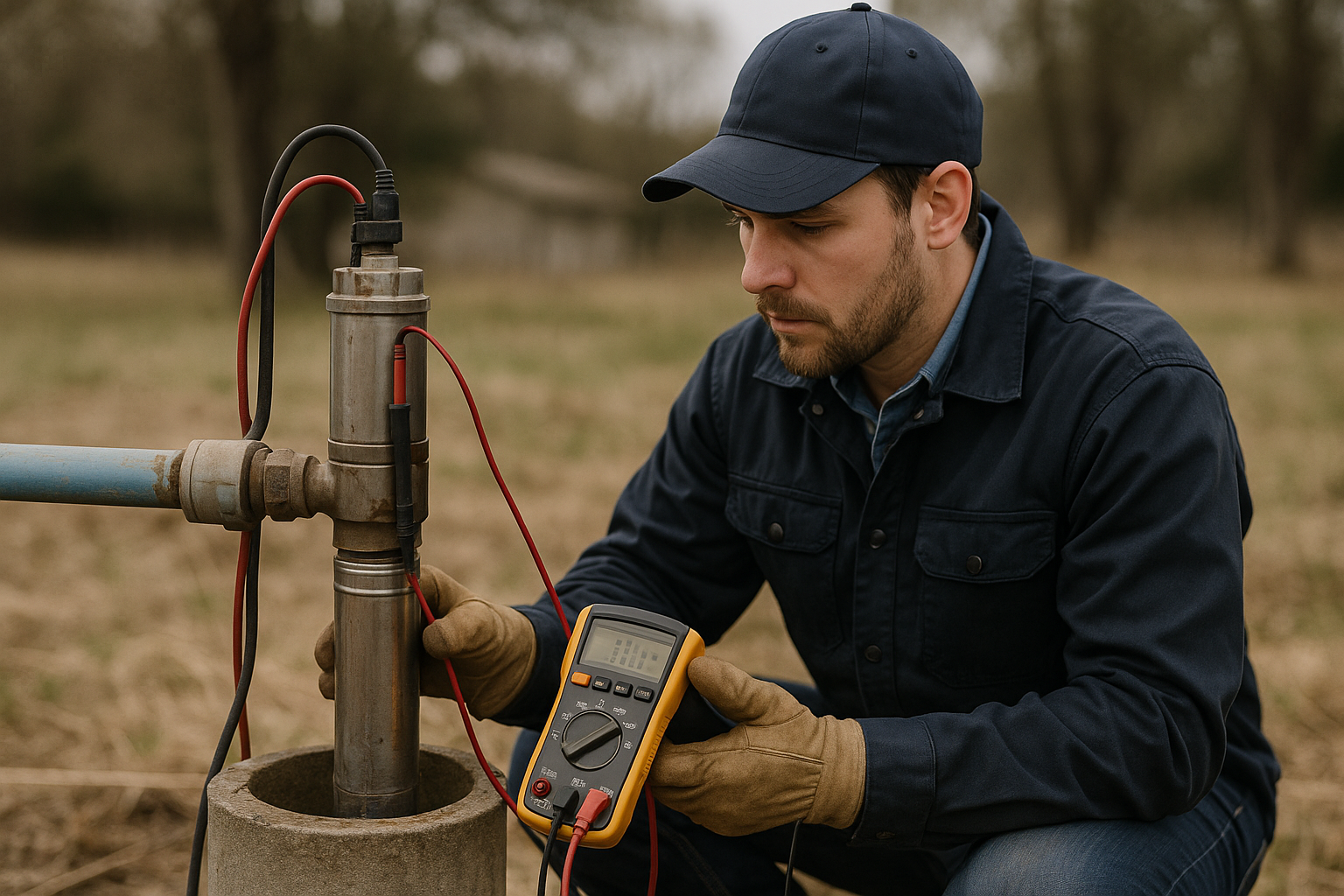
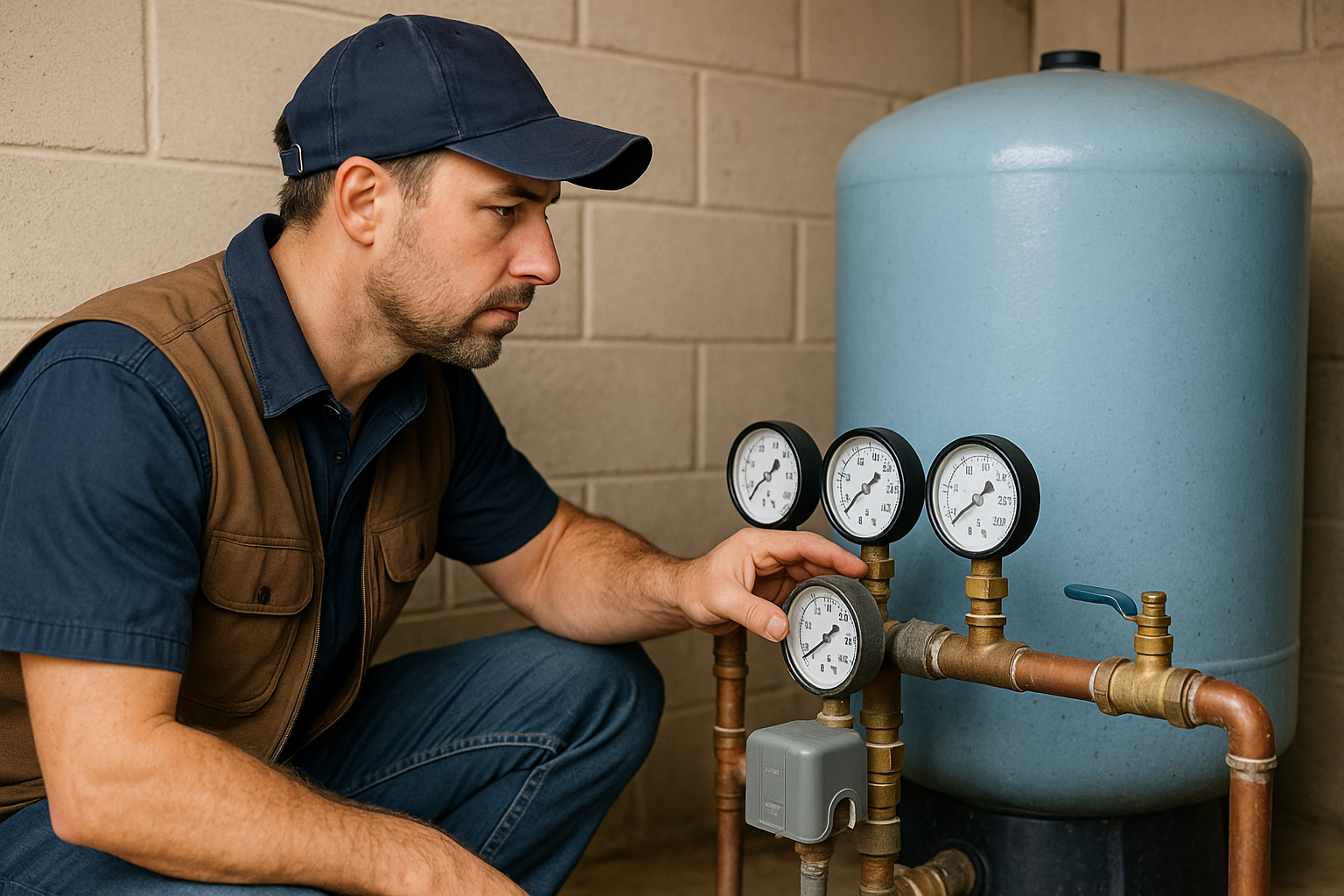
Your well does not push water straight to your faucets. Instead, a submersible pump sitting deep in the well casing lifts water up to a pressure tank near your home. That tank holds a cushion of compressed air above a rubber bladder. As water fills the tank, the air compresses and stores energy; that stored pressure is what feeds your house between pump cycles. A pressure switch watches the tank and tells the pump when to turn on (usually around 40 PSI) and off (usually around 60 PSI). Most healthy homes run on a 40/60 or 30/50 setting.
When any one of these parts drifts out of spec, you feel it as low or fluctuating pressure. A waterlogged tank that has lost its air charge makes the pump cycle rapidly. A switch set too low or with corroded contacts never lets the system build proper pressure. A worn pump simply cannot move enough water. And in granite country, fine sediment can clog screens, filters and the pump intake, throttling flow even when every component is technically working. Pinpointing which link in that chain has failed is exactly what a proper diagnosis is for.
Common Causes of Low Pressure Around 4S Ranch
After since 2020 working wells across San Diego County, we see a handful of culprits over and over in this terrain:
- Hard-water scaling: Groundwater drawn from granitic rock around Black Mountain and the San Dieguito watershed carries dissolved calcium and magnesium. Over years, that mineral builds up inside pump impellers, check valves and tank fittings, narrowing the path water has to travel and steadily choking your pressure.
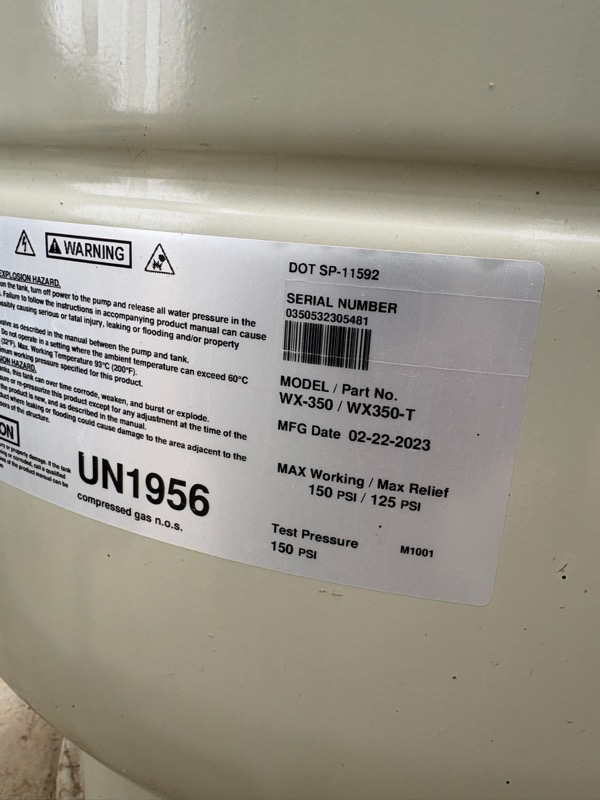
- Failed or waterlogged pressure tank: The bladder inside a pressure tank is a wear item. When it ruptures or the air charge bleeds off, you get short, rapid pump cycling and pressure that surges then collapses, often the single most common call we get from 4S Ranch homeowners.
- Pressure switch drift or corrosion: The small contacts inside a pressure switch pit and corrode over time, especially in our coastal-influenced humidity, causing the pump to cut out early and leave you short on pressure.
- Sediment from decomposed granite: After heavy winter storms roll through the Bernardo and Lusardi Creek drainages, fine granite particles can migrate into a well and pack the screen, dropping yield and flow.
- Seasonal water-table drop: Fractured-rock aquifers hold less water than sandy basins, so during dry years the level in your well can fall enough that a pump set too high starts drawing air or struggling to keep up with peak demand.
- Elevation and long runs: Many 4S Ranch and Santa Fe Valley lots sit on slopes or far from the wellhead. Every foot of vertical lift costs roughly half a PSI, so a home uphill of its tank can read noticeably low even with a healthy pump.
What You Can Safely Check First
Before you call anyone, there are a few homeowner-friendly checks that can tell you a lot, and sometimes solve the problem outright:
- Read your pressure gauge. Most systems have a gauge near the tank. Watch it through a full pump cycle. Healthy household pressure sits between 40 and 60 PSI. If it barely climbs, or swings wildly, note the numbers; they are gold to a technician.
- Listen to the pump. If you hear it snapping on and off every few seconds (rapid cycling), that points squarely at a waterlogged tank or bad switch.
- Check whether it is the whole house or one fixture. If only one faucet is weak, the problem is a clogged aerator or local plumbing, not your well. If every fixture is weak, the issue is system-wide.
- Tap the pressure tank. A healthy tank sounds hollow on top and solid (full of water) on the bottom. If it sounds solid all the way up, the bladder has likely failed.
- Look for leaks. Wet spots around the wellhead, the pressure tank, or along supply lines can quietly bleed away the pressure you are paying to build.
- Note recent events. Did pressure drop right after a storm (sediment), after a power flicker (pump or switch), or gradually over months (scaling or a tired pump)? The timeline narrows the cause.
What you should not do is open the well cap, pull electrical covers, or attempt to adjust the pump itself. Well systems combine 240-volt power with water, and the pump may hang hundreds of feet down. Those steps belong to a licensed professional.
When to Call a Professional in 4S Ranch
Reach out to Southern California Well Service right away if you experience any of the following:
- No water or a sudden, dramatic pressure loss — this can mean a failed pump, a tripped pump breaker, or a critically low well, and it warrants same-day attention.
- Rapid pump cycling that you can hear from inside the house, which usually means tank or switch failure that will burn out the pump if ignored.
- Cloudy, gritty or discolored water after a storm, signaling sediment intrusion that needs filtration or screen cleaning.
- Grinding, humming or buzzing from the pump or pressure switch, which points to mechanical wear or an electrical fault.
- Persistent low pressure even after you have confirmed there are no obvious leaks or clogged aerators.
We are a licensed C-57 well-drilling contractor founded in 2020, with 60+ years of family heritage. Our diagnostic visit is a flat $125, credited toward any repair we perform, so the assessment pays for itself the moment you approve the work.
What Repairs Typically Cost
Every well is different, but these 2026 ranges give 4S Ranch homeowners a realistic sense of investment:
- Pressure switch replacement: $150–$350. The most common and most affordable fix when a switch has drifted or corroded.
- Pressure tank replacement: $600–$1,500, depending on tank size and fittings. The fix for waterlogged tanks and rapid cycling.
- Submersible pump replacement: $2,500–$5,500, including pulling the old pump and the labor of working in a deep granite-country well.
- Sediment filtration: $300–$900, ideal for the granite-particle intrusion common after winter storms here.
- Iron/manganese filtration or a water softener: $1,500–$3,500 to tame the hard, mineral-rich water that scales pumps and pipes.
- Constant-pressure or booster system: $2,000–$4,500, an excellent choice for hillside Santa Fe Valley lots that need steady pressure regardless of demand.
- Hydrofracturing to boost a low-yield well: $3,000–$8,000.
- New turnkey well: $18,000–$42,000 when an old well is beyond rehabilitation.
- Well abandonment/decommissioning: $1,500–$5,000 to properly seal a retired well to county code.
We always quote in writing before any work begins, and we will tell you honestly when a $200 switch will solve a problem rather than steering you toward a tank or pump you do not need.
Frequently Asked Questions
Why does my 4S Ranch well lose pressure during the summer?
Summer combines two stresses: higher household and irrigation demand, and a seasonally lower water table in fractured-rock aquifers. If your pump or tank is already marginal, peak summer use is when the weakness shows. A flow test and pressure check will tell us whether you need a tank, a switch adjustment, or a constant-pressure upgrade to ride out the dry months.
Is low pressure a sign my well is running dry?
Usually not. The large majority of low-pressure calls we handle around 4S Ranch trace back to the pressure tank, switch, pump or scaling, all of which are repairable. True low yield does happen in granite country, but we confirm it with a flow test before ever recommending well deepening or hydrofracturing.
How quickly can you come out?
We offer same-day emergency service for no-water situations across northern San Diego County. From our Ramona office we reach 4S Ranch quickly, and for less urgent diagnostics we typically schedule within a day or two.
Could hard water really be causing my pressure problem?
Yes. The granitic groundwater here is genuinely hard, and over years scale narrows pump impellers, valves and fittings. We often find that descaling or a properly sized softener both restores pressure and extends the life of the whole system.
Should I adjust the pressure switch myself?
We do not recommend it. The switch sits in a live 240-volt circuit, and an incorrect setting can short-cycle and destroy your pump. A technician can reset it safely in minutes during a service call.
Do you charge for an estimate?
Our diagnostic visit is $125, and that fee is credited back to you toward any repair we complete. It buys you a clear, professional read on exactly what is wrong before you spend a dollar on parts.
Serving 4S Ranch and All of San Diego County
From our offices in Ramona (1077 Main St) and Anza (57174 CA-371 (US Hwy 79)), Southern California Well Service supports well owners throughout 4S Ranch, Del Sur, Santa Fe Valley, Rancho Bernardo and the surrounding communities. Whether you need a quick pressure-switch swap or a complete pump and tank overhaul, our local crews know this terrain and arrive ready to work. Call (760) 440-8520 or text (760) 219-5877 today, and let us restore the strong, reliable water pressure your home deserves.