
Low Water Pressure Solutions in Garnet
Dealing with weak water pressure in Garnet? Low water pressure can make showers frustrating and appliances ineffective. Our team diagnoses the root cause and restores your water pressure fast.
📋 In This Guide
Need Low Water Pressure Solutions in Garnet?
We serve Garnet and all of Riverside County. Licensed C-57 contractor (CSLB #1086994), founded 2020.
Call: (760) 440-8520Our Low Water Pressure Solutions Services
- Pressure tank repair and replacement
- Pressure switch adjustment
- Pump upgrades for better pressure
- Constant pressure systems
- Booster pump installation
- Clogged pipe diagnosis
- Well yield testing
- Complete system evaluation
Why Garnet Chooses SCWS
✓ Local Expertise
We know Riverside County geology and wells
✓ Fast Response
Same-day service for Garnet
✓ Fair Pricing
Honest quotes, no surprises
✓ Quality Work
CSLB #1086994 · founded 2020
Our Locations
Related Articles
Continue learning about well maintenance and troubleshooting
Low Water Pressure From Well: Complete Fix Guide
Diagnose and solve low pressure problems
Well Pressure Switch: Settings, Adjustment & Replacement
Everything about pressure switches
Pressure Tank Maintenance: Complete Guide
Keep your pressure tank working properly
Comprehensive Low Water Pressure Solutions for Garnet Properties
As a Garnet property owner with a private well, your water system is essential for daily life in this Riverside County community near the Hemet/San Jacinto Valley. Garnet's unique geological setting and arid environment present specific challenges for maintaining consistent water pressure in well systems. At Southern California Well Service (SCWS), founded in 2020, with 60+ years of family heritage, we specialize in diagnosing and resolving low water pressure issues tailored to Garnet's distinct conditions. Our team, based in Ramona and Anza, is just a call away at (760) 440-8520, offering same-day emergency service when needed. As licensed C-57 well drilling contractors (CSLB #1086994), we bring expert insight to every job, understanding the intricacies of desert valley wells.
Understanding Garnet's Unique Geological and Environmental Challenges
Garnet, located in Riverside County near the Hemet/San Jacinto Valley, sits in a desert valley region characterized by alluvial fan deposits, sandy gravels, and underlying fractured bedrock, shaped by historic flooding from the San Jacinto Mountains. This geology creates aquifers that are often shallow but highly variable—water is stored in porous sand and gravel layers, yet recharge is slow due to the arid climate and limited rainfall in Southern California. Wells in Garnet typically range from 100 to 400 feet deep, tapping into these alluvial deposits, but low precipitation and high evaporation rates mean groundwater levels can drop significantly during droughts, directly impacting well pressure.
The area's flat to gently sloping valley terrain minimizes elevation-related pressure loss compared to foothill regions, but the sandy, loose soils pose other risks. Sediment can easily infiltrate well casings, clogging screens and reducing flow over time. Hard water, rich in minerals like calcium and magnesium from dissolving bedrock, is prevalent, causing scaling in pipes, pressure tanks, and pumps, which restricts water movement and mimics pressure issues. Additionally, Garnet's desert environment subjects equipment to extreme temperature swings—hot days and cool nights—that can stress metal components, leading to cracks or corrosion in older systems.
Agricultural and urban water demands in the Hemet/San Jacinto Valley further strain local aquifers, as large-scale irrigation and municipal pumping lower the water table, affecting private well yields. Many Garnet properties rely on wells for both domestic and small-scale irrigation needs, increasing system stress if not properly managed. SCWS technicians are trained for Riverside County's desert valley conditions, addressing both geological and environmental factors to ensure reliable water pressure solutions.
Common Causes of Low Water Pressure in Garnet Wells
Low water pressure in Garnet often arises from a combination of environmental dryness, geological sediment, and overtaxed aquifers. Based on decades of service in Riverside County, here are the primary issues we encounter:
- Pump Wear or Failure: Submersible pumps in Garnet wells endure heavy use, especially for irrigation, and wear out from mineral scaling in hard water. A failing pump struggles to maintain pressure, particularly if over 10-15 years old or undersized for demand.
- Pressure Tank Problems: Tanks can lose air charge or suffer bladder rupture from mineral corrosion, disrupting pressure regulation. Desert heat accelerates tank degradation if not shaded or maintained, common in exposed Garnet setups.
- Sediment Clogging: Sandy alluvial soils and gravels in Garnet infiltrate wells, clogging screens or accumulating in pipes. Iron bacteria or mineral deposits create additional blockages, reducing flow and simulating pressure loss.
- Low Well Yield: Drought and regional over-pumping deplete alluvial aquifers, reducing water availability. Yields below 5 GPM—frequent in Garnet during dry seasons—feel like pressure issues as pumps can't draw enough water.
- Electrical or Control Issues: Power fluctuations in rural valley areas can disrupt pump operation, while misadjusted pressure switches (e.g., set to a low 20/40 psi range) directly lower household pressure. Dust and heat also degrade exposed wiring.
- Pipe Leaks or Corrosion: Aging galvanized pipes or sun-damaged PVC lines can leak, losing pressure. Buried lines in Garnet's sandy soils are prone to shifting or cracking from temperature extremes or heavy vehicle traffic on rural properties.
Diagnosing Low Water Pressure in Garnet
Identifying the root cause of low water pressure in Garnet requires a systematic approach, tailored to desert valley well systems and arid conditions. SCWS employs precise diagnostics to avoid guesswork. Here's how we proceed:
- Initial Assessment: We start by understanding your experience—does pressure drop during irrigation or specific times? Is it uniform or localized? This distinguishes systemic issues (pump/tank) from pipe or supply problems in Garnet's mixed-use properties.
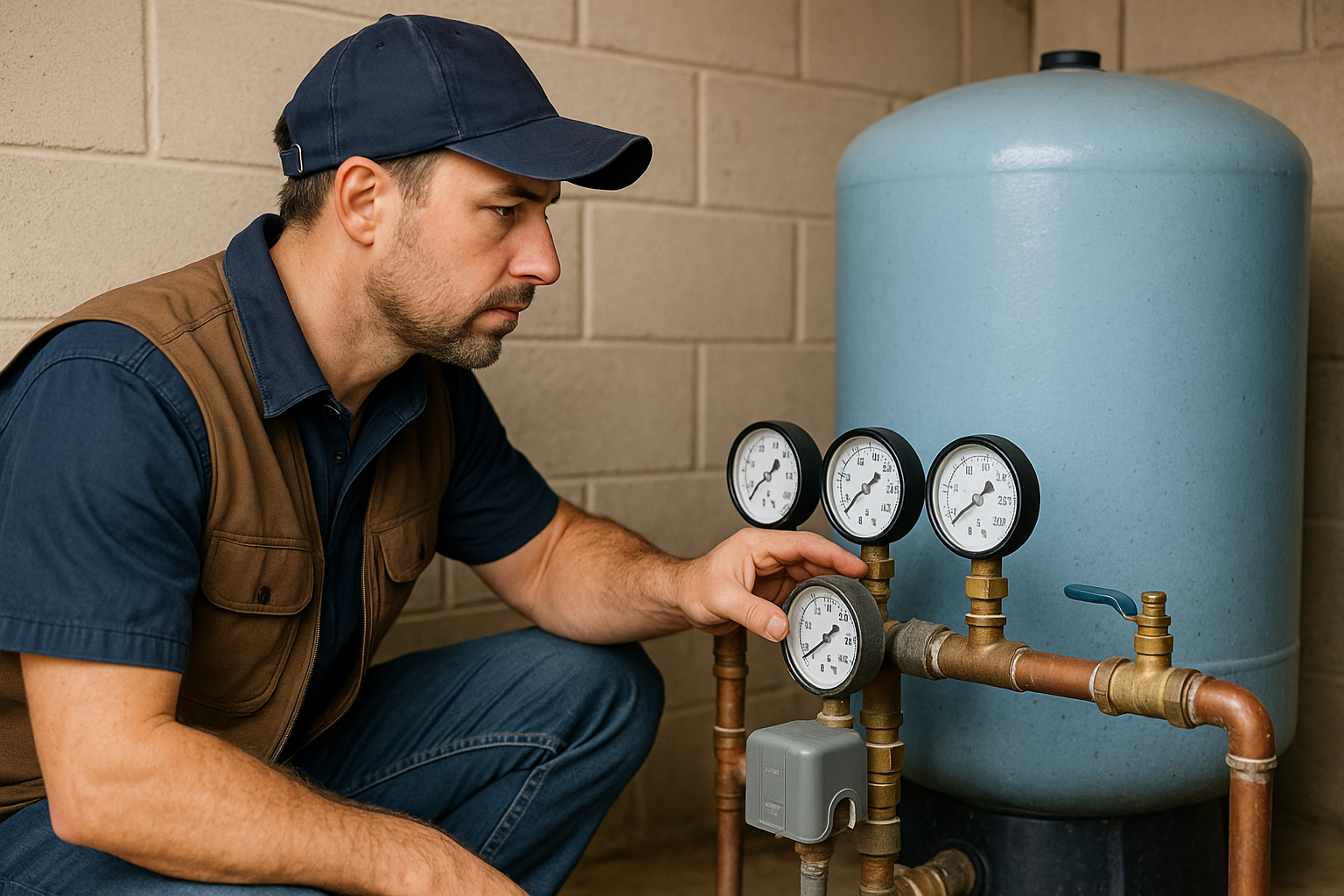
- Pressure Reading: Using a gauge at an outdoor spigot or near the tank, we measure static and dynamic pressure (psi) against the standard 40-60 psi range. Garnet's flat terrain means minimal elevation loss, focusing diagnostics on equipment or aquifer supply.
- Pump and Tank Inspection: We check pump amperage and listen for unusual sounds (e.g., cavitation from sediment). For tanks, we test air pre-charge and tap for waterlogging—a dull thud indicates failure, accelerated by hard water and heat.
- Well Yield Test: We measure flow rate (GPM) directly from the well to assess aquifer health. In Garnet, yields under 5 GPM often signal drought stress or regional groundwater depletion in alluvial layers.
- Pipe and Screen Evaluation: We inspect for leaks or corrosion and may use a downhole camera to check casing and screens for sediment buildup—common in sandy valley soils. Flow tests isolate blockages in specific pipe runs.
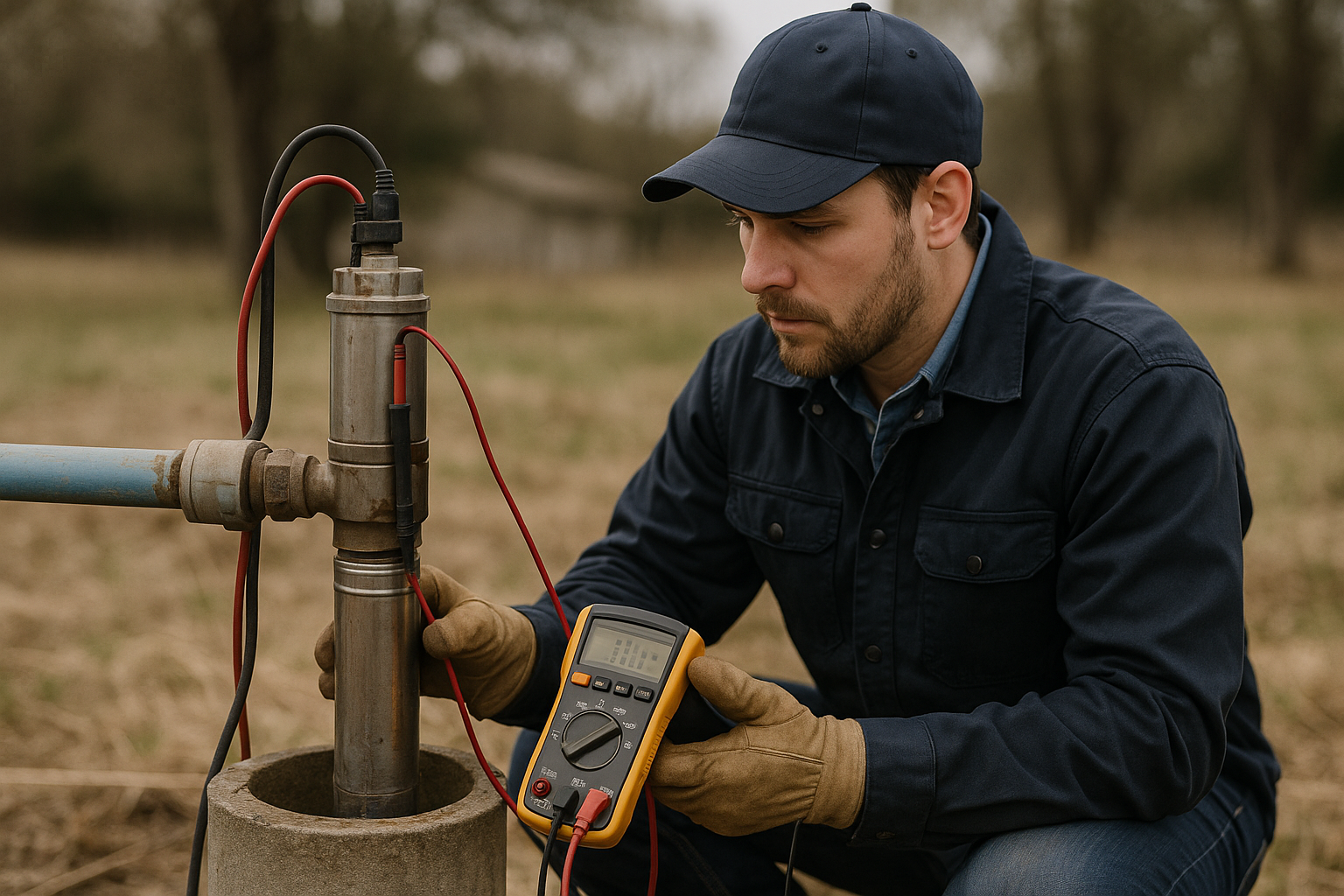
- Electrical Diagnostics: We test voltage and continuity at the pump and control box, crucial in rural Garnet where power instability or dust exposure can affect performance over long wiring runs.
This comprehensive diagnostic takes 1-2 hours for $150-$250, factoring in travel to Riverside County. We provide a detailed report and recommendations, ensuring transparency before any repairs start.
Solutions to Restore Water Pressure in Garnet
Once the issue is pinpointed, SCWS offers customized solutions for Garnet's desert valley wells, addressing sediment, drought, and equipment wear. Here are common fixes with approximate costs (2026 rates, site-specific):
- Pump Repair or Replacement: Worn pumps may be overhauled (impeller replacement, $300-$500) or replaced. A 1 HP submersible for a 300-ft Garnet well costs $1,200-$1,800 installed. Variable-speed pumps ($2,000-$3,000) are ideal for irrigation-heavy properties.
- Pressure Tank Replacement: Failed tanks are replaced with corrosion-resistant models—a 44-gallon tank runs $600-$900 installed. We set pre-charge to match pump cut-out (e.g., 38 psi for 40/60), optimizing performance in harsh desert conditions.
- Booster Pump Installation: For larger properties or multi-zone irrigation in Garnet, a booster pump adds 20-30 psi. A durable system with check valve costs $800-$1,500, ensuring consistent pressure across flat expanses.
- Constant Pressure System: For steady 50-60 psi regardless of demand, we install variable frequency drive (VFD) systems—perfect for Garnet homes with variable water needs. Cost: $2,500-$4,000 installed, offering reliability in arid regions.
- Pipe Clearing or Replacement: Clogged lines are cleared with jetting ($200-$400) or chemical descaling for minerals. Damaged pipes are replaced with UV-resistant PEX or PVC ($500-$1,200 for typical runs), minimizing disruption in sandy soils.
- Well Rehabilitation: For sediment or low yield, we clean wells with air-lifting or chemical treatments ($900-$1,800). If aquifer depletion persists, deepening (additional 50-100 ft at $50-$80/ft) or hydrofracturing ($3,000-$5,000) can increase supply in alluvial zones.
- Pressure Switch Adjustment: Resetting a misadjusted switch to 40/60 psi often fixes pressure for $100-$150, including service—a cost-effective solution for many Garnet wells.
We guarantee workmanship and use parts rated for Garnet's hard water and desert extremes, extending system life. Costs are transparent, discussed upfront, ensuring no surprises.
Maintenance Tips to Prevent Low Water Pressure in Garnet
Preventative maintenance is critical in Garnet's arid valley environment to avoid pressure issues and costly breakdowns. These actionable steps can sustain your well system:
- Annual Inspections: Schedule a professional check-up every 12-18 months ($150-$200) to test pump performance, tank pressure, and water quality. Early detection of sediment or scaling saves on repairs. SCWS offers maintenance plans for Garnet clients.
- Tank Air Charge Checks: Verify tank pre-charge quarterly with a tire gauge (2 psi below cut-out, e.g., 38 psi for 40/60). Add air if low with a compressor. Replace tanks every 7-10 years due to hard water and heat exposure.
- Water Testing: Test for minerals and bacteria yearly ($50-$100 via SCWS or labs). High mineral content warns of scaling—install a water softener ($800-$1,200) or iron filter ($500-$900) to protect equipment.
- Drought Conservation: During dry seasons, reduce irrigation and stagger heavy use to ease aquifer strain. Low-flow fixtures maintain pressure with limited supply in over-pumped valley regions.
- Electrical Protection: Use surge protectors on pump controls to guard against rural power fluctuations. Shield wiring from dust and heat—common in Garnet's desert setting—and inspect annually for wear.
- Wellhead Maintenance: Keep the wellhead free of sand, debris, or vegetation to prevent sediment entry. Secure caps and seals to block surface contaminants in loose alluvial soils.
These practices can extend your system's lifespan by 5-10 years, minimizing pressure disruptions. SCWS provides guides and reminders for Garnet residents to stay proactive.
When to Call a Professional in Garnet
While some maintenance can be DIY, certain signs in a desert valley like Garnet demand expert help to prevent total failure. Contact SCWS at (760) 440-8520 if you observe:
- Sudden Pressure Loss: An abrupt drop without obvious cause (like peak irrigation) may signal pump failure or a major leak—urgent issues requiring immediate attention.
- Frequent Pump Cycling: Short-cycling (rapid on/off) often indicates a waterlogged tank or faulty switch, stressing the pump and risking burnout if not fixed.
- No Water Flow: Complete loss is an emergency—likely pump or power failure. SCWS offers same-day service in Garnet to resolve critical outages quickly.
- Strange Pump Noises: Grinding or humming suggests mechanical issues or cavitation (air from clogs or low water). Ignoring these risks total system failure in harsh desert conditions.
- Visible Leaks or Wet Spots: Unexplained damp areas near pipes or wellhead indicate pressure loss from leaks, often hidden in Garnet's sandy, shifting soils.
- Water Quality Changes: Cloudy, gritty, or metallic water often ties to pressure drops from clogged screens or casing issues—common in sediment-heavy alluvial aquifers.
Attempting complex repairs without proper tools or licensing can worsen damage or violate Riverside County regulations, often requiring permits for well work. SCWS handles all compliance with Department of Water Resources standards, safeguarding your investment.
Why Garnet Trusts Southern California Well Service
With since 2020 serving Riverside and San Diego Counties, SCWS has built a reputation for reliability in desert communities like Garnet through tailored expertise. Here's why locals choose us:
- Regional Knowledge: We understand Garnet's alluvial geology, drought patterns, and irrigation demands in the Hemet/San Jacinto Valley, enabling precise diagnostics and effective fixes.
- Rapid Response: Offices in Ramona (1077 Main St) and Anza (57174 CA-371 (US Hwy 79)) position us for fast, same-day service—vital in rural desert areas where water is critical.
- Clear Pricing: No hidden fees—detailed quotes are provided before work begins, ensuring trust for Garnet property owners.
- Top-Rated Service: Our CSLB #1086994, supported by hundreds of reviews, reflects our commitment to quality across the region, including Riverside County.
- Full-Service Solutions: From pump upgrades to well deepening to water treatment, we're a one-stop shop for all well needs, simplifying care in remote valley settings.
Low water pressure doesn't have to hinder your life in Garnet. Whether it's a quick adjustment or a comprehensive system overhaul, SCWS has the skills, tools, and local insight to restore your well's performance. Call (760) 440-8520 today for a free estimate or emergency assistance—let us solve your water pressure challenges so you can thrive in this desert valley community.
Frequently Asked Questions
Why does my Garnet well water have such low pressure during the hot summer months?
Garnet sits in an unincorporated stretch of the Coachella Valley near North Palm Springs, where very hot, dry summers drive heavy demand on swamp coolers, irrigation, and household use at the same time the desert aquifer is under the most stress. When everyone draws hard during a heat wave, the static water level in many Garnet wells dips and your pump simply cannot lift enough water to hold steady pressure. We test your well's recovery rate and recommend solutions such as a larger pressure tank, a constant-pressure system, or staggered irrigation timing so you keep usable pressure even on 115-degree afternoons.
Is hard water and sediment really worse for wells out here near the San Gorgonio Pass?
Yes. Groundwater in the Garnet area is typically high in dissolved minerals and carries fine sand from the alluvial desert soils washed down through the San Gorgonio Pass. That hard water leaves scale inside pipes, pressure tanks, and pump components, while sand grit wears impellers and clogs screens. Both problems quietly choke flow and look like a pressure issue. We often pair a pressure fix with sediment filtration ($300-$900) or a water softener ($1,500-$3,500) so the repair actually lasts in Garnet's mineral-heavy, sandy conditions.
How deep are wells in Garnet, and does depth affect my water pressure?
Because Garnet draws from desert aquifers that can sit well below the surface, deep wells are common here, and a deeper well means your pump has to lift water much farther before it ever reaches your pressure tank. An undersized or aging pump in a deep Garnet well will struggle to maintain 40-60 psi, especially as the water table drops seasonally. During our $125 diagnostic (credited toward any repair) we measure pumping depth and pump performance to confirm whether a pump upgrade ($2,500-$5,500) or a booster system ($2,000-$4,500) is the right call.
Could the constant desert wind and dust near the I-10 windmills be damaging my equipment?
The blowing sand and dust common along Interstate 10 by the San Gorgonio Pass windmills can absolutely shorten the life of exposed well equipment in Garnet. Grit works into pressure switches, pump controls, and wiring, while extreme heat cycles crack seals and fatigue tanks. A worn pressure switch ($150-$350) or a failed pressure tank ($600-$1,500) is a frequent cause of erratic or low pressure we find on Garnet properties. We recommend shaded, sealed enclosures for controls to protect your investment from the harsh desert environment.
My pressure dropped suddenly. Should I get an emergency visit in Garnet?
A sudden, total loss of pressure in Garnet usually points to a failed pump, a burst line in the sandy soil, or a control failure, and in desert heat going without water is a genuine emergency. Southern California Well Service offers same-day emergency response throughout the Garnet and North Palm Springs area. Call us at (760) 440-8520 or text (760) 219-5877, and we will diagnose the problem fast before a small failure leaves your household completely dry.
What does it cost to fix low water pressure on a Garnet property?
It depends on the cause, which is why we start with a $125 diagnostic that is credited toward your repair. Common Garnet fixes range from a pressure switch adjustment or replacement ($150-$350) and a new pressure tank ($600-$1,500), up to a pump replacement ($2,500-$5,500). If the desert aquifer itself is the limit, hydrofracturing ($3,000-$8,000) or a brand-new deeper well ($18,000-$42,000) may be warranted. We are a licensed C-57 contractor founded in 2020, with 60+ years of family heritage, with offices in Ramona (1077 Main St) and Anza (57174 CA-371 (US Hwy 79)). Call (760) 440-8520 for an honest, upfront quote.