
Low Water Pressure Solutions in Paradise Hills
Dealing with weak water pressure in Paradise Hills? Low water pressure can make showers frustrating and appliances ineffective. Our team diagnoses the root cause and restores your water pressure fast.
📋 In This Guide
Need Low Water Pressure Solutions in Paradise Hills?
We serve Paradise Hills and all of San Diego County. Licensed C-57 contractor (CSLB #1086994), founded 2020.
Call: (760) 440-8520Our Low Water Pressure Solutions Services
- Pressure tank repair and replacement
- Pressure switch adjustment
- Pump upgrades for better pressure
- Constant pressure systems
- Booster pump installation
- Clogged pipe diagnosis
- Well yield testing
- Complete system evaluation
Why Paradise Hills Chooses SCWS
✓ Local Expertise
We know San Diego County geology and wells
✓ Fast Response
Same-day service for Paradise Hills
✓ Fair Pricing
Honest quotes, no surprises
✓ Quality Work
CSLB #1086994 · founded 2020
Our Locations
Related Articles
Continue learning about well maintenance and troubleshooting
Low Water Pressure From Well: Complete Fix Guide
Diagnose and solve low pressure problems
Well Pressure Switch: Settings, Adjustment & Replacement
Everything about pressure switches
Pressure Tank Maintenance: Complete Guide
Keep your pressure tank working properly
Low Water Pressure Help for Paradise Hills Well Owners
Paradise Hills is a hilltop residential neighborhood in southeastern San Diego, tucked into the City of San Diego within San Diego County and bordered by National City, Bonita, Lincoln Acres, and the Sweetwater area. Most homes here connect to municipal water, but a number of larger and older parcels still rely on private wells, and when one of those wells loses pressure the difference is felt immediately. Showers turn weak, irrigation sputters, washing machines take forever to fill, and a household that once ran without a second thought suddenly revolves around the water system. If you are a Paradise Hills well owner staring down a pressure gauge that will not climb, the good news is that low pressure almost always traces back to a handful of identifiable, fixable causes.
The terrain and geology around Paradise Hills shape how local wells behave. The neighborhood sits on hilly ground built from sedimentary and sandstone deposits laid over decomposed granite and fractured crystalline bedrock, a profile typical of San Diego County. Wells in this urbanized, semi-arid pocket commonly run somewhere between 100 and 400 feet deep, drawing from fractured rock or sediment-bearing zones. That combination of elevation, fine sediment, and seasonal swings in the water table produces a distinct set of pressure problems, and understanding them is the first step toward a lasting fix rather than a temporary patch.
How Your Well Water Pressure System Works
Before you can diagnose weak pressure, it helps to know how the pieces of a private well system fit together. A residential well is not pressurized directly from the ground. Instead, three core components work in sequence to deliver steady water to your taps.
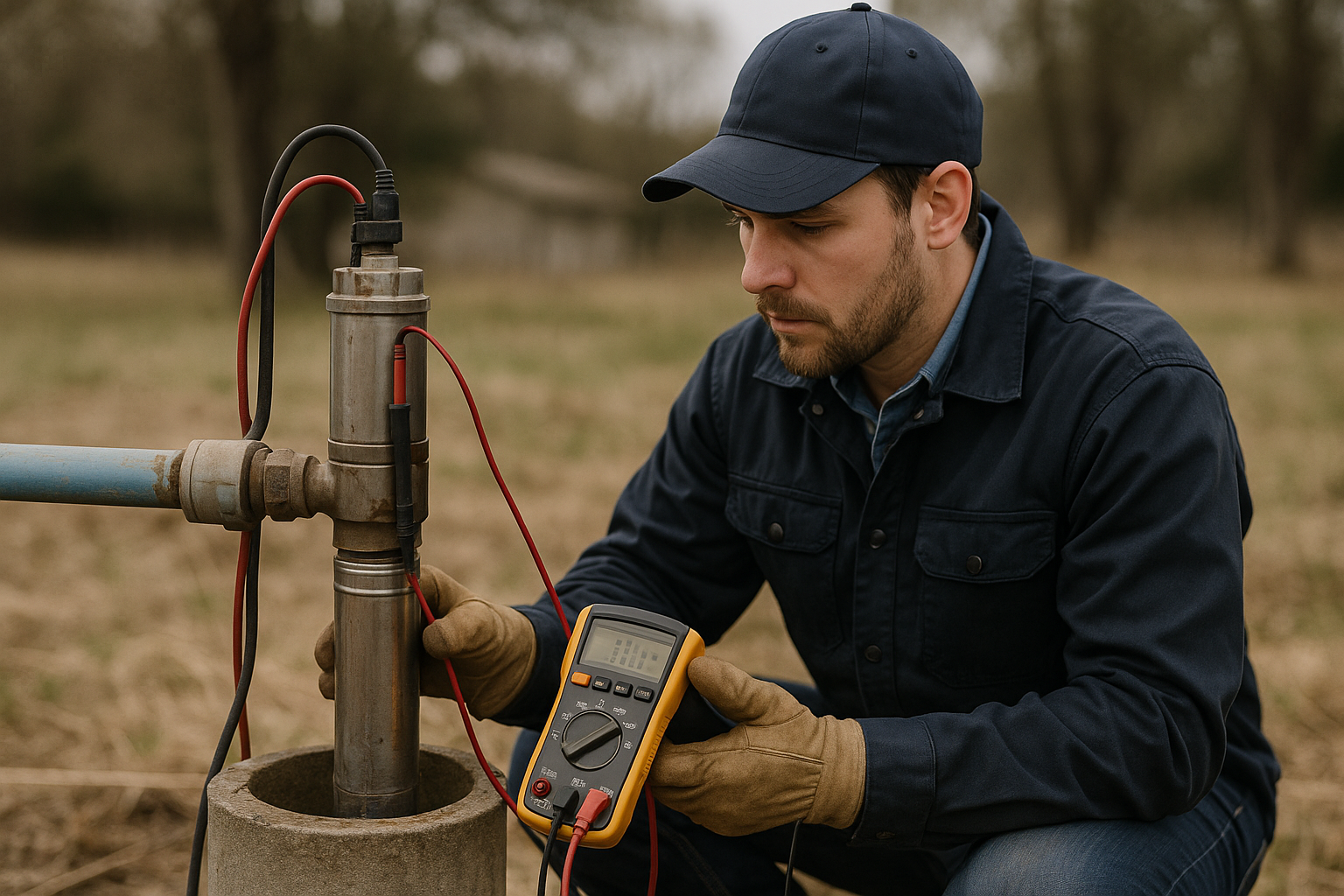
The well pump does the heavy lifting. In most Paradise Hills wells this is a submersible pump set deep in the casing, below the water level, pushing water up the drop pipe toward the house. On a hilltop lot the pump may have to lift water several hundred feet and then move it further uphill to the home, so it is working against real elevation. When a pump weakens, wears, or begins to draw air, pressure throughout the house drops.
The pressure tank stores water under pressure so the pump does not have to run every time you open a faucet. Inside the tank is a rubber bladder or diaphragm separating water from a cushion of compressed air. As water enters, it compresses that air; as you use water, the air pushes it back out, holding pressure steady between pump cycles. A healthy tank means smooth, even flow. A waterlogged tank with a failed bladder makes the pump cycle on and off rapidly, which both hammers the equipment and leaves you with fluctuating pressure.
The pressure switch is the brain that tells the pump when to run. It is set with a cut-in and a cut-out point, most commonly 40/60: the pump kicks on when tank pressure falls to 40 PSI and shuts off when it climbs to 60 PSI. Some systems run 30/50. When that switch drifts out of adjustment, corrodes, or sticks, your pump may start too late, stop too early, or behave erratically, all of which show up at the tap as low or uneven pressure.
One more concept matters on a hilltop well: drawdown. Every time the pump runs, it pulls the water level in the well down. If the aquifer cannot recharge quickly enough, or if the seasonal water table has already dropped, the pump can outpace the well and momentarily draw air or run dry. The result is pressure that fades during heavy use and recovers after the well rests. Recognizing that pattern is often the clue that points to a supply issue rather than an equipment failure.
Common Causes of Low Pressure in Paradise Hills
Drawing on decades of well work across San Diego County, we see the same culprits surface again and again in hilltop neighborhoods like Paradise Hills. The local geology and elevation tend to push a few of these to the top of the list.
- Pumping lift on a hilltop lot. Homes perched at the higher elevations of Paradise Hills demand more from their pumps, which must move water both up out of the well and uphill to the house. A pump that was marginally sized, or one that has gradually worn, simply cannot keep pace, and pressure suffers most at upstairs fixtures and the far end of the property.
- Sediment from sedimentary and sandstone formations. The fine sand and silt common to the area's sedimentary deposits migrate into wells over time, clogging intake screens, abrading pump impellers, and packing into pipes and fixtures. As flow narrows, pressure falls, and the wear quietly accelerates until something fails outright.
- Seasonal water table decline. Southern California's semi-arid climate and recurring dry stretches lower groundwater levels, especially late in the dry season. When the water table drops, a well that performed fine in winter can struggle by late summer, producing pressure that sags during peak demand.
- Failed or waterlogged pressure tank. Mineral content and sediment in local groundwater are hard on tank bladders. Once the bladder ruptures or the air charge is lost, the tank waterlogs, the pump short-cycles, and pressure swings wildly instead of holding steady.
- Pressure switch problems. Corroded contacts, a clogged sensing port, or a switch knocked out of its 40/60 calibration will leave the pump running on the wrong schedule, capping the pressure your system can build.
- Clogged screens, filters, or aging pipe. Older delivery lines on long-established parcels, combined with sediment-loaded water, narrow over time. A single clogged sediment screen or a partly blocked line can throttle the whole house even when the pump and tank are healthy.
What You Can Check Yourself
Before calling anyone, there are a few safe checks a Paradise Hills homeowner can make. None of these require opening the well itself, and they often pinpoint the problem or at least give a technician a valuable head start.
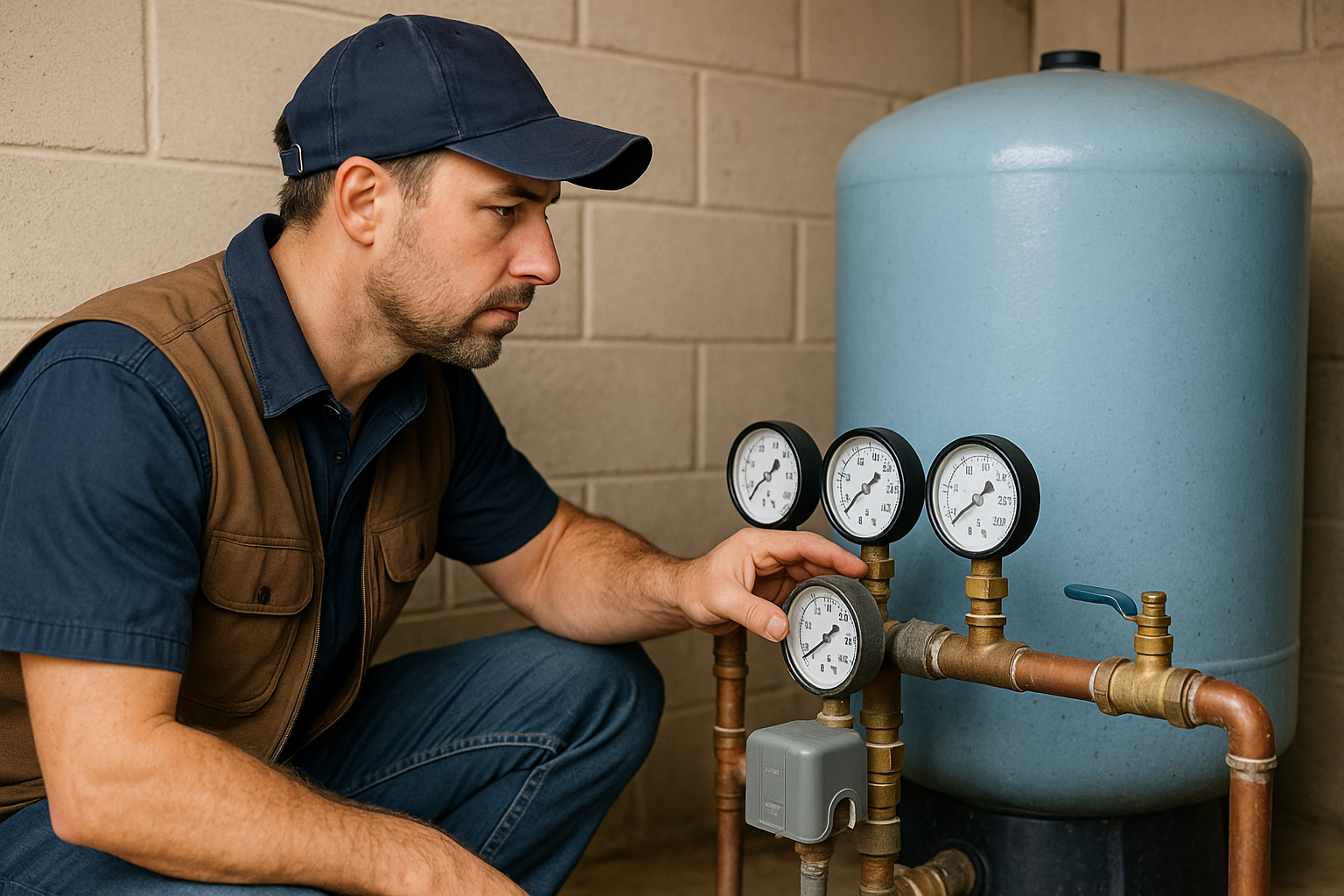
- Read the pressure gauge. Find the gauge mounted near your pressure tank and watch it through a full cycle. It should swing between your cut-in and cut-out points, typically 40 and 60 PSI. If it never reaches 60, hovers low, or barely moves, the pump, switch, or tank is the likely suspect. A reading stuck below 30 PSI deserves prompt attention.
- Listen to the pressure switch. Watch and listen as the pump cycles. If it clicks on and off every few seconds (short-cycling), your tank has almost certainly lost its air charge or failed its bladder. If the pump never seems to shut off, the switch may be stuck or the system cannot reach cut-out pressure.
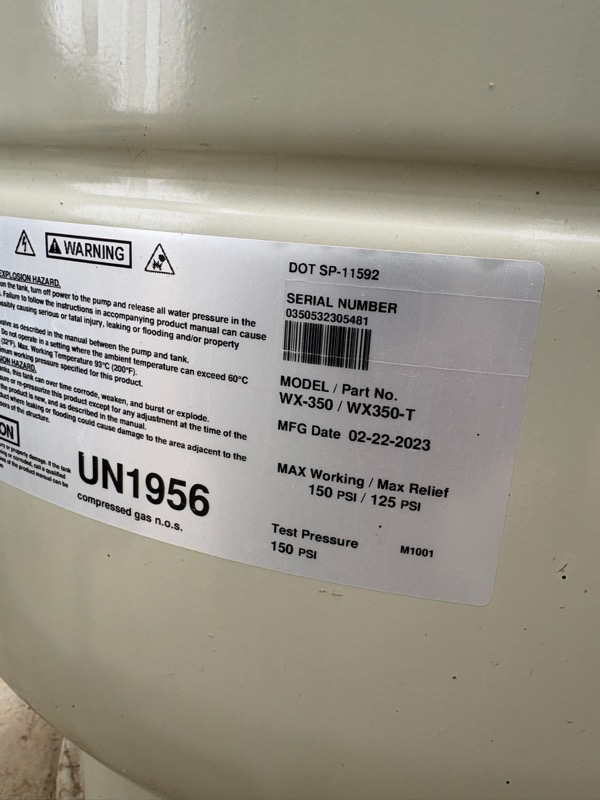
- Check the tank's air charge. With the pump off and the system drained of pressure, a quick tire-gauge reading on the tank's air valve should sit about 2 PSI below your cut-in setting (roughly 38 PSI on a 40/60 system). A reading far off from that, or water spitting out of the air valve, signals a tank problem.
- Inspect sediment screens and filters. If you have an inline sediment filter or screen, shut off the system, relieve the pressure, and check the cartridge. A filter caked with sand or rust is a common, easily overlooked cause of whole-house pressure loss, and replacing the cartridge sometimes restores flow on its own.
Always shut off power to the pump at the breaker before touching electrical components, and never attempt to pull a pump or open well piping yourself. Those tasks belong to a licensed well contractor with the right equipment.
When to Call a Professional
Some symptoms point past anything a homeowner should tackle and into the territory of a licensed C-57 well contractor. Call us if you run into any of the following in Paradise Hills:
- No water or a sudden, severe pressure drop that does not return, which can indicate pump failure or a well that has dropped below the pump.
- Grinding, clicking, or rapid cycling sounds from the pump or tank, signaling mechanical wear, a failed tank, or a pump struggling with elevation lift or low water.
- Cloudy water, sand, or sudden discoloration, which suggests sediment intrusion or screen damage tied to the area's sandstone and sedimentary geology.
- Pressure that keeps fading during heavy use, a classic sign of drawdown outpacing well recharge, particularly late in the dry season.
- Problems that persist after you have checked the gauge, switch, and tank, meaning the fault lies deeper in the pump, the well, or the supply itself.
When you call, our diagnostic visit is $125, and we credit that fee toward any repair we perform, so the assessment effectively pays for itself once the work begins.
Realistic Cost Ranges in Paradise Hills
Every well is different, and the right fix depends on what we find on site. Still, it helps to know roughly where prices land before we arrive. The following ranges reflect typical Paradise Hills jobs as of 2026:
- Pressure switch replacement: $150 to $350
- Pressure tank replacement: $600 to $1,500
- Submersible pump replacement: $2,500 to $5,500
- Sediment filtration system: $300 to $900
- Iron/manganese filter or water softener: $1,500 to $3,500
- Constant-pressure or booster system: $2,000 to $4,500
- New well, turnkey: $18,000 to $42,000
- Hydrofracturing to improve yield: $3,000 to $8,000
- Well abandonment/decommissioning: $1,500 to $5,000
We provide an honest, itemized estimate before any work begins, and we will never push a new well or a costly upgrade when a switch adjustment or tank swap will solve the problem.
Serving Paradise Hills and the Surrounding San Diego County Communities
Southern California Well Service has been keeping water flowing for property owners across San Diego County since 2020. We are a licensed C-57 well drilling contractor with, and we work throughout Paradise Hills and its neighbors, including National City, Bonita, Lincoln Acres, and the Sweetwater area. Our crews run out of two offices: 1077 Main St, Ramona, CA 92065, and 57174 CA-371 (US Hwy 79), Anza, CA 92539, positioning us to reach hilltop neighborhoods quickly. Because we understand the sediment-prone, fractured-bedrock geology beneath this part of San Diego County, we diagnose the real cause the first time instead of guessing. Same-day emergency service is available when you have no water and cannot wait.
Frequently Asked Questions
Why does my Paradise Hills well lose pressure only in the afternoon or late summer?
That pattern usually points to drawdown and a seasonal decline in the water table. As the semi-arid dry season progresses, groundwater levels fall, and heavy afternoon use can pull the well down faster than it recharges. Pressure sags during the demand and recovers once the well rests. We can measure your well's yield and recovery rate to confirm whether supply, rather than equipment, is the limiting factor.
What pressure should my well system hold?
Most residential systems are set to cut in at 40 PSI and cut out at 60 PSI, so your gauge should cycle steadily between those numbers. Some systems run 30/50. If your pressure never reaches the high end, hovers below 30, or swings unpredictably, something in the pump, switch, or tank needs attention.
Can sediment really cause low water pressure?
Yes. The sandstone and sedimentary formations common around Paradise Hills shed fine sand and silt that clog well screens, wear down pump impellers, and pack into filters and fixtures. Sediment is one of the most frequent causes of gradual pressure loss we see in the area, and a filtration system often pays for itself by protecting your pump and tank.
Is a booster or constant-pressure system worth it on a hilltop lot?
For homes at the higher elevations of Paradise Hills, it often is. A constant-pressure system with a variable frequency drive adjusts the pump speed continuously to hold steady pressure regardless of demand, while a booster pump amplifies pressure through long uphill runs. Both can transform the experience at upstairs fixtures and distant outdoor spigots.
How much will it cost to fix my low pressure?
It depends on the cause. A pressure switch runs $150 to $350, a new tank $600 to $1,500, and a full submersible pump replacement $2,500 to $5,500. Our $125 diagnostic visit identifies exactly what is needed, and that fee is credited toward whatever repair you approve.
Do you offer same-day or emergency service in Paradise Hills?
We do. When you have no water or a critical pressure failure, we prioritize fast response and offer same-day emergency service whenever possible. Call us and we will get a technician out to assess and restore your supply.
Restore Your Water Pressure Today
Do not let weak water pressure disrupt your household any longer. Founded in 2020, with 60+ years of family heritage, a C-57 license, across San Diego County, Southern California Well Service has the local knowledge to get your Paradise Hills well running at full strength. Call us at (760) 440-8520 for a free estimate or same-day emergency service, or text us anytime at (760) 219-5877. Your diagnostic visit is just $125 and credited toward your repair, so reaching out costs you nothing once the work is done.