


Ranch Well Service Solutions for Hemet Properties
Out past the Florida Avenue corridor, where the subdivisions thin out and the pasture begins, Hemet returns to its roots as ranch country. The San Jacinto Valley has been working land for well over a century — citrus and avocado groves, alfalfa and row crops, cattle on the dry foothills, and horse property tucked into Valle Vista, Cactus Valley, and the high ground out toward Sage. For these large rural parcels, a municipal hookup is rarely the answer. The water that keeps a Hemet ranch running comes up from a well, and the reliability of that well shapes everything from how many head you can carry to whether your pasture stays green through a Riverside County summer.
A ranch well is a different animal than a household well. Demand is higher, more varied, and far less forgiving — livestock drink every day regardless of season, irrigation peaks in the heat, and in fire country you need water in reserve when the wind comes up. Getting the well, pump, and storage sized correctly for a Hemet property means understanding both the land above and the alluvial basin below. At Southern California Well Service, we have spent more than 30 years drilling and servicing wells across the San Jacinto Valley, and we build ranch water systems for the way these properties actually run.
A Hemet Ranch's Water Demands
The first step in any ranch water system is honest accounting of how much water the property actually consumes — not as a single number, but across several very different uses that peak at different times.
Livestock is the demand that never takes a day off. As a rough planning guide, a horse drinks roughly 10 to 12 gallons per day, and a beef cow can take 20 to 30 gallons or more in the heat of a Hemet summer. Lactating cattle, weather, and feed type push those figures higher. A modest horse property with a handful of animals is a manageable load, but a working cattle operation can total hundreds or thousands of gallons a day before a single sprinkler turns on. Livestock water is also the demand you can least afford to interrupt.
Pasture and crop irrigation is usually the largest single draw, and it is seasonal and intense. Irrigation is measured in acre-inches — the water needed to cover an acre to a depth of one inch — and a single acre-inch is roughly 27,000 gallons. Irrigating pasture, alfalfa, citrus, or avocados across even a few acres during the San Jacinto Valley's hot, dry months adds up to a very large volume delivered over short, demanding windows. This is the use that most often outstrips what a well can pump in real time.
Household and domestic use — the home, outbuildings, landscaping, and any guest or ranch-hand quarters — is comparatively small but constant, and it is the use you notice immediately when pressure drops. Fire and defensible-space reserve is the demand many owners overlook until it matters. In the brush-and-grass terrain around Hemet's foothills, holding dedicated water in reserve for wildfire protection is not optional thinking. We never invent a single gallons-per-day total for a property without walking it, because the right number depends entirely on animal counts, irrigated acreage, and how the parcel is laid out.
Designing a Ranch Water System
Here is the key insight that drives good ranch water design in the San Jacinto Valley: your well does not have to pump fast enough to meet peak demand. It has to pump enough over 24 hours to refill storage. The well, storage, and pumping are three separate jobs, and matching them correctly is what separates a system that works from one that runs dry every July afternoon.
Storage tanks are the heart of the design. A well that produces a modest, steady yield can comfortably support heavy irrigation and livestock loads if it feeds large storage tanks — commonly 2,500 to 10,000 gallons or more on a ranch — that fill slowly through the day and night and then deliver water quickly when demand spikes. The tank, not the well, handles the peak. This approach also protects the well itself, letting the pump run in steady cycles instead of being hammered against a draw it cannot sustain.
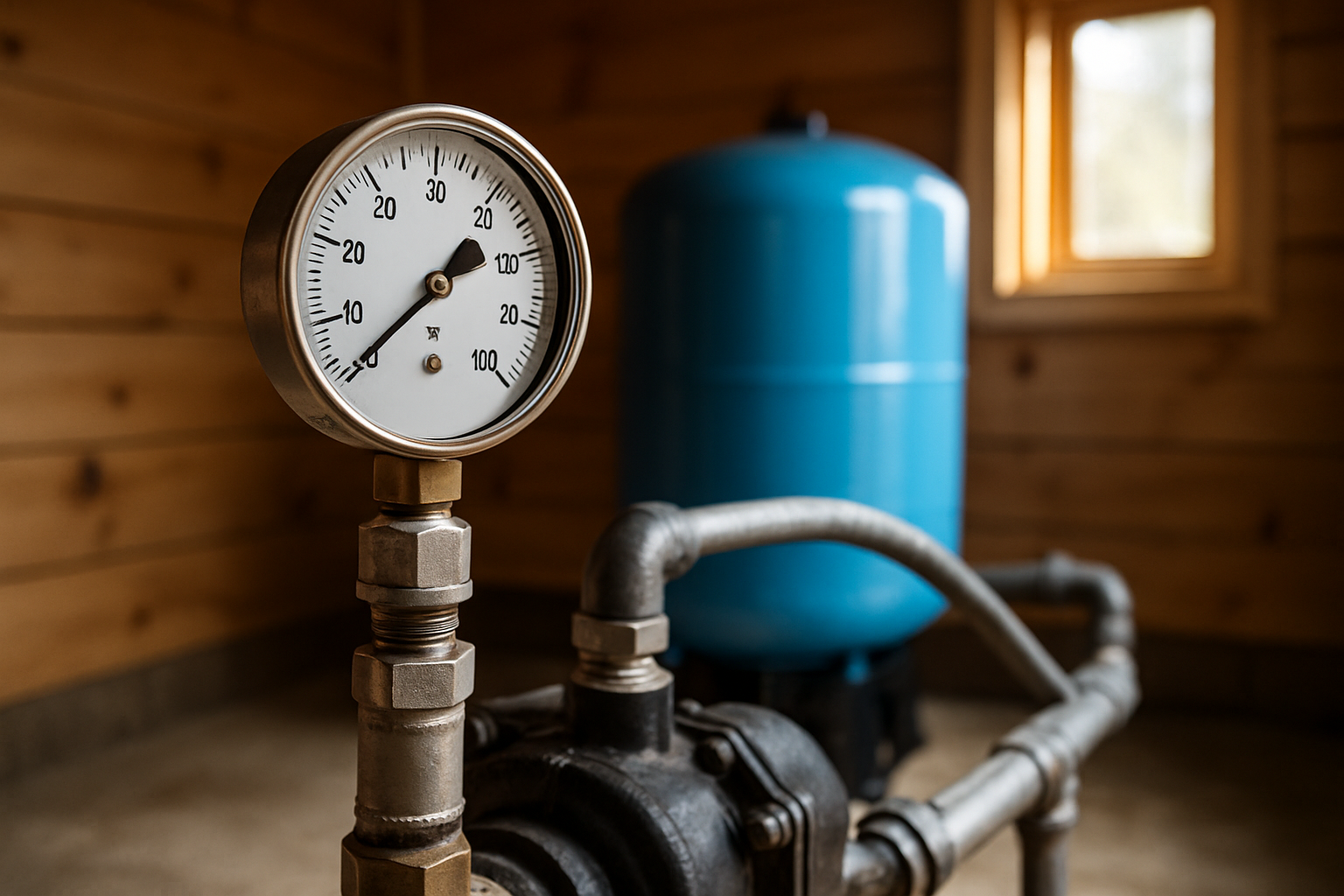
Pumping and pressure come in two stages. A submersible pump lifts water from the well into storage; a separate booster pump then pressurizes the water from the tank out to the home, hydrants, and irrigation. For ranches that want even, dependable pressure across long runs and varying demand, a constant-pressure (VFD) system adjusts pump speed automatically, eliminating the pressure swings that plague large rural plumbing. Fire reserve should be built into the storage plan from the start — a dedicated minimum volume that stays in the tank, plus fittings and hydrant connections sized to your local fire district's standards so equipment can draft from your supply when it counts.
Water Quality for Livestock & Irrigation
Groundwater in the San Jacinto Valley is generally hard, and quality varies considerably across the basin. Hard water — high in calcium and magnesium — is the most common issue, and over time it scales pipes, pumps, and irrigation emitters. Iron and manganese can stain fixtures and clog drip systems. The two issues that demand real attention on a Hemet ranch, though, are nitrates and salinity.
Nitrates are a known concern in this basin, particularly near land with a long agricultural history; sampling in the valley has found elevated nitrate-nitrogen at various locations. Nitrates matter for both household drinking water and young livestock. Salinity, measured as total dissolved solids (TDS), varies widely across the San Jacinto basin — some areas show TDS well above 1,000 mg/L, and decades of pumping have shifted higher-TDS water around within the basin. High TDS is hard on salt-sensitive crops like avocados and can affect livestock if it climbs far enough.
The only way to know what is actually in your water is to test it. We recommend testing any ranch well for the parameters that match its uses — drinking-water safety, nitrates, TDS and salinity for irrigation, hardness, and iron or manganese where staining appears. From there, treatment is matched to the problem: softening or scale control for hard water, filtration for iron and sediment, and reverse osmosis or blending strategies where TDS or nitrates need to be reduced for sensitive uses. There is no single fix — the right system depends entirely on your test results and what the water has to do.
Drought Resilience, Reliability & Backup
The San Jacinto Valley's groundwater basin has a long history of stress. Extraction has at times outpaced recharge, water levels have dropped substantially over the decades, and the Hemet-San Jacinto Watermaster now monitors the basin closely. For a ranch owner, the practical takeaway is that a well's static water level and yield can change over the years, and dry-cycle years put real pressure on shallower wells.
Designing for resilience means a few things. Generous storage carries you through pump downtime, power outages, and short-term yield dips. Backup power — a properly sized generator or automatic transfer setup — keeps water flowing to livestock when the grid goes down, which in rural Hemet is a question of when, not if. Where a property's water security justifies it, redundancy at the pump or even a second well removes a single point of failure. Simple monitoring of water level, flow, and pressure lets you catch a declining well early, while there is still time to plan rather than react.
Maintenance & Common Ranch Well Issues in Hemet
Ranch wells work harder than household wells, and they show it. The most common problems we see across the San Jacinto Valley include:
- Hard-water scaling that narrows pipes, fouls pressure tanks, and reduces pump efficiency over time.
- Sand and sediment in the water, which signals a screen or casing issue and grinds down pump components and irrigation hardware.
- Pump wear from heavy cycling — undersized storage forces pumps to start and stop constantly, and that short-cycling is one of the fastest ways to burn out a motor.
- Aging casing on older ranch wells, some drilled generations ago, which can corrode, crack, or let in fines.
- Declining yield as basin levels shift or as the well ages and its screens clog with mineral buildup.
Most of these are far cheaper to manage with periodic inspection than to fix after a failure. A pump pulled and checked on schedule, water tested annually, and storage sized to reduce cycling will add years to a ranch system's life.
When to Call Southern California Well Service
Some warning signs should never wait. Call us if you notice pressure that drops or surges, air sputtering at the faucet or hydrant, sand or cloudiness in the water, a pump that runs constantly or cycles rapidly, a sudden drop in how much water the well delivers, or any staining or off taste that suggests a quality change. On a ranch, a well that quits is an emergency — livestock cannot wait — and we offer same-day emergency service across the region. If you are planning ahead instead of reacting, that is the best time of all to call: sizing a new well, expanding storage, or boosting an underperforming system is far easier to do on your schedule than during a July outage. Our diagnostic visit is $125 and is credited toward any work we perform.
Serving Hemet Ranches & Rural Properties
Southern California Well Service is a licensed C-57 water well drilling contractor with more than 30 years of experience and a 4.9-star rating, serving San Diego, Riverside, and San Bernardino counties. We work throughout Hemet and the surrounding San Jacinto Valley — East Hemet, Valle Vista, Cactus Valley, the Diamond Valley Lake area, Winchester, San Jacinto, and the higher ranch country out toward Sage. Our two offices put crews close to your land: Ramona at 1077 Main St, Ramona, CA 92065, and Anza at 57174 US Hwy 79, Anza, CA 92539. Whether you run a few horses on a few acres or a working cattle and irrigation operation, we build and maintain water systems for the way Hemet ranches actually use water. Call (760) 440-8520 or text (619) 259-0410.
Frequently Asked Questions
Do I need a permit to drill a well on my Hemet ranch?
Yes. New wells in this area require permitting through Riverside County, and the San Jacinto basin is actively managed by the Hemet-San Jacinto Watermaster, so groundwater pumping is monitored. We handle the permitting process as part of our drilling work and make sure your well is constructed to code.
How deep are wells in the Hemet area?
It depends on where your property sits. In the alluvial valley floor, productive wells often fall in a moderate depth range, while ranch parcels up in the foothills toward Sage frequently need to go deeper to reach reliable water-bearing zones. Until we evaluate your specific location, we speak in ranges rather than promises — every parcel is different.
How much does a new ranch well cost?
A turnkey new agricultural or ranch well typically runs $25,000 to $60,000 or more, depending on depth, geology, and yield. Adding storage and a booster system generally runs $3,000 to $8,000, and a pump replacement or install runs $2,500 to $8,000. We give firm quotes after assessing the site.
Can you boost an old, low-yield well instead of drilling a new one?
Often, yes. Many older Hemet ranch wells produce a modest but steady yield that is perfectly usable when paired with adequate storage tanks and a booster or constant-pressure system. Letting the well refill storage around the clock can meet heavy peak demand without drilling. We will tell you honestly whether boosting your existing well is the smart move or whether a new well makes more sense.
Should I test my well water, and for what?
Absolutely. We recommend testing for nitrates, total dissolved solids and salinity, hardness, iron, and manganese — all of which appear in San Jacinto Valley groundwater and all of which affect drinking water, livestock, and irrigation differently. Testing tells us exactly what treatment, if any, your ranch needs.
How fast can you respond in an emergency?
We offer same-day emergency service across our coverage area. When a ranch loses water, livestock are at stake, so we prioritize those calls. Phone (760) 440-8520 or text (619) 259-0410 and we will get a crew moving.
Keep Your Hemet Ranch Running
A dependable well is the foundation of every working property in the San Jacinto Valley, and the right system — well, storage, pumping, and treatment sized for your livestock, your pasture, and your fire reserve — keeps your land productive year after year. Whether you need a new ranch well, more storage, better pressure, water testing, or emergency service today, Southern California Well Service is ready to help. Call (760) 440-8520 or text (619) 259-0410 to talk with a licensed C-57 contractor who knows Hemet ranch country.