SC By SCWS Team | February 3, 2026 | 9 min read
Water Hammer in Well Pump Systems: Causes & Solutions
BANG! THUD! BANG! Every time your well pump kicks on or a faucet closes, your pipes sound like someone's hitting them with a hammer. That's exactly what's happening—except the "hammer" is water. Water hammer is more than annoying; it's actively damaging your plumbing, your pump, and your peace of mind. Let's fix it.
⚠️ Water Hammer Damage Is Cumulative
- • Pressure spikes can reach 5-10x normal operating pressure
- • Each bang weakens pipe joints and fittings
- • Can cause pinhole leaks, burst pipes, and failed connections
- • Damages pump seals, pressure tanks, and water heaters
- • The longer it continues, the worse the damage accumulates
What Exactly Is Water Hammer?
Water hammer (technically called "hydraulic shock") occurs when moving water is suddenly forced to stop or change direction. Here's the physics:
The Science of the Bang
- 1. Water has mass and momentum. When your pump pushes water through pipes at 5-10+ feet per second, that water has significant kinetic energy.
- 2. Water doesn't compress. Unlike air, water volume can't be reduced—when it stops, it stops completely.
- 3. Sudden stops create shockwaves. When a valve closes or pump stops, the water's momentum converts to a pressure spike that travels back through the system at up to 4,000 feet per second.
- 4. The shockwave bounces. The pressure wave reflects off surfaces, creating multiple bangs as it reverberates through your plumbing.
Common Causes in Well Systems
1. Pump Starting and Stopping
When your well pump kicks on, it accelerates water from zero to full flow almost instantly. When it stops, that momentum has to go somewhere. Well systems are particularly prone to this because:
- Long pipe runs (from pump to house) build up more momentum
- Submersible pumps start at full power instantly
- Short cycling multiplies the problem (multiple starts per minute)
- No soft-start capability on standard pumps
2. Check Valve Slam
Check valves prevent water from flowing back down into the well when the pump stops. But when flow reverses, the valve must close—and if it slams shut, it creates a massive hammer:
Standard Swing Check Valve
Most common type. Flapper swings closed when flow stops. Can slam violently, causing loud hammer.
Spring-Loaded Check Valve
Better for well systems. Spring helps close valve smoothly before flow fully reverses. Reduces slam.
3. Quick-Closing Valves
Modern plumbing is full of valves that close instantly:
- Washing machine solenoid valves: Snap shut in milliseconds
- Dishwasher fill valves: Same problem
- Single-lever faucets: Quick quarter-turn closure
- Toilet fill valves: Especially modern fast-fill types
- Irrigation solenoid valves: Major hammer source on well systems
4. Waterlogged Pressure Tank
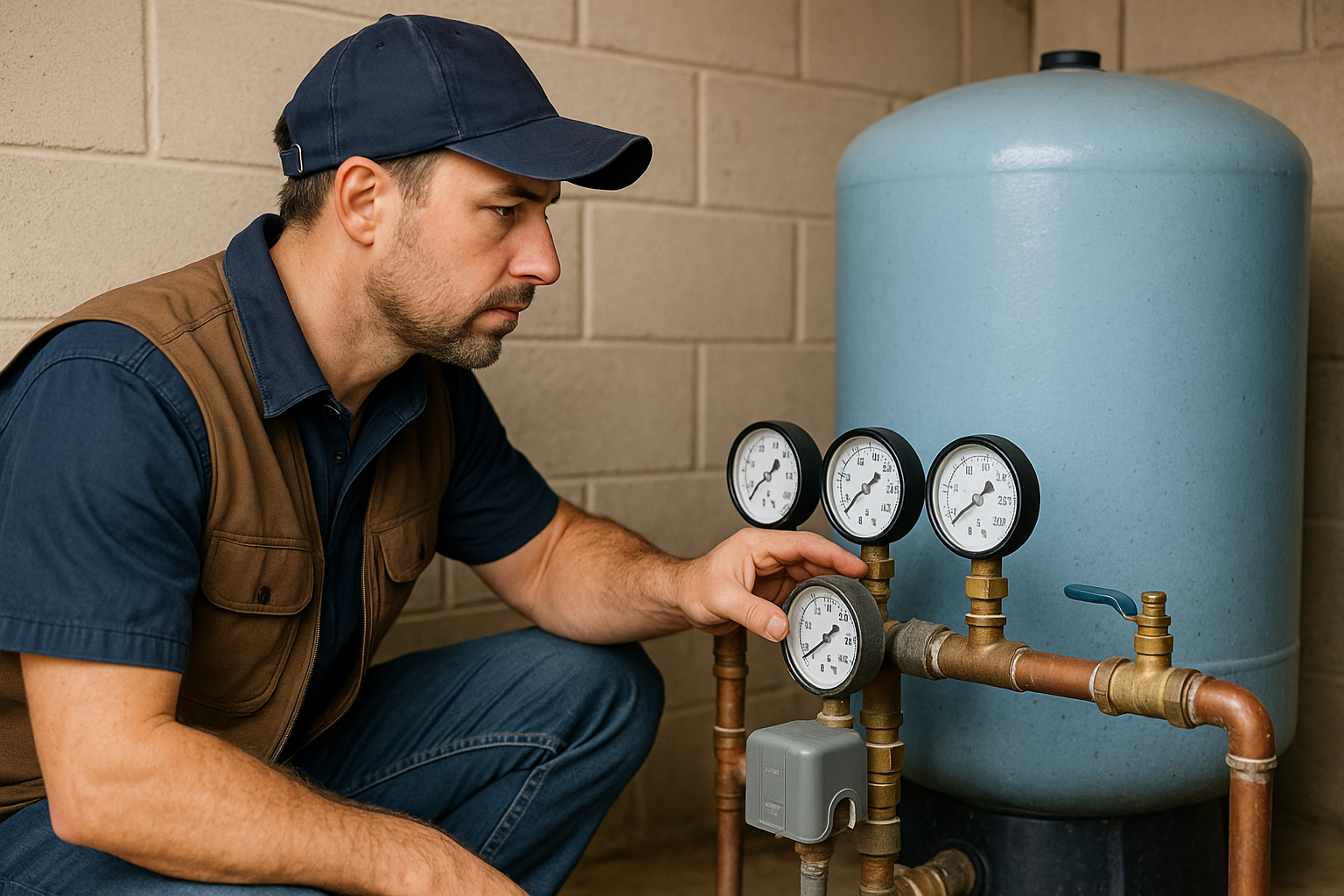
Your pressure tank is supposed to be your first line of defense against water hammer. The air bladder acts as a cushion, absorbing sudden pressure changes. When the tank is waterlogged:
- No air cushion means no shock absorption
- Every pressure spike hits the system at full force
- Pump short cycles, creating more start/stop events
- Each event creates hammer
Learn more about pressure tank problems and short cycling.
5. High System Pressure
The higher your water pressure, the worse the hammer. Water at 80 PSI has significantly more kinetic energy than water at 40 PSI:
- Ideal residential pressure: 40-60 PSI
- Maximum recommended: 70-80 PSI
- Above 80 PSI: Hammer is much more severe, fixtures and appliances wear faster
6. Loose or Unsecured Pipes
Water hammer causes pipes to physically move. If pipes aren't properly secured:
- They bang against walls, joists, or each other
- Movement stresses joints and connections
- Sound is amplified throughout the house
- Long-term movement causes leaks
7 Solutions to Stop Water Hammer
1. Install Water Hammer Arrestors
Water hammer arrestors are purpose-built devices containing a sealed air chamber (or piston) that absorbs pressure shockwaves:
Where to Install Arrestors
- • Near the pressure tank: Protects entire system from pump-related hammer
- • At washing machine connections: Both hot and cold lines
- • At dishwasher supply: Behind the unit
- • Near irrigation valves: Especially manifold locations
- • At problem fixtures: Anywhere you hear hammer
Cost: $15-$50 per arrestor, $100-$400 total for professional installation of multiple units.
2. Replace or Upgrade Check Valves
If your check valve is slamming, upgrade to a slam-free design:
| Check Valve Type | Hammer Reduction | Best For |
|---|---|---|
| Spring-loaded | Good | General well systems |
| Silent/non-slam | Excellent | Severe hammer problems |
| Slow-closing | Excellent | High-flow systems |
| In-line spring | Good | Tight spaces, retrofit |
Cost: $50-$200 for valve, $200-$500 installed.
3. Fix or Replace Your Pressure Tank
If your pressure tank is waterlogged, it's providing zero shock absorption. Two solutions:
- Recharge the air: If the bladder is intact, add air through the valve stem ($75-$150 service call)
- Replace the tank: If the bladder has failed ($400-$1,500 installed)
A properly working pressure tank dramatically reduces water hammer. See our pressure tank replacement guide.
4. Install a Pressure Reducing Valve (PRV)
If your system pressure exceeds 60-70 PSI, a PRV reduces incoming pressure to a safer level:
- Reduces kinetic energy of moving water
- Less severe hammer when valves close
- Protects fixtures and appliances
- Reduces water waste
Cost: $200-$400 installed.
5. Add an Expansion Tank
Beyond your main pressure tank, a small expansion tank near the water heater absorbs thermal expansion and provides additional hammer protection:
- Absorbs pressure spikes from heater cycling
- Provides extra system cushioning
- Required by code in many areas for closed systems
Cost: $150-$400 installed.
6. Secure Loose Pipes
Properly securing pipes won't eliminate hammer, but it reduces noise and damage:
- Add pipe straps every 4-6 feet on horizontal runs
- Use cushioned hangers to reduce transmitted vibration
- Secure pipes at changes in direction
- Check connections in walls and ceilings
Cost: $50-$200 DIY, $150-$400 professional.
7. Upgrade to a Variable Speed Pump (Constant Pressure System)
The ultimate hammer solution: variable speed pumps don't create the abrupt start/stop events that cause most well system hammer:
- Soft start—pump ramps up gradually instead of instant full speed
- Continuous operation—runs constantly at varying speeds rather than cycling on/off
- Soft stop—ramps down when demand decreases
- Eliminates pump-related hammer almost entirely
Cost: $2,500-$5,000 for complete system upgrade.
⚡ Solution Quick Comparison
| Solution | Effectiveness | Cost | DIY? |
|---|---|---|---|
| Hammer arrestors | Good for fixtures | $100-$400 | Yes |
| Better check valve | Good for pump hammer | $200-$500 | No |
| Fix pressure tank | Good overall | $75-$1,500 | No |
| PRV installation | Moderate | $200-$400 | No |
| Expansion tank | Moderate | $150-$400 | Maybe |
| Secure pipes | Reduces noise/damage | $50-$400 | Yes |
| Variable speed pump | Excellent | $2,500-$5,000 | No |
When to Call a Professional
While some hammer fixes are DIY-friendly, call a professional if:
- Hammer is severe or worsening
- You've noticed leaks developing
- Hammer started suddenly (may indicate system failure)
- You suspect pressure tank or pump issues
- The check valve needs replacement (requires pulling the pump)
- You want a proper system evaluation
Frequently Asked Questions
What causes water hammer in well pump systems?
Water hammer in well systems is caused by sudden changes in water flow—when the pump starts or stops abruptly, when valves close quickly, or when check valves slam shut. The moving water has momentum, and when suddenly stopped, creates a pressure shockwave that travels through the pipes, causing the banging sound.
Can water hammer damage my well pump or plumbing?
Yes, water hammer causes significant damage over time. The pressure spikes can be 5-10 times normal operating pressure, which stresses pipe joints, loosens fittings, damages valves, can rupture pipes, harms pump seals and impellers, and shortens the life of appliances like water heaters and washing machines.
Why does my well pump cause pipes to bang when it shuts off?
When the pump stops, water that was flowing suddenly has nowhere to go. If there's no check valve, water may rush back toward the pump until it hits the closed pump outlet, creating a hammer. With a check valve, the valve may slam shut violently when flow reverses. Both scenarios create the banging noise.
What is a water hammer arrestor and do I need one?
A water hammer arrestor is a device containing a sealed air chamber that absorbs pressure shockwaves. When water suddenly stops, instead of hammering the pipes, it compresses the air in the arrestor. Most well systems benefit from arrestors installed near the pressure tank and at quick-closing valves.
Will a bigger pressure tank help with water hammer?
Yes, a properly sized pressure tank with adequate air charge acts as a large shock absorber for the entire system. Undersized or waterlogged tanks provide little cushioning, making water hammer worse. However, a proper tank alone may not eliminate hammer—you may still need arrestors at specific locations.
How do I stop water hammer when my washing machine fills?
Washing machines have quick-closing solenoid valves that are notorious for causing water hammer. Install water hammer arrestors on both hot and cold supply lines to the washer. These small devices absorb the shock when the valves snap shut. Most hardware stores carry washing machine arrestors for $15-$30 each.
Can high water pressure cause water hammer?
Yes, high water pressure makes hammer worse. The higher the pressure, the more force in the moving water, and the bigger the shockwave when flow stops. If your system pressure exceeds 60-70 PSI, consider installing a pressure reducing valve. This also protects appliances and reduces water waste.
How much does it cost to fix water hammer in a well system?
Water hammer fixes range from simple to complex: securing loose pipes costs $50-$200, installing hammer arrestors costs $100-$400, replacing check valves costs $200-$500, recharging/replacing pressure tank costs $75-$1,500, installing a pressure reducing valve costs $200-$400, and adding expansion tanks costs $150-$400.
Tired of Banging Pipes?
Water hammer is more than annoying—it's slowly damaging your entire plumbing system. Our technicians can evaluate your well system, identify the hammer sources, and recommend the most cost-effective solutions. We serve all of San Diego and Riverside Counties.