SC By SCWS Team | February 3, 2026 | 10 min read
Well Pump Keeps Tripping Breaker: 8 Causes & How to Fix
Your well pump trips the breaker. You reset it. It trips again. This frustrating cycle isn't just annoying—it's a warning sign that something is seriously wrong. Circuit breakers exist to prevent fires and equipment damage, so when one keeps tripping, it's doing its job protecting you from something dangerous. Let's find out what's causing it and how to fix it safely.
🚨 Critical Safety Rules
- • Never reset a breaker more than twice—if it trips again, leave it off
- • Never install a larger breaker—this defeats safety protection
- • Well pumps use 240V—lethal voltage requires professional caution
- • Smell burning? Leave breaker off, call immediately
Why Breakers Trip: Understanding the Basics
A circuit breaker trips when current flow exceeds its rating. For well pumps, this typically means:
Types of Breaker Trips
Overload Trip
Gradual current increase above rating. Motor working too hard (worn bearings, seized pump, restricted flow). Breaker heats up and trips after minutes to hours.
Short Circuit Trip
Instant massive current surge. Hot wire touching neutral or ground. Breaker trips immediately—often with a spark or pop.
Ground Fault Trip
Current leaking to ground (wet motor, damaged insulation). GFCI breakers trip instantly. Standard breakers may trip from resulting overload.
Thermal Trip
Motor overheating triggers internal protection OR breaker overheating from sustained high current. Trips after extended running.
8 Common Causes of Well Pump Breaker Trips
1. Bad Start Capacitor
Start capacitors provide the extra electrical "boost" motors need to begin spinning. When a capacitor fails, the motor can't generate enough starting torque and draws excessive current (called "locked rotor amps").
Signs of Capacitor Failure:
- • Breaker trips immediately or within seconds of starting
- • Pump hums loudly but doesn't start (before tripping)
- • Visible bulging, leaking, or burn marks on capacitor
- • Sometimes starts, sometimes doesn't (intermittent failure)
The fix: Replace the capacitor. This is one of the most common and affordable repairs ($100-$250 including service call). Always replace with exact specifications—voltage and microfarad ratings must match.
2. Failing Pump Motor
As pump motors age, their windings degrade. Damaged insulation allows current to leak between windings or to ground, increasing amp draw until it exceeds breaker capacity.
Signs of Motor Failure:
- • Pump runs for decreasing periods before tripping
- • Higher than normal amp readings on testing
- • Burning smell (insulation breakdown)
- • Pump is 10-15+ years old
- • History of running dry or overheating
🔍 Professional Testing
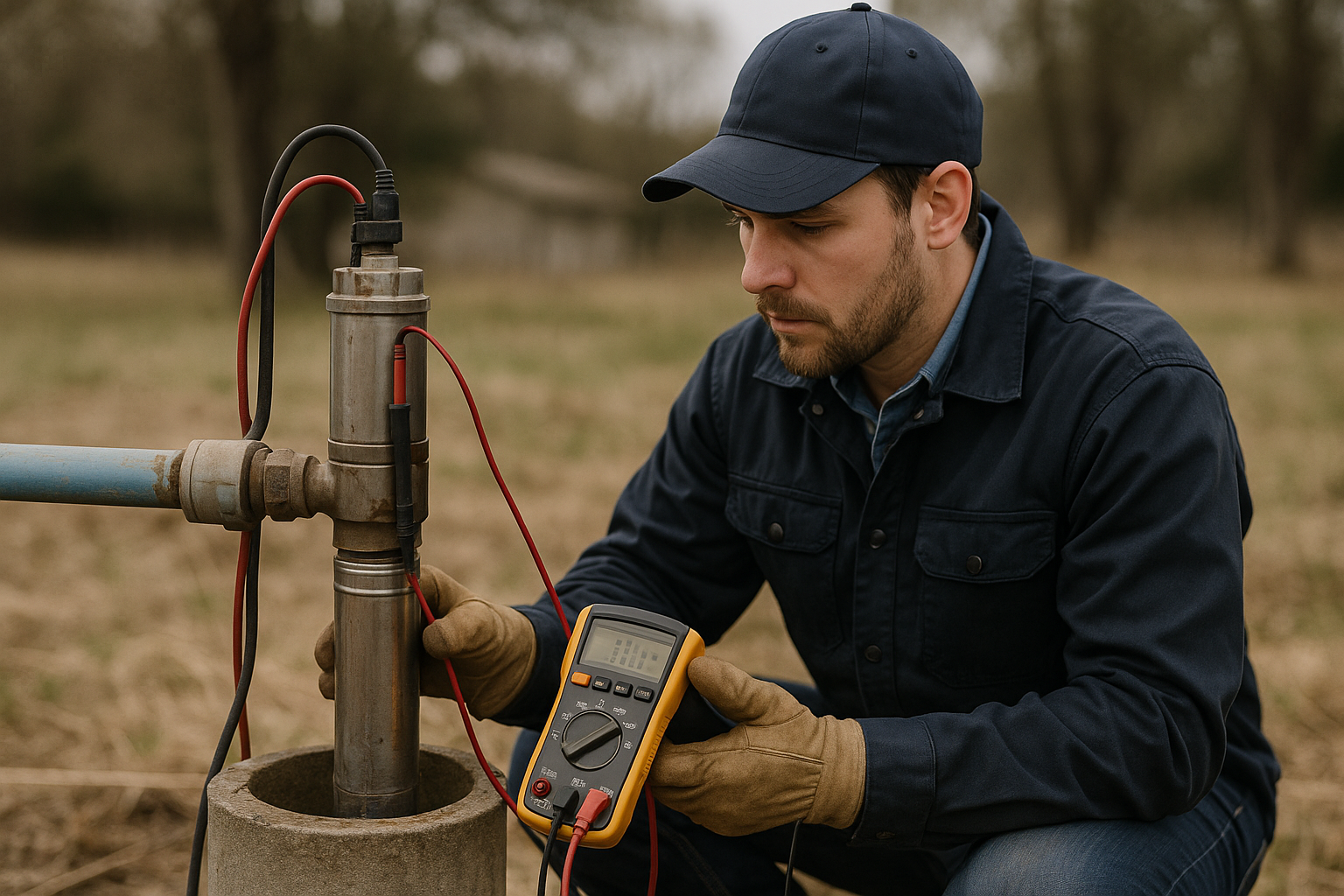
Technicians use megohm meters to test motor winding insulation resistance. Low readings (below 1 megohm to ground) confirm motor failure. Amp clamp meters verify current draw during operation.
The fix: Motor/pump replacement. For submersible pumps, this means pulling the pump from the well ($1,500-$3,500+). See our pump replacement cost guide.
3. Seized or Jammed Pump
When a pump can't physically turn—due to sand, sediment, failed bearings, or corrosion—the motor draws locked rotor current (5-7 times normal running current), instantly overloading the circuit.
Signs of Seized Pump:
- • Breaker trips instantly when turned on
- • Loud hum before trip (motor energized but can't turn)
- • History of sediment or sand in water
- • Pump wasn't used for extended period (seized from sitting)
The fix: Pump replacement is usually required. Sometimes pumps can be freed if the seizure is minor, but the underlying cause (sand entry, bearing wear) needs to be addressed.
4. Wiring Problems
Electrical wiring issues between the breaker and pump can cause trips:
- Damaged wire insulation: Allows shorts to ground or between conductors
- Corroded connections: Creates resistance, heat, and voltage drop
- Undersized wire: Heats up under load (previous incorrect installation)
- Water in conduit: Moisture causing ground faults
- Rodent damage: Chewed wires touching each other
⚠️ Underground Wiring
Submersible pump wiring runs underground and down the well—potentially hundreds of feet. Damage anywhere along this path can cause trips. Well wiring repairs can be complex and expensive.
The fix: Locate and repair damaged wiring. May be simple (tightening connections, $100-$200) or complex (replacing well drop cable, $500-$1,500+).
5. Control Box Failure (Submersible Pumps)
Submersible pump control boxes contain capacitors, relays, and overload protection. Any component failure can cause breaker trips:
- Failed capacitor: Same effect as standalone capacitor failure
- Stuck relay: Keeps power applied continuously or erratically
- Damaged overload protector: May trip prematurely or allow overcurrent
- Burned contacts: Creates arcing and heat
The fix: Replace failed control box components or entire control box ($200-$400). Much cheaper than pump replacement.
6. Pump Running Dry
Submersible pumps are cooled by the water they pump. When a pump runs dry (well water level drops below pump intake), it rapidly overheats:
- Motor temperature rises dramatically
- Winding insulation degrades from heat
- Current draw increases as windings heat
- Internal thermal protection may trip first
- Breaker trips if thermal protection doesn't
Signs of Dry Running:
- • Trips during periods of heavy water use
- • Air sputtering from faucets before trip
- • Trips more often during dry season
- • Pump works fine after "resting" for hours
The fix: Address the low water level. Options include lowering the pump, installing a low-water cutoff switch, adding storage tanks, or well rehabilitation. See wells running out of water.
7. Short Cycling Overheating
When a pump short cycles (turns on/off rapidly), each start generates significant heat. Without adequate cooling time between cycles, the motor overheats:
- Starting current is 5-7x running current
- Motor doesn't get time to cool between starts
- Cumulative heat builds up in windings
- Eventually trips thermal protection or breaker
The fix: Address the cause of short cycling (usually a waterlogged pressure tank). See pump short cycling causes.
8. Bad Breaker
Sometimes the breaker itself is the problem:
- Worn breaker: Internal mechanism weakened from age or repeated trips
- Loose connection: Creates heat at breaker terminals
- Wrong breaker type: Not rated for motor loads
- Undersized breaker: Originally installed incorrectly
📋 Breaker Sizing for Well Pumps
Well pump breakers should be 150-200% of the motor's full load amps (FLA) to accommodate starting current. A 10-amp pump typically needs a 20-amp breaker. Check the pump nameplate for FLA rating.
The fix: Have an electrician test and replace the breaker if faulty ($75-$200). Never self-diagnose by installing a larger breaker.
🔍 Diagnostic Flowchart
When does it trip?
→ Instantly: Short circuit, seized pump, or bad capacitor
→ After seconds: Capacitor, locked rotor, or severe overload
→ After minutes/hours: Motor overheating, dry running, or short cycling
Does the pump make noise before tripping?
→ Loud humming, no water: Seized pump or bad capacitor
→ Normal running sound: Motor failure or dry running
→ Clicking: Short cycling, pressure tank issue
Any visible signs?
→ Burning smell: Motor or wiring failure—serious
→ Bulged capacitor: Capacitor failure
→ Scorched wires: Connection or wiring problem
What NOT to Do
🚫 Install a Larger Breaker
This defeats the safety protection. Wires could overheat and start a fire before the oversized breaker trips.
🚫 Keep Resetting Repeatedly
Each reset potentially causes more damage. Two resets max—then call for help.
🚫 Bypass Safety Devices
Never jumper around thermal protection, control boxes, or safety switches.
🚫 DIY 240V Troubleshooting
Unless you're a trained electrician, leave 240V diagnosis to professionals. It can kill.
Repair Cost Summary
| Problem | Solution | Typical Cost |
|---|---|---|
| Failed capacitor | Replace capacitor | $100-$250 |
| Control box failure | Replace control box | $200-$400 |
| Wiring connections | Repair/tighten | $100-$200 |
| Well drop cable | Replace cable | $500-$1,500 |
| Bad breaker | Replace breaker | $75-$200 |
| Waterlogged tank | Recharge/replace | $75-$1,500 |
| Failed pump motor | Replace pump | $1,500-$3,500+ |
Frequently Asked Questions
Why does my well pump keep tripping the breaker?
Well pumps trip breakers when they draw more current than the circuit can safely handle. Common causes include a failing pump motor (drawing excessive amps), bad start capacitor, seized pump, wiring problems, undersized breaker, ground fault, or the pump overheating from running dry or short cycling. The breaker is protecting you from fire—the underlying cause needs to be fixed.
Is it safe to keep resetting the breaker when my well pump trips it?
No. Each time a breaker trips and you reset it, you're allowing potentially dangerous current to flow again. If the breaker trips immediately upon reset, there's a serious fault that could cause fire or equipment damage. Never reset more than twice. If it trips again, leave it off and call a professional.
My well pump runs fine for a while then trips. Why?
When a pump runs then trips after some time, it usually indicates the motor is overheating. Causes include a failing motor with damaged windings, pump running dry (low water level), short cycling causing heat buildup, or inadequate ventilation around the motor. The thermal overload or breaker trips to prevent fire.
Can a bad capacitor cause my well pump to trip the breaker?
Yes. Start capacitors help motors generate the initial torque needed to start. When a capacitor fails, the motor struggles to start and draws excessive current (locked rotor amps), which trips the breaker. Capacitors are common failure points and relatively inexpensive to replace ($50-$150).
Should I install a larger breaker to stop the tripping?
Absolutely not. The breaker size is matched to the wire gauge and pump requirements for safety. Installing a larger breaker defeats this protection and creates a fire hazard—the wires could overheat before the oversized breaker trips. Always fix the underlying problem, never the symptom.
How do I know if my well pump motor is failing?
Signs of a failing motor include tripping breakers, humming without starting, running hot, reduced water pressure/flow, higher than normal amp draw, visible damage to wiring, burning smell, or the pump is over 10-15 years old. A technician can test amp draw and insulation resistance to confirm motor condition.
What causes a well pump to trip immediately when turned on?
Instant trips indicate a dead short or severe overload: direct short circuit in wiring or motor, completely seized pump, failed capacitor, or wrong breaker size. This is a serious fault requiring professional diagnosis. Do not keep resetting—the fault needs to be found and repaired before powering the circuit.
How much does it cost to fix a well pump that keeps tripping the breaker?
Costs vary by cause: capacitor replacement costs $100-$250, control box replacement costs $200-$400, wiring repair costs $150-$500, breaker replacement costs $75-$200, and pump motor replacement costs $1,500-$3,500+. A diagnostic service call typically costs $100-$200 to identify the specific problem.
Well Pump Tripping Your Breaker?
Don't keep resetting and hoping for the best. Our technicians safely diagnose electrical issues and can often identify the problem over the phone before arriving. We serve all of San Diego and Riverside Counties with same-day emergency service.