Well Pump Short Cycling: Causes, Diagnosis & Fixes
Short cycling is when your well pump turns on and off every few seconds to a minute instead of running for several minutes at a time. It's one of the most common — and most destructive — well system problems we diagnose. Left unchecked, short cycling can burn out a $3,000+ submersible pump in a matter of months.
The good news: in about 70% of the short-cycling calls we respond to across San Diego County, the fix is a pressure tank replacement ($500-$1,200) rather than a pump replacement. The key is diagnosing the actual cause before throwing money at the wrong component.
What Exactly Is Short Cycling?
A properly functioning well system works like this: when you open a faucet, water flows from the pressure tank. As the tank depletes, pressure drops to the "cut-in" point (usually 30 or 40 PSI), the pressure switch activates the pump, and the pump runs for several minutes until the tank refills to the "cut-out" point (usually 50 or 60 PSI). A healthy system might cycle 4-8 times per hour during normal use.
Short cycling means the pump is cycling 20, 30, even 60+ times per hour. You'll hear it: click-on, hum for 15-30 seconds, click-off, pause, click-on again. The pressure gauge may bounce rapidly between a narrow range.
Why this is urgent: Every pump startup draws 3-5× the normal running amperage. That inrush current generates enormous heat in the motor windings. A pump rated for 8 starts per hour being forced to start 40 times per hour is experiencing 5× the thermal stress. Motor winding insulation breaks down, bearings overheat, and the pump fails prematurely.
Cause #1: Waterlogged Pressure Tank (Most Common)
This accounts for roughly 60-70% of the short-cycling cases we see. Here's what happens:
Inside your pressure tank is a rubber bladder that separates an air charge from the water. The air acts as a spring — it compresses as the tank fills and pushes water out as you use it. This air cushion is what allows the tank to deliver 10-20+ gallons of water between pump cycles.
When the bladder ruptures (they typically last 5-10 years), the air and water mix. The air gradually gets absorbed into the water or bled off through fixtures. Now your 44-gallon pressure tank effectively holds less than a gallon of usable drawdown. Every time you open a faucet, pressure drops instantly, and the pump has to kick on.
How to Confirm a Waterlogged Tank
- The tap test: Tap the side of the tank from top to bottom with your knuckles. A healthy tank sounds hollow (air) in the upper portion and solid (water) in the lower portion. A waterlogged tank sounds solid almost all the way up.
- The Schrader valve test: There's a tire-valve-style fitting at the top of the tank. With the pump off and a faucet open to relieve pressure, press the pin. You should get a steady hiss of air. If you get a spray of water, the bladder is blown.
- The weight test: A waterlogged 44-gallon tank weighs about 400 pounds. Try rocking it. If it doesn't budge, it's probably full of water.
Fix: Replace the pressure tank. A standard 44-gallon bladder tank runs $500-$800 installed. An 86-gallon tank (recommended for families of 4+ or homes with irrigation) runs $800-$1,200 installed. This is a straightforward job that takes 1-2 hours.
Cause #2: Incorrect Pressure Tank Air Charge
Even with a good bladder, the wrong air charge causes problems. The air pre-charge should be set to 2 PSI below your cut-in pressure. For a standard 30/50 system, that's 28 PSI. For a 40/60 system, that's 38 PSI.
- Air charge too low: The tank can't push water out effectively. Most of the tank's capacity sits below the usable pressure range, and the pump cycles too often.
- Air charge too high: The air pushes against the incoming water, reducing how much the tank can store. Same result — rapid cycling.
- No air charge: Same as a waterlogged tank, even if the bladder is fine.
Fix: Turn off the pump. Open a faucet to drain the tank completely. Check the air charge with a standard tire gauge at the Schrader valve on top. Adjust with a bicycle pump or small compressor. This is free and takes 10 minutes — check it every 6 months.
Cause #3: Failing Pressure Switch
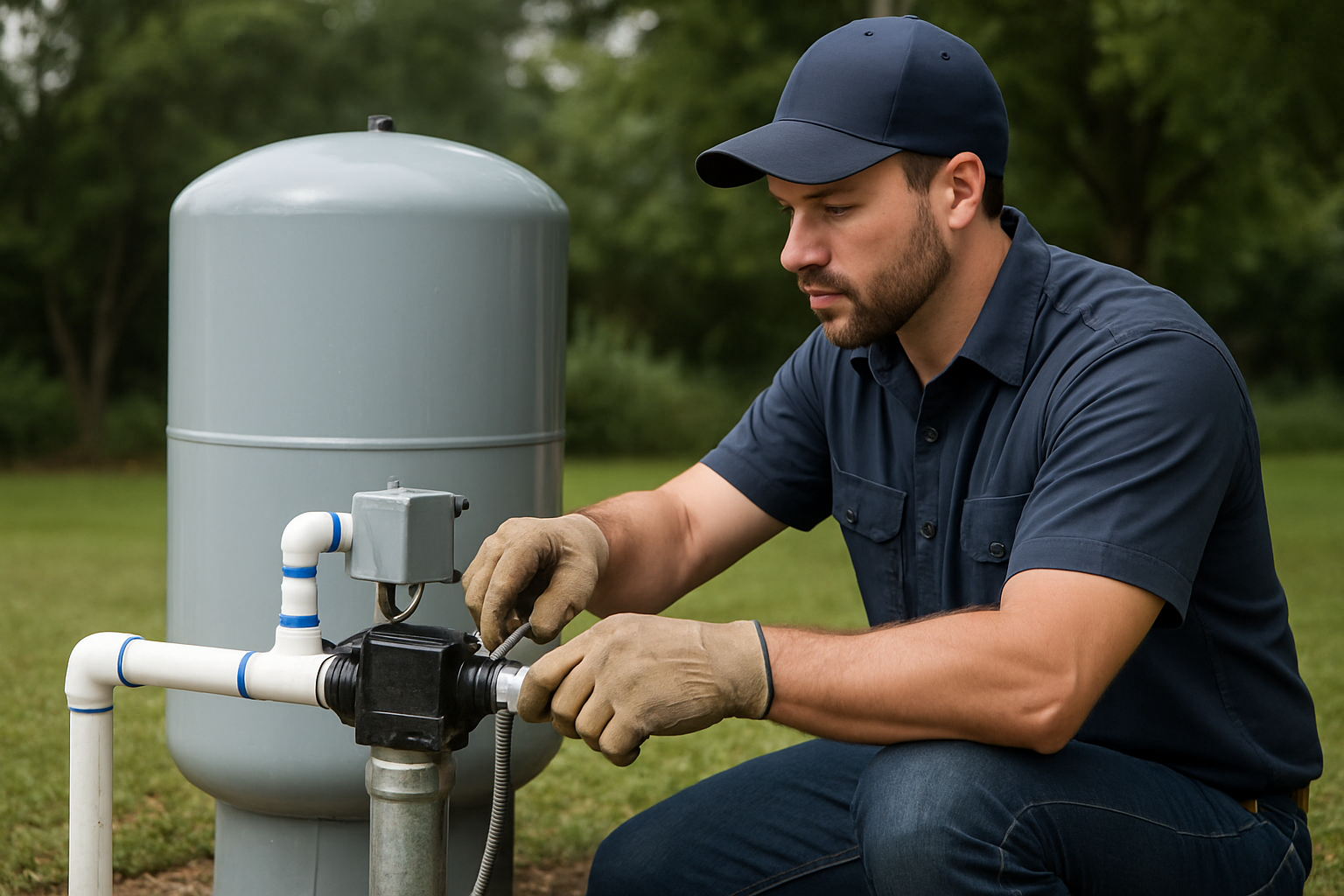
The pressure switch is a small device mounted on a tee near the pressure tank. It has internal contacts that close (pump on) at the cut-in pressure and open (pump off) at the cut-out pressure. When these contacts deteriorate:
- Pitted contacts can cause erratic switching — the pump turns on and off rapidly as contacts make and break connection
- Clogged sensing port — mineral buildup blocks the tiny tube that senses water pressure, causing the switch to misread pressure and cycle erratically
- Incorrect adjustment — if the cut-in and cut-out pressures are too close together (less than 20 PSI spread), the pump cycles through the range too quickly
Fix: Pressure switch replacement is $150-$300 installed. It's a quick job. We carry common switches on every service truck.
Cause #4: Leak in the System
A leak anywhere between the pump and your fixtures causes the system to lose pressure, triggering the pump. Leaks can be:
- Above ground: Running toilet (the #1 hidden water waster), dripping faucet, leaking water heater, irrigation valve stuck open. Check by turning off all water use and watching the pressure gauge — if it drops, you have a leak.
- Underground: Cracked pipe between well and house, leaking fitting at the wellhead. Harder to find. Look for soggy patches in the yard between the well and the house.
- In the well: Cracked drop pipe or leaking check valve. Water runs back down the well when the pump stops, pressure drops, and the pump kicks back on.
Toilet test: A single running toilet can waste 200+ gallons per day and cause constant pump cycling. Put food coloring in the toilet tank. If color appears in the bowl within 15 minutes without flushing, the flapper is leaking. A $5 flapper valve can stop $3,000 in pump damage.
Cause #5: Check Valve Failure
Check valves are one-way valves installed in the drop pipe inside the well. They prevent water from flowing back down the well when the pump stops. When a check valve fails:
- Pump shuts off at cut-out pressure
- Water immediately starts draining back down the well through the failed valve
- System pressure drops within seconds
- Pressure switch triggers the pump back on
- Cycle repeats endlessly
Telltale sign: If you hear a "thud" or water hammer sound every time the pump shuts off, the check valve is probably failing — water is slamming back against the pump when it reverses direction. Fix: Requires pulling the pump to access the check valve(s). $150-$400 for the valve itself, plus $800-$1,500 for the pump pull. Since you're already pulling the pump, we check everything else while it's out.
Cause #6: Undersized Pressure Tank
Many older homes in San Diego County have pressure tanks that were sized for the original household but are now inadequate. A 20-gallon tank that was fine for a retired couple becomes a short-cycling machine when a family of five moves in and adds irrigation.
The rule of thumb: your tank should provide at least 1 gallon of drawdown per GPM of pump capacity. A 10 GPM pump needs a tank with at least 10 gallons of drawdown (that's roughly a 32-gallon tank). For comfort and pump protection, we recommend oversizing by 50-100%.
Fix: Upgrade to a larger tank. Going from a 20-gallon to an 86-gallon tank is one of the best investments you can make for your well system. Cost: $800-$1,200 installed. Dramatically reduces pump cycling and extends pump life.
Cause #7: Pump Can't Build Pressure (Worn Pump)
If the pump itself is worn out, it may not be able to push water up to the cut-out pressure. The pump runs and runs, pressure slowly builds to maybe 45 PSI in a 30/50 system but never reaches the 50 PSI cut-out point. Eventually the pressure switch's low-pressure safety kicks off the pump, pressure drops, and the cycle starts over.
This is the least common cause of short cycling but the most expensive to fix. If your pump runs for extended periods without reaching cut-out pressure, the impellers are likely worn. Fix: Pump replacement. $1,500-$5,000 depending on well depth.
How to Diagnose Short Cycling: Step by Step
- Time the cycles. How long does the pump run? How long between cycles? Note these for your technician.
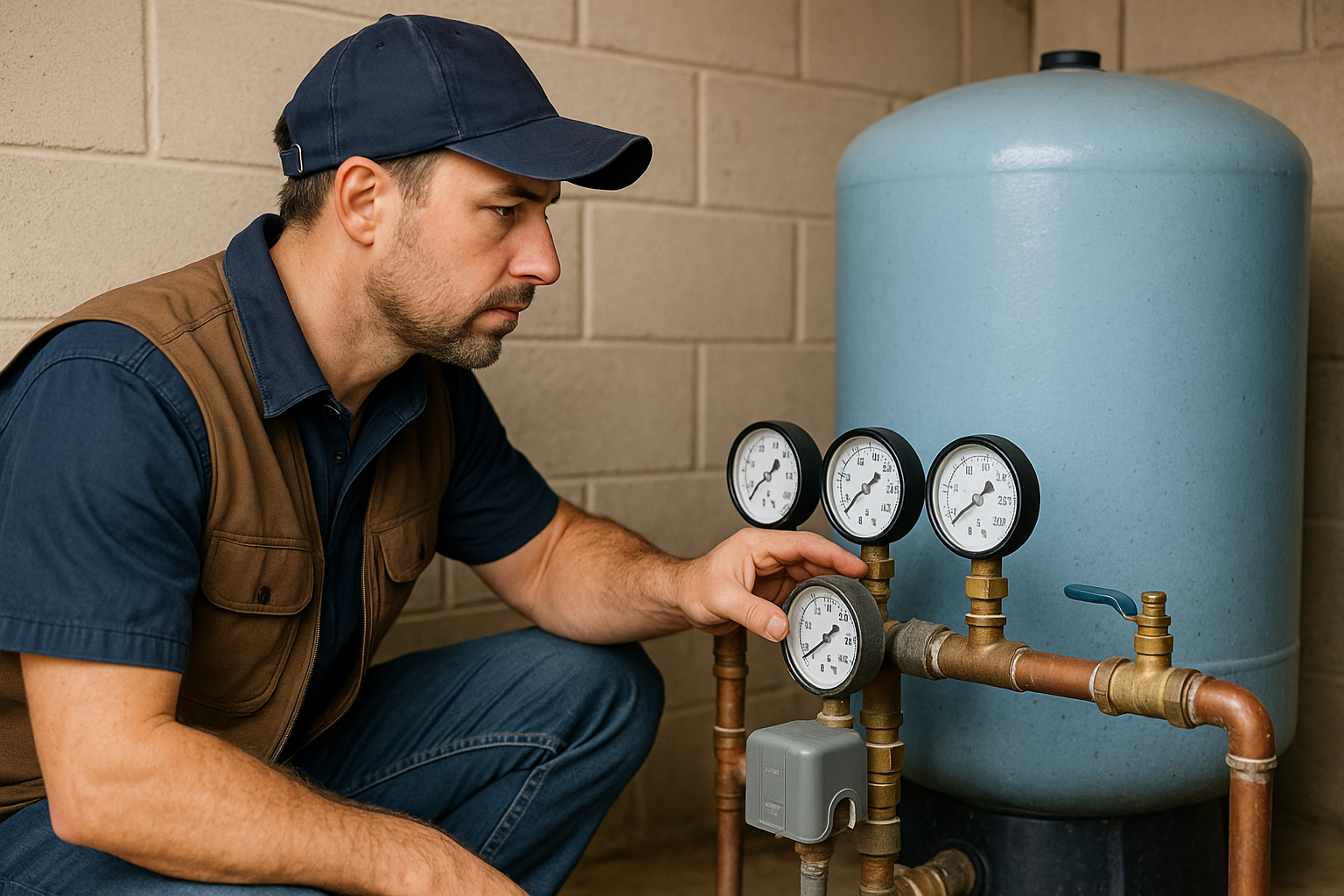
- Watch the pressure gauge. What's the pressure when the pump kicks on? When it shuts off? Is the range normal (20 PSI spread) or narrow?
- Check the pressure tank. Do the tap test and Schrader valve test described above.
- Turn off all water use. If the pump still cycles with nothing running, you have a leak somewhere.
- Check for running toilets. The food coloring test. Do this before calling anyone.
- Listen for water hammer. A thud when the pump shuts off points to a check valve issue.
Cost Summary: Short Cycling Fixes
| Cause | Typical Fix Cost | Frequency |
|---|---|---|
| Waterlogged pressure tank | $500–$1,200 | ~60-70% of cases |
| Wrong air charge | Free (DIY) | ~10% |
| Bad pressure switch | $150–$300 | ~8% |
| System leak | $0–$500+ | ~7% |
| Failed check valve | $1,000–$1,900 | ~5% |
| Undersized tank | $800–$1,200 | ~5% |
| Worn pump | $1,500–$5,000 | ~5% |
Notice that the cheapest fixes are also the most common. That's why proper diagnosis matters — we've seen homeowners spend $4,000 on a new pump when a $700 pressure tank was the actual problem.
Pump Short Cycling? Get It Diagnosed Right.
We carry diagnostic equipment and common parts on every truck. Most short-cycling problems can be identified and fixed in a single visit. Serving all of San Diego, Riverside, and San Bernardino counties.
Call (760) 440-8520