Air Spurting From Faucets: Diagnosing Air in Well Lines | SCWS
Air bursting from your faucets when you turn them on? Learn what causes air in well water lines—from dropping water levels to failing pumps—and how to fix it properly.
📋 In This Guide
See our air leak services.
(760) 440-8520Understanding Air in Your System
Some air in well water is normal—groundwater contains dissolved gases that can come out of solution when pressure changes at the faucet. However, excessive air causing sputtering, spitting, and inconsistent flow indicates a problem. The air is either being pulled into the system through a leak, sucked in by the pump, or accumulating due to a failing component. Pay attention to when it happens: all the time, only at startup, during heavy use, or at specific fixtures. This pattern helps diagnose the cause.
Dropping Water Level Problems
If your water level has dropped below or near the pump intake, the pump draws air along with water. This happens during drought, over-pumping, or as aquifers deplete. Symptoms include intermittent air spurts (worse during heavy use), reduced flow rate, and the pump running longer. Verify by measuring your static water level if you have access. Solutions include lowering the pump deeper, restricting flow to let the well recover, or in severe cases, drilling a deeper or new well. A pump running dry can burn out quickly.
Pipe and Fitting Leaks
A crack, loose fitting, or bad seal in the piping between your pump and pressure tank can allow air to enter. Look for wet spots near pipe joints, listen for hissing sounds, and check fittings for corrosion. The drop pipe inside the well is a common failure point—PVC can crack, and threaded joints can work loose over time. Pitless adapter seals also fail. These leaks may not be visible since they're pulling air in rather than leaking water out. A well service professional can pressure test the system to locate leaks.
Pump and Check Valve Issues
Worn pump impellers cavitate, creating air bubbles in the water. A failing foot valve or check valve lets the water column drain back down the well between cycles—when the pump restarts, it pushes air ahead of the water. Signs of valve failure: pressure drops immediately after pump stops, pump runs briefly/stops/runs again, air clears after the first few seconds of flow. Check valves are accessible and replaceable. Pump impeller wear requires pulling and rebuilding or replacing the pump.
We service all major pump brands including Franklin Electric, Grundfos, Goulds (Xylem), and Sta-Rite (Pentair). Our trucks carry common parts and components for same-day repairs.
Waterlogged Pressure Tank
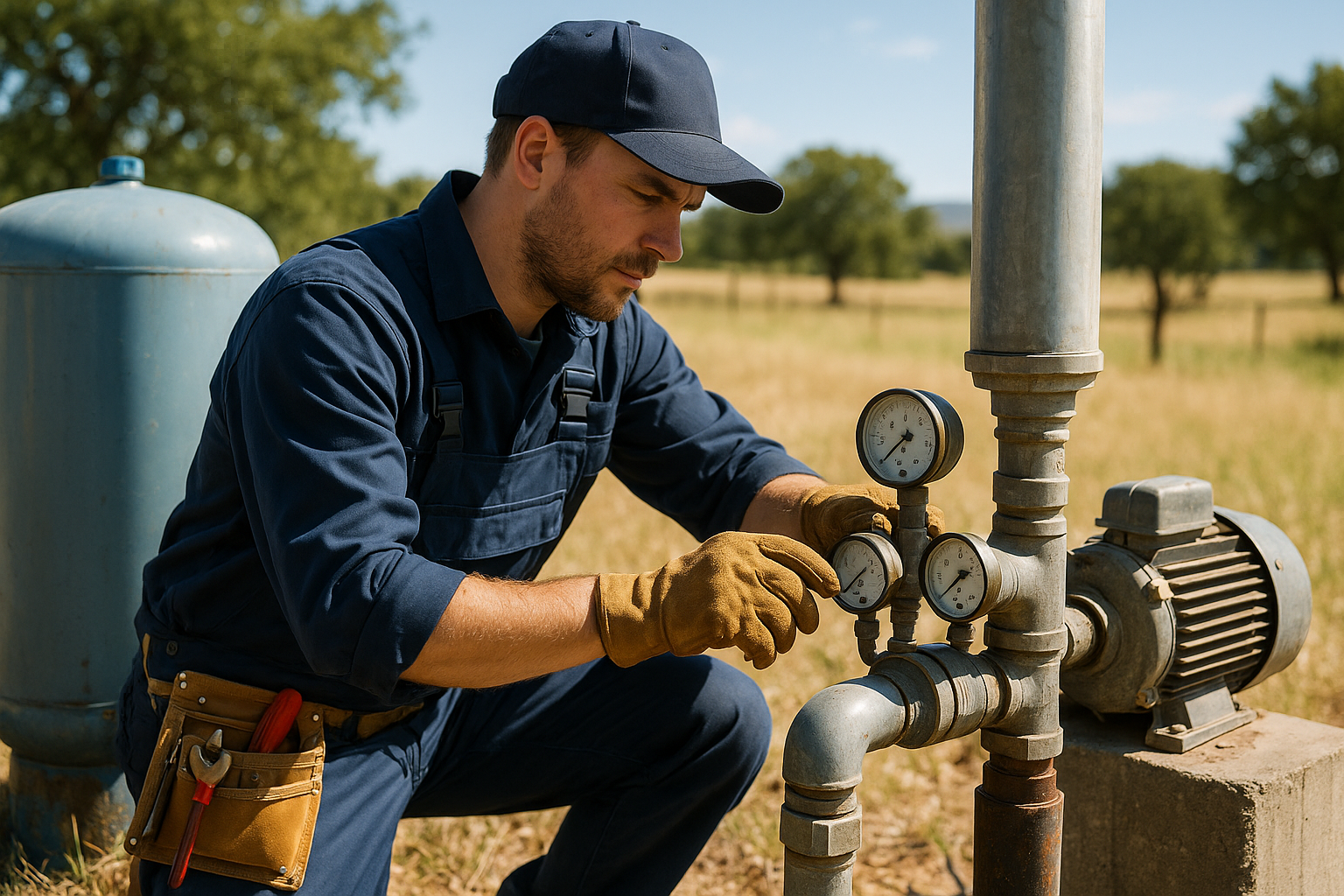
A waterlogged pressure tank is one of the most overlooked causes of air-related problems at the faucet. Inside a standard bladder tank, an air cushion (pre-charged to about 2 PSI below your cut-in pressure) separates the air from the water. When the bladder ruptures or loses its charge, the tank fills completely with water—no air cushion remains to maintain steady pressure.
The result is rapid-cycling: the pump kicks on for a few seconds, shuts off, kicks back on almost immediately. Each short cycle can introduce small bursts of air into the lines, especially if the pump is drawing from near the water surface in the well. You'll also notice pressure spikes and drops—a surge when the pump starts, then pressure immediately falling when it stops.
How to check: Tap the side of your pressure tank from top to bottom. A properly functioning tank sounds hollow (air) in the upper portion and solid (water) in the lower portion. If it sounds solid all the way up, it's waterlogged. You can also press the Schrader valve on top—if water comes out instead of air, the bladder has failed.
A waterlogged tank can usually be fixed by replacing the bladder (on serviceable tanks) or replacing the entire tank. Standard residential tanks like the Well-X-Trol WX-302 (85 gallons) or Flexcon FL-12 run between $350–$800 installed depending on size. We recommend replacing rather than re-bladdering for tanks over 8 years old, since the tank shell may also be corroding internally.
While a waterlogged tank isn't the direct cause of air in the water, the rapid cycling it creates stresses the pump, check valves, and fittings—which leads to the air leak problems described above. Fix the tank first, then check if the air issue resolves before chasing other causes.
Methane and Dissolved Gases
In some areas of Southern California—particularly in the Inland Empire foothills, parts of Anza, and near old oil or gas activity—well water can contain dissolved methane or other gases. Unlike mechanical air leaks, these gases are naturally present in the aquifer and come out of solution when the water hits atmospheric pressure at your faucet.
Signs of dissolved gas vs. mechanical air:
- The air appears as tiny uniform bubbles (like carbonation), not large spurts
- Water looks milky or cloudy for a few seconds, then clears from the bottom up
- It happens consistently at every fixture, every time—not intermittently
- No correlation with pump cycling or heavy usage
- You may notice a slight sulfur or petroleum-like odor
Dissolved methane above 28 mg/L is considered an explosion hazard by the California Department of Water Resources and requires a venting system. Even at lower concentrations (7–28 mg/L), an aeration or venting treatment system is recommended. A simple water test from a certified lab (around $75–$150) will tell you exactly what gases are present and at what concentrations.
If methane is confirmed, treatment options include spray aeration systems ($2,000–$4,000 installed), packed tower aerators for higher concentrations, or in extreme cases, drilling a new well into a different aquifer zone. We've handled methane issues in wells throughout Riverside and San Bernardino counties and can recommend the appropriate treatment based on your test results.
Step-by-Step Diagnostic Guide
Before calling a professional, you can narrow down the cause yourself with this systematic approach. Work through these steps in order—each one eliminates a possible cause.
Step 1: Observe the Pattern
Run every faucet in the house, one at a time. Note when the air appears:
- Only at startup (first use of the day): Likely a check valve or foot valve issue—water drains back overnight and air fills the void
- During heavy use (multiple fixtures running): The well can't keep up. Water level is dropping below the pump intake during draw-down
- Constant, at every fixture: Major leak in the system, severe pump wear, or dissolved gas in the aquifer
- Only at one fixture: Local plumbing issue, not the well system. Check the aerator and supply lines to that fixture
- Intermittent, random bursts: Usually a cracked drop pipe or loose pitless adapter—air enters when conditions are right
Step 2: Check the Pressure Tank
Walk to your pressure tank and watch the pressure gauge during a pump cycle. Healthy behavior: pressure builds slowly from cut-in (typically 30–40 PSI) to cut-out (50–60 PSI) over 1–3 minutes, then holds steady as the pump shuts off. Problem signs:
- Rapid cycling (pump runs less than 30 seconds per cycle) = waterlogged tank
- Pressure drops immediately when pump stops = check valve failure
- Gauge bounces or vibrates = air in the pressure tank plumbing
- Pressure never reaches cut-out = well can't keep up or pump is worn
Step 3: Listen at the Wellhead
Go to your well casing and listen carefully. A hissing or sucking sound at the well seal indicates air is being drawn in through a bad seal. Check the sanitary seal (the cap on top of the casing) for cracks, gaps, or missing bolts. A properly sealed well should be airtight. While you're there, look for any water seeping around the base of the casing—this could indicate casing damage below grade.
Step 4: Run a Flow Test
Turn on a single faucet to a steady stream and time how long it takes for the air to clear. If it clears in 15–30 seconds and doesn't return during continuous flow, you're likely dealing with a check valve issue. If air continues during sustained flow, the problem is either at the pump level (worn impellers, low water) or a persistent leak in the piping.
Step 5: Check Your Water Level (If Possible)
If you have an air line or water level indicator, check your static water level (after the pump has been off for at least 4 hours). Compare it to your pump setting depth (this should be on your well completion report or known from the last time the pump was pulled). If the static level is within 20 feet of the pump intake, you're at risk of air entrainment during heavy draw-down.
When to Call a Professional
Some air issues are DIY-diagnosable but virtually all require professional equipment to fix. Call a well service company if:
- Air doesn't clear after bleeding the system — the cause is underground and requires specialized equipment to diagnose
- Pump is rapid-cycling — continued operation will burn out the motor ($1,200–$3,500 to replace)
- Water has turned muddy or sandy along with the air — your pump may be sucking from the bottom of the well, risking pump damage and well collapse
- You smell rotten eggs or gas — possible methane or hydrogen sulfide, both require professional testing and treatment
- Water production has dropped significantly — the well may be declining, and continued pumping can damage the aquifer zone
- You hear grinding, screaming, or banging from the well — the pump is likely cavitating or running dry. Shut it off immediately to prevent motor damage
At Southern California Well Service, our 6-ton pump rigs can pull and inspect your pump, camera the well to check water level and casing condition, pressure-test the piping, and have you back running the same day in most cases. We carry common check valves, pressure tanks, and pump components on every truck.
Typical Repair Costs
The cost to fix air in your water lines depends entirely on the cause. Here's what to expect in the San Diego, Riverside, and San Bernardino county service area as of 2026:
| Problem | Typical Cost | Notes |
|---|---|---|
| Check valve replacement | $200–$500 | Accessible above-ground valves. If the foot valve (downhole) needs replacing, add pump pull cost. |
| Pressure tank replacement | $350–$800 | Depends on tank size. 85-gallon is most common for residential. |
| Pump pull + inspection | $800–$1,500 | Includes pulling pump, inspecting impellers, checking foot valve, resetting. |
| Drop pipe repair/replacement | $1,000–$3,000 | Depends on well depth and pipe material (PVC vs. stainless steel). |
| Pump replacement (complete) | $1,800–$4,500 | Includes new pump end, motor, wire, and installation. Varies by HP and depth. |
| Lowering pump deeper | $1,200–$2,500 | If water level has dropped. May need additional drop pipe and wire. |
| Well deepening | $5,000–$15,000+ | Last resort for declining wells. Cost depends on depth and geology. |
| Methane aeration system | $2,000–$4,000 | Spray aeration most common. Packed tower for higher concentrations. |
Most air-in-water issues fall in the $200–$1,500 range. The most expensive scenario—a declining well that needs deepening—is less common but does happen, especially in areas with heavy development or drought conditions.
Preventing Air Problems
You can't prevent every air issue, but proper maintenance significantly reduces the risk:
- Annual pressure tank check: Verify the air charge with a tire gauge on the Schrader valve. It should read 2 PSI below your cut-in pressure (e.g., 28 PSI for a 30/50 system). Top off with a bicycle pump if low.
- Don't over-pump your well: If you have a low-yield well, stagger heavy water use (laundry, irrigation) rather than running everything simultaneously. This prevents draw-down below the pump.
- Replace check valves proactively: Check valves are cheap ($25–$75 for the part) but expensive to ignore. Replace the above-ground check valve every 5–7 years. The downhole foot valve should be inspected whenever the pump is pulled.
- Maintain your well seal: Inspect the sanitary seal on top of your casing annually. Replace cracked or corroded seals immediately—they cost under $50 and prevent both air intrusion and contamination.
- Monitor your water level: If your well has an air line or you know your static level, check it annually. A declining trend means you should plan ahead rather than wait for air problems to appear.
- Schedule preventive maintenance: A professional well inspection every 2–3 years catches developing issues before they become emergencies. An inspection typically costs $150–$300 and can save thousands in emergency repairs.
Frequently Asked Questions
Why is air coming out of my faucets with the water?
Air in the lines usually means: your water level has dropped below the pump intake (pump is sucking air), you have a leak in the piping between pump and tank letting air in, the pump impellers are worn causing cavitation, or there's a crack in the drop pipe. After heavy pumping, air can also enter when the well recharges. Start by checking your water level if possible.
Can a bad check valve cause air in water lines?
Yes. A failed foot valve or check valve allows water to drain back down the well when the pump stops. When the pump restarts, it pulls in air before the water column fills back up. You'll notice this pattern: air spurts when you first use water after the pump has been off a while. The air clears after running for a minute. Replacing the check valve solves this.
Is air in well water dangerous?
Air itself isn't dangerous—it's just dissolved gases coming out of solution or air being introduced mechanically. However, air in the lines can indicate serious problems: a failing pump, dropping water level, or system leaks. These underlying issues need attention. Chronic air problems also cause water hammer, wear on fixtures, and inconsistent pressure. Address the cause rather than ignoring it.
Get Expert Help
Contact Southern California Well Service for professional assistance.
Call (760) 440-8520Serving San Diego, Riverside & San Bernardino Counties
Related Articles
Continue learning about well maintenance and troubleshooting