
Booster Pump Installation in Blue Jay
Southern California Well Service provides professional booster pump installation to Blue Jay and throughout San Bernardino County. With 30+ years experience and a 4.9★ Google rating, we're the trusted choice for well owners.
📋 In This Guide
Need Booster Pump Installation in Blue Jay?
We serve Blue Jay and all of San Bernardino County. Licensed C-57 contractor with 24/7 emergency service.
Call: (760) 440-8520Our Booster Pump Installation Services
- Fast response times to Blue Jay
- Licensed, bonded, and insured (C-57 #1013597)
- Upfront pricing with no hidden fees
- Quality parts and professional workmanship
- 24/7 emergency service available
- Residential and agricultural wells
Why Blue Jay Chooses SCWS
✓ Local Expertise
We know San Bernardino County geology and wells
✓ Fast Response
Same-day service for Blue Jay
✓ Fair Pricing
Honest quotes, no surprises
✓ Quality Work
4.9★ rating, hundreds of reviews
Our Locations
Related Articles
Continue learning about well maintenance and troubleshooting

Booster Pumps in Blue Jay: Fixing Weak Water Pressure on the Mountain
Blue Jay sits high in the San Bernardino Mountains at roughly 5,200 feet, tucked along the north shore of Lake Arrowhead just off Highway 189. Living up here is wonderful, but the same terrain that gives Blue Jay its forested charm also makes household water pressure unpredictable. Whether you are on a private well farther up Daley Canyon or connected to the Lake Arrowhead Community Services District main, the steep grades, long lateral runs, and big elevation swings between the street and your home can leave faucets dribbling and showers feeling weak. A properly sized booster pump is often the most cost-effective fix. At Southern California Well Service, we have spent more than 30 years solving low-pressure problems for mountain homeowners across San Bernardino County, and we know how Blue Jay's geography shapes what works.
Why Water Pressure Runs Low in Blue Jay
Pressure is really about elevation and distance. Every foot of vertical rise costs you roughly 0.43 psi, so a home perched 80 or 100 feet above its water source can lose 35 to 45 psi before a drop ever reaches the kitchen. In a mountain community like Blue Jay, where driveways climb sharply off the main roads and parcels stack up the hillside, that loss is common. Three local factors stack up here:
- Hillside lots and switchback driveways — homes set well above the road or the well pad lose pressure to elevation before anything else happens.
- Long service lines — many Blue Jay properties sit hundreds of feet from the meter or wellhead, and friction in that long pipe run bleeds off additional pressure, especially with older galvanized lines.
- Granite and fractured bedrock wells — wells drilled into the San Bernardino Mountains' crystalline granite often produce modest, steady yields rather than gushers, so the system has little reserve pressure to spare.
Add winter draw-down, the demands of running a few fixtures at once, and the occasional second story, and it is easy to see why so many Blue Jay homeowners describe their water as "fine until two people use it."
How a Booster Pump Actually Works
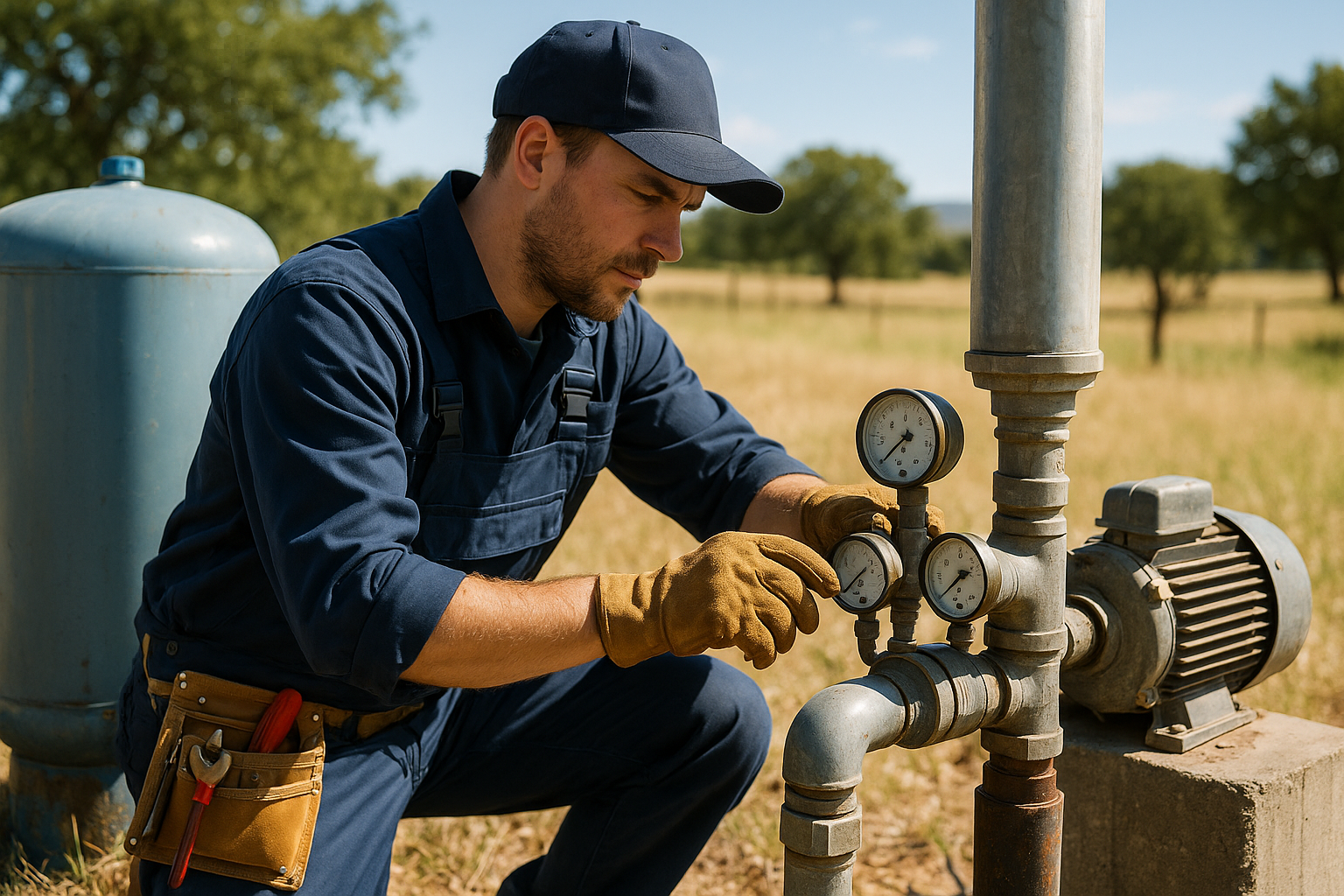
A water booster pump is an electric pump installed on your plumbing line, after the well's pressure tank or after the municipal meter, that adds pressure on demand. When you open a tap, the pump senses the drop and spins up to push water through the house at the level you set, typically 50 to 60 psi. Modern boosters use a small pressure tank and either a pressure switch or a variable-frequency drive (VFD). The VFD style, often sold as a constant-pressure system, ramps the motor up and down smoothly so you get the same firm pressure whether one fixture or four are running. That steady output is exactly what hillside Blue Jay homes need, because it compensates for elevation loss without the surging and cycling of older setups.
It is worth understanding what a booster does not do: it cannot create water that is not there. If your well is running low or your supply line is undersized, a booster will simply pull harder on a struggling source. That is why we always diagnose the whole system before recommending one.
Signs You Need a Booster Pump
- Showers lose force the moment someone runs the dishwasher, washing machine, or a second shower.
- Upstairs fixtures trickle while downstairs taps are acceptable.
- Irrigation or drip lines on the uphill side of the property barely emit water.
- Your pressure gauge reads below 40 psi, or swings wildly between cycles.
- It takes a long time for hot water to arrive, a clue your flow rate is too low.
- You added a bathroom, a casita, or a second story and pressure never recovered.
Booster Pump vs. a New Well Pump or Constant-Pressure System
Not every pressure complaint calls for the same fix, and matching the solution to the cause is where local experience pays off. Here is how we think it through for Blue Jay properties:
- A booster pump is the right call when your source has adequate water and pressure at the tank but loses it on the way to or through the house, classic for elevated lots and long runs.
- A constant-pressure (VFD) system makes sense when you want consistent pressure across changing demand and are willing to invest a little more for comfort and longer equipment life. On a well, this often replaces both the old pressure switch and the booster with a single smart controller.
- A new submersible well pump is the answer when the existing pump is undersized, worn, or failing, no amount of boosting fixes a pump that cannot lift enough water from the bedrock.
- A new or recharged pressure tank solves rapid cycling and pressure swings caused by a waterlogged bladder, sometimes that alone restores the pressure you were missing.
Picking the wrong one wastes money. We see homeowners buy a booster online only to learn the real problem was a tired well pump or a dead pressure tank. A short diagnostic up front prevents that.
Sizing a Booster Pump for Your Home
Sizing comes down to two numbers: the flow you need (gallons per minute) and the pressure you want to add. A typical Blue Jay single-family home needs 8 to 12 GPM to run simultaneous fixtures comfortably, and the boost has to cover your elevation gain plus the pressure you want at the tap. We calculate the vertical rise from your source to your highest fixture, add friction losses for the length and diameter of your service line, and then select a pump and tank that deliver firm pressure without short-cycling. Oversizing wastes electricity and wears the motor; undersizing leaves you no better off. Getting it right requires measuring your actual system, not guessing from a catalog.
What to Check Before You Call
A few quick observations help us help you faster:
- Note your pressure gauge reading at the tank, both at rest and while a tap runs.
- Time how long your well pump runs and rests, frequent rapid cycling points to a tank problem.
- Check whether low pressure affects the whole house or only the upstairs and uphill fixtures.
- Look for leaks, drips, or wet spots along the service line, especially after a hard mountain freeze.
- Know the age of your pump and tank if you can, equipment over 10 to 15 years old is often near end of life.
When to Call a Professional
Booster pumps involve electrical wiring, pressure-rated plumbing, and correct tank charging, and in a mountain community a botched install can mean burst lines in a freeze or a burned-out motor within a season. A C-57 licensed contractor will confirm your source can support a booster, size the equipment to your home, protect the motor with the right controls, and make sure everything is freeze-protected for Blue Jay winters. We also pressure-test the finished system so you know it performs before we leave.
Cost of Booster Pump and Pressure Solutions
Every home is different, but these ranges give Blue Jay homeowners a realistic idea of what to budget:
- Constant-pressure or booster pump system: $2,000 to $4,500 installed, depending on flow rate, controls, and plumbing modifications.
- Pressure tank replacement: $600 to $1,500, often the fix when the real issue is cycling rather than low source pressure.
- New well pump: $2,500 to $5,500, when the underlying pump is the limiting factor.
- Diagnostic visit: $125, credited toward any work we perform.
We give upfront, written quotes after we see the system, so there are no surprises.
Serving Blue Jay and the Surrounding Mountain Communities
Southern California Well Service covers Blue Jay and the neighboring Lake Arrowhead communities, including Cedar Glen, Twin Peaks, Crestline, Rimforest, Sky Forest, and Lake Gregory. Working from our Ramona and Anza offices, we are set up to handle both scheduled installations and same-day emergencies when a home up here suddenly loses pressure. We understand the access challenges of mountain roads, the realities of granite-bedrock wells, and the freeze precautions every install at 5,000 feet demands. When you call, you reach a crew that has done this work on these mountains for decades.
Frequently Asked Questions
Will a booster pump fix low water pressure in my Blue Jay home?
Usually, yes, if your well or supply line delivers enough water but loses pressure due to elevation or a long pipe run. A booster adds the pressure your hillside lot needs. If the real problem is a weak well pump or a waterlogged tank, that has to be addressed first, which is why we diagnose before recommending.
How much does a booster pump cost installed in Blue Jay?
A booster or constant-pressure system typically runs $2,000 to $4,500 installed, depending on the flow rate, controls, and any plumbing changes. Replacing a pressure tank runs $600 to $1,500, and a new well pump runs $2,500 to $5,500. Our diagnostic visit is $125 and is credited toward the work.
Do I need a booster pump or a new well pump?
A booster pump helps when your source has adequate water but the house loses pressure to elevation or distance. A new well pump is needed when the pump itself is undersized, worn, or failing. We measure your system to tell the difference rather than guessing.
What pressure should my home have?
Most homes are comfortable at 50 to 60 psi. Below 40 psi, fixtures feel weak. On elevated Blue Jay lots, a properly sized booster or constant-pressure system holds that target even when several fixtures run at once.
Will a booster pump work with my private well?
Yes, as long as the well produces enough water. The booster installs after the pressure tank and lifts pressure on demand. We confirm your well's yield and tank condition first so the booster is not asked to compensate for a struggling source.
Do you offer freeze-protected installations for the mountains?
Yes. At Blue Jay's elevation, freeze protection is essential. We install and insulate equipment so it survives San Bernardino Mountain winters, and we pressure-test every system before we leave.
Get Firm Water Pressure in Blue Jay
Call Southern California Well Service for a booster pump assessment. Diagnostic is $125, credited toward your repair. Call (760) 440-8520 or text (760) 219-5877.
(760) 440-8520