
Booster Pump Installation in Lake Morena
Southern California Well Service provides professional booster pump installation to Lake Morena and throughout San Diego County. With 30+ years experience and a 4.9★ Google rating, we're the trusted choice for well owners.
📋 In This Guide
Need Booster Pump Installation in Lake Morena?
We serve Lake Morena and all of San Diego County. Licensed C-57 contractor with 24/7 emergency service.
Call: (760) 440-8520Our Booster Pump Installation Services
- Fast response times to Lake Morena
- Licensed, bonded, and insured (C-57 #1013597)
- Upfront pricing with no hidden fees
- Quality parts and professional workmanship
- 24/7 emergency service available
- Residential and agricultural wells
Why Lake Morena Chooses SCWS
✓ Local Expertise
We know San Diego County geology and wells
✓ Fast Response
Same-day service for Lake Morena
✓ Fair Pricing
Honest quotes, no surprises
✓ Quality Work
4.9★ rating, hundreds of reviews
Our Locations
Related Articles
Continue learning about well maintenance and troubleshooting

Booster Pumps in Lake Morena: Dependable Water Pressure in Rural East County
Lake Morena sits high in the mountains of eastern San Diego County, near Campo and the Lake Morena County Park, at roughly 3,000 feet along the Cleveland National Forest's southern edge. This is rural well country, where nearly every home draws from a private well into decomposed-granite and fractured bedrock, and where the nearest municipal main is far away. The same remoteness that makes Lake Morena peaceful also means you are entirely responsible for your own water pressure, and on these hilly, large parcels weak pressure is a common complaint. If your showers run thin, your irrigation can not reach the back of the property, or pressure collapses when two fixtures open, a properly sized booster pump is often the right answer. Southern California Well Service has worked the East County backcountry for more than 30 years from our Ramona and Anza offices, and we understand these wells intimately.
Why Water Pressure Runs Low in Lake Morena
Backcountry water systems face challenges that flatland homes never see. In Lake Morena, low pressure usually comes from a blend of terrain, well type, and distance:
- Hilly lots and elevation gain — homes set above their wellhead lose pressure to the climb, and many Lake Morena parcels stack up rugged terrain.
- Fractured granite wells — bedrock wells in this region often produce modest, steady yields rather than abundant flow, leaving little surplus pressure.
- Long service lines — large rural parcels mean the run from the well to the house and outbuildings can be hundreds of feet, and friction in that pipe steals pressure.
- Aging equipment — many backcountry pumps and tanks have served for decades and simply lose the push they once had.
Add summer demand, the realities of a low-yield well, and the occasional second structure, and it is easy to see why so many Lake Morena owners describe water that is "fine until two taps run."
How a Booster Pump Works
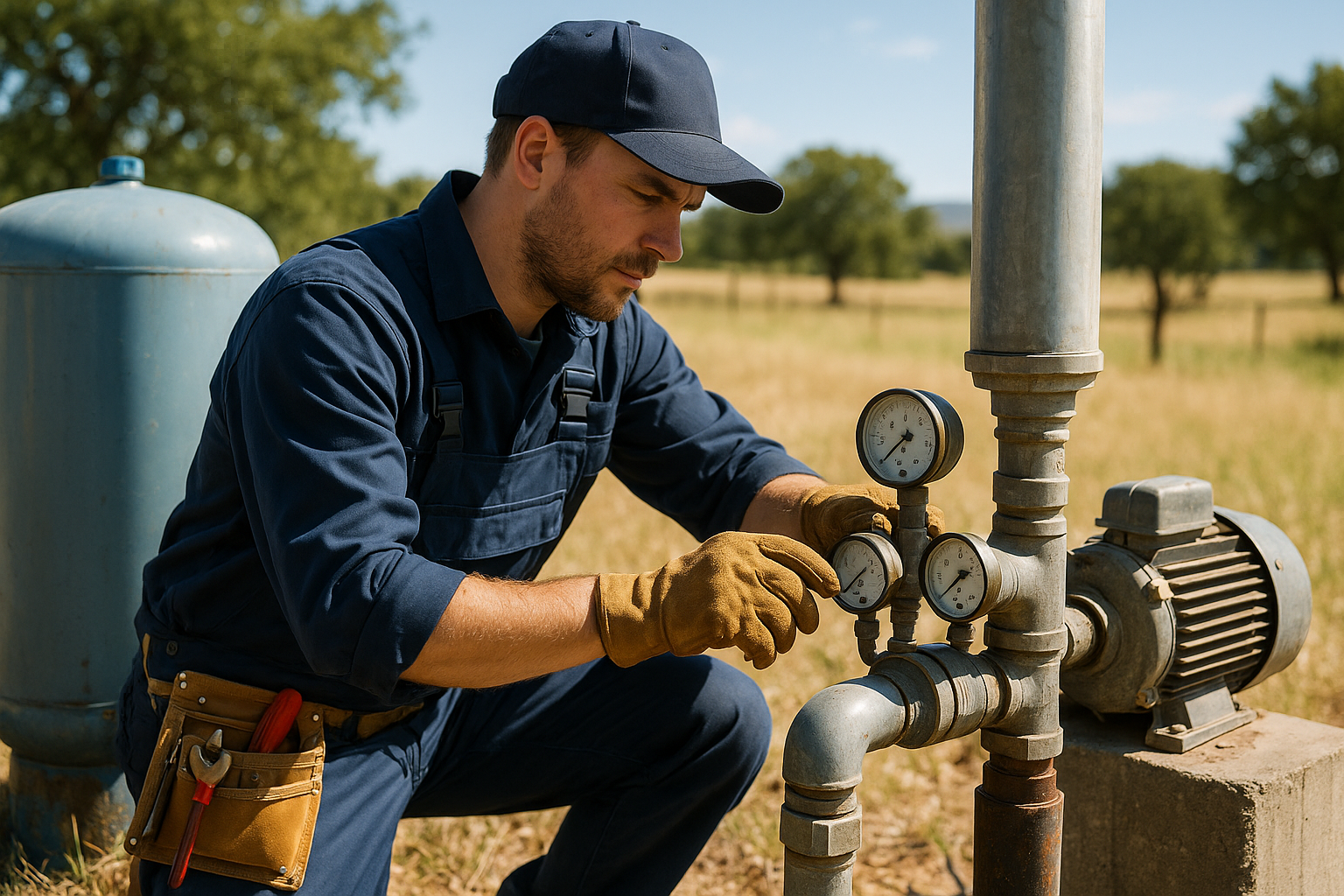
A booster pump is an electric pump installed on your water line after the pressure tank, adding pressure on demand. When you open a tap, it senses the drop and runs to hold a firm, steady level, typically 50 to 60 psi. The best systems use a variable-frequency drive, a constant-pressure setup, that ramps the motor smoothly so pressure stays even whether one fixture or several are open. For hilly Lake Morena properties that lose pressure to elevation and distance, that steady delivery is exactly what restores comfortable water.
A booster adds pressure, not water. If your well yield is low or your line is undersized, a booster will only pull harder on a limited source, and on a fractured-granite well that can risk drawing the well down. That is why we always check well yield, pump condition, and tank health before recommending one.
Signs You Need a Booster Pump
- Showers fade the moment irrigation, the washer, or a second fixture runs.
- Uphill fixtures and distant hose bibs barely produce water.
- Your pressure gauge reads under 40 psi or swings between cycles.
- Filling a tub, trough, or tank takes far longer than it used to.
- You added a casita, a barn, or expanded irrigation and pressure dropped.
Booster Pump vs. New Well Pump vs. Constant-Pressure System
On a backcountry well, matching the fix to the cause is critical:
- Booster pump — best when the well delivers enough water and pressure at the tank but the house loses it to elevation and long runs.
- Constant-pressure (VFD) system — ideal for even pressure across changing demand and longer equipment life, a strong choice for hilly parcels with multiple structures.
- New well pump — necessary when the submersible is undersized, worn, or failing, no booster fixes a pump that cannot lift enough from the bedrock.
- New pressure tank — solves cycling and pressure swings from a waterlogged bladder, sometimes the only repair needed.
Sizing a Booster Pump for Rural Properties
Sizing balances flow against the pressure you need to add. A typical Lake Morena home wants 8 to 12 GPM for simultaneous fixtures, but on a low-yield granite well we size carefully so the booster never demands more than the well can sustainably give. We measure your service-line length and diameter, calculate friction loss, factor in elevation gain to the house and outbuildings, and select a pump and tank that hold firm pressure without short-cycling or stressing the well. Protecting the well is as important as boosting the house.
What to Check Before You Call
- Read your pressure gauge at rest and while water runs.
- Note how often the pump cycles, rapid on-off points to a tank issue.
- Determine whether weak pressure is house-wide or only at distant or uphill fixtures.
- Look for leaks or wet spots along the buried service line.
- Know your well's depth and yield and the age of your pump and tank if possible.
When to Call a Professional
Backcountry well work involves electrical wiring, pressure-rated plumbing, low-yield well protection, and correct tank charging. A C-57 licensed contractor confirms your well can support a booster without being overdrawn, sizes the system to your demand and your well's capacity, protects the motor, and tests the result. Fractured-granite East County wells in particular reward experience, knowing how yield, elevation, and demand interact is what keeps a fix from backfiring.
Maintaining Your System in the Backcountry
Out here, you are your own water utility, so a little maintenance goes a long way. We recommend an annual check of the pressure-tank air charge, attention to any cycling that signals a failing bladder, and a listen for unusual motor noise. We also suggest knowing your well's seasonal behavior, many East County wells draw down through late summer and recover with winter rains, and a constant-pressure system can be set to ride out those swings gracefully. Because help is farther away in the backcountry, catching a low tank charge or a struggling pump early prevents a no-water emergency miles from the nearest main. When we install a system we show you the seasonal checks and stay available year-round.
Cost of Booster Pump and Pressure Solutions
- Constant-pressure or booster system: $2,000 to $4,500 installed.
- Pressure tank replacement: $600 to $1,500.
- New well pump: $2,500 to $5,500.
- Diagnostic visit: $125, credited toward any work.
We provide written, upfront quotes after inspecting your system.
Serving Lake Morena and East County San Diego
Southern California Well Service serves Lake Morena and the surrounding backcountry communities including Campo, Potrero, Boulevard, Pine Valley, and Descanso. From our Ramona and Anza offices we handle scheduled installations and same-day emergencies across rural East County. We understand fractured-granite wells, the demands of hilly rural parcels, and how to size a pressure system that keeps your home strong while protecting a precious mountain well.
Frequently Asked Questions
Will a booster pump fix low pressure on my Lake Morena property?
Often yes, if your well delivers enough water but the home loses pressure to elevation and long pipe runs. A booster restores firm pressure. On a low-yield granite well, we size carefully so the booster never overdraws the well, and if a worn pump is the real cause we address that first.
How much does a booster pump cost in Lake Morena?
A booster or constant-pressure system typically runs $2,000 to $4,500 installed. A pressure tank runs $600 to $1,500, and a new well pump $2,500 to $5,500. Our diagnostic visit is $125, credited toward the work.
Do I need a booster or a new well pump?
A booster helps when the well has water but the property loses pressure to elevation and distance. A new pump is needed when the submersible is worn, undersized, or failing. We measure your well and system to tell the difference.
Will a booster overdraw my low-yield well?
Not if it is sized correctly. We measure your well's sustainable yield first and select a booster and tank that improve household pressure without demanding more water than the well can give, which protects both your supply and the pump.
How are wells in Lake Morena different?
Most are drilled into fractured granite and decomposed-granite bedrock, which tends to produce modest, steady yields rather than high flow. That makes correct sizing and well protection especially important when adding a booster.
How fast can you reach Lake Morena?
From our Ramona and Anza offices we serve the East County backcountry regularly, with scheduled visits and 24/7 emergency response when a rural home loses water.
Get Firm Water Pressure in Lake Morena
Call Southern California Well Service for a booster pump assessment. Diagnostic is $125, credited toward your repair. Call (760) 440-8520 or text (619) 259-0410.
(760) 440-8520