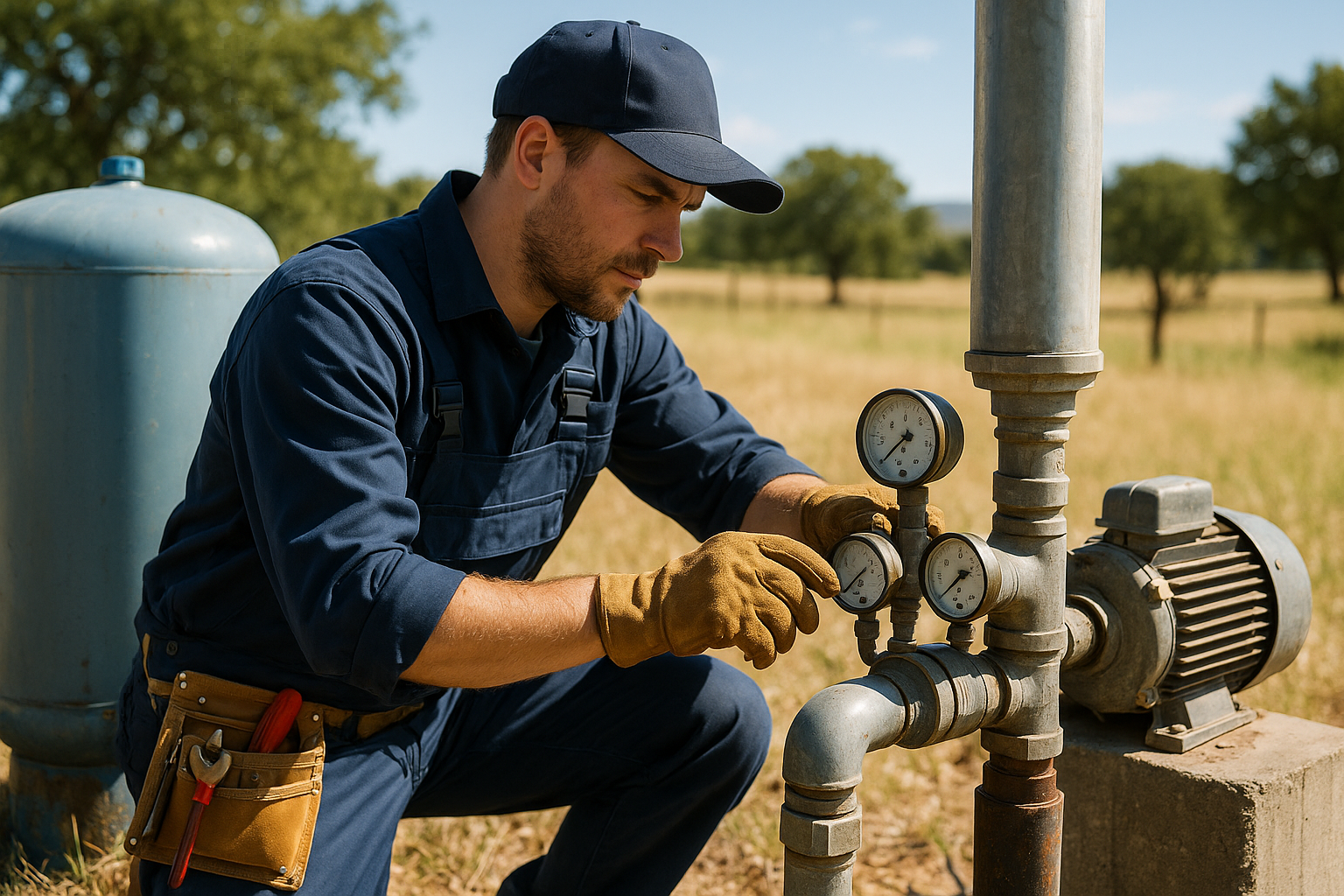
How to Prime a Well Pump: Step-by-Step Instructions
Learn how to prime your well pump to restore water flow. Complete DIY guide with step-by-step instructions for jet pumps and shallow well pumps.
See our pump priming services.
Call (760) 440-8520Why Well Pumps Lose Prime
A well pump "loses prime" when air gets into the system where water should be. Jet pumps and shallow well pumps must maintain a column of water from the pump down to the well water to function. When air breaks this column, the pump spins but can't move water—you'll hear it running but get little or no flow.
Common causes of lost prime include:
- Power outage: After extended outages, water can drain back down, especially if the foot valve is weak
- Failing foot valve: The foot valve at the bottom of the drop pipe prevents water from draining back; when it fails, prime is lost
- Air leaks: Cracks in pipes, loose fittings, or worn pump seals let air into the suction side
- Low water level: If the water table drops below the foot valve, the pump sucks air
- Recent work: Any service that opened the system may have introduced air
Important: Submersible pumps (installed down in the well itself) are self-priming and don't need this procedure. This guide is specifically for jet pumps and other above-ground pumps that require priming.
⚠️ Safety First: Always disconnect power to the pump before opening any fittings or removing the priming plug. Well pumps run on 240V electricity—enough to cause serious injury. Turn off the breaker and verify power is off before working on the pump.
Tools and Materials Needed
Before you begin, gather these supplies:
- Clean water: Several gallons—5-gallon buckets work well
- Funnel or hose: For directing water into the priming port
- Adjustable wrench or socket set: For the priming plug (usually 3/4" or 1")
- Teflon tape: For resealing the priming plug
- Flashlight: To see inside the pump housing
- Towels or rags: This can get messy
You may also want a helper to add water while you monitor the pump or operate switches.
Step-by-Step Pump Priming Process
Step 1: Turn Off the Power
Go to your electrical panel and turn off the breaker for the well pump. This is typically a 30-40 amp double-pole breaker. Verify the pump won't start by trying the pressure switch or listening for the pump. Never assume it's off—test it.
Step 2: Locate the Priming Plug
Find the priming plug on top of the pump housing. It's usually a square or hex-head plug, often 3/4" or 1". Some pumps have a dedicated priming port; others use a pipe fitting that can be removed. If you can't identify it, check your pump's manual or look for the highest point on the pump casing.
Step 3: Remove the Plug and Check Water Level
Using your wrench, carefully remove the priming plug. Water may spill out if there's still some in the pump. Look inside—if you see the impeller or the housing is dry, the pump definitely needs priming. Set the plug aside and keep the Teflon tape ready.
Step 4: Add Water to the Pump Housing
Using a funnel or hose, slowly pour clean water into the priming port. Fill until water reaches the top of the port. The water will gradually drain down the suction pipe toward the well, displacing air. This process may take several gallons depending on your pipe length and diameter.
Step 5: Cycle the Water
Continue adding water as it drains. You're trying to fill the entire suction line from the pump down to the foot valve. For a 100-foot well with 1-1/4" pipe, this could be 5-10 gallons. Keep adding water until the level holds steady without draining—this means you've displaced all the air.
Step 6: Reinstall the Plug
Once the water level holds, wrap the priming plug threads with fresh Teflon tape (3-4 wraps clockwise). Reinstall the plug and tighten snugly—don't over-tighten as this can crack the fitting.
Step 7: Restore Power and Test
Turn the breaker back on. The pump should start automatically if the pressure tank is low. Listen for normal pump sounds—a smooth hum indicates water is flowing. If the pump runs but makes grinding or whining sounds, shut it off immediately and repeat the priming process.
Step 8: Check for Flow
Open a faucet and verify water flows. It may sputter initially as the last air clears the lines. Within a minute or two, you should have steady flow. If the pump runs but you get no water after 2-3 minutes, turn it off to prevent damage and investigate further.
When Priming Won't Fix the Problem
Sometimes priming doesn't work, or the pump loses prime again shortly after. This usually indicates a more serious issue that requires professional attention:
- Repeated loss of prime within hours or days: Almost certainly an air leak or failed foot valve
- Can't get water to hold in pump: Major leak in suction line, possibly a cracked pipe underground
- Pump makes unusual noises when running: Impeller damage or bearing failure
- Water level in well is too low: Foot valve may be above the water table—the pump can't reach water
- Visible water spraying from pump or pipes: Mechanical failure requiring repair or replacement
If you've attempted priming twice without success, or if the pump keeps losing prime, it's time to call a professional. Continuing to run a pump without proper prime will damage the seals and impeller, turning a minor repair into a major expense.
⚠️ Don't Force It: Never run a pump dry for more than 30-60 seconds. If priming isn't working after two attempts, stop and call for help. The cost of a service call is far less than replacing a burned-out pump.
We service all major pump brands including Franklin Electric, Grundfos, Goulds (Xylem), and Sta-Rite (Pentair). Our trucks carry common parts and components for same-day repairs.
Frequently Asked Questions
How long does it take to prime a well pump?
Priming a jet pump typically takes 10-30 minutes once you have water flowing into the pump housing. The actual time depends on the depth to water, the length of your drop pipe, and whether you have any air leaks in the system. If priming takes more than an hour or fails repeatedly, there's likely a deeper issue.
Why does my pump keep losing prime?
Repeated loss of prime usually indicates an air leak somewhere in the suction line. Common causes include a failing foot valve at the bottom of the well, cracked or loose pipe fittings, a damaged pump seal, or a hole in the drop pipe. Low water levels can also cause the foot valve to suck air.
Can I damage my pump by running it without prime?
Yes. Running a pump dry—even for a short time—can cause significant damage. The water flowing through the pump provides lubrication and cooling for the seals and impeller. Without water, these components overheat and wear rapidly. Never let a pump run more than 30-60 seconds without water flowing.
Get Expert Well Service
Southern California Well Service has served San Diego, Riverside, and San Bernardino counties for decades. Licensed C-57 contractor.
Call (760) 440-8520Available 24/7 for emergencies
Related Articles
Continue learning about well maintenance and troubleshooting