7 Signs You Need a New Well Pump (Don't Ignore #3)
We pull about 200 well pumps a year across San Diego, Riverside, and San Bernardino counties. Most of the time, homeowners tell us the same thing: "I knew something was off for months, but I kept hoping it would fix itself." It never does. A well pump that's failing will keep getting worse until it dies completely — usually at the worst possible time.
Here are the seven warning signs we see most often, what's actually happening inside your well, and when it makes sense to repair versus replace.
1. Your Water Pressure Has Dropped Noticeably
This is the most common early symptom. You turn on the shower and it's weaker than it used to be. The garden hose doesn't spray as far. The kitchen faucet takes longer to fill a pot.
What's happening: The pump's impellers — the spinning discs that push water upward — wear down over time. Sand and grit in your well water act like sandpaper on these components. As they erode, the pump moves less water per cycle. A pump that delivered 12 GPM when new might only produce 6-7 GPM after 10 years.
Important distinction: Low pressure can also come from a waterlogged pressure tank (failed bladder), a partially closed valve, or a clogged filter. Before assuming the pump is bad, check these first. A waterlogged tank is a $500-$1,000 fix. A new pump is $2,000-$5,000.
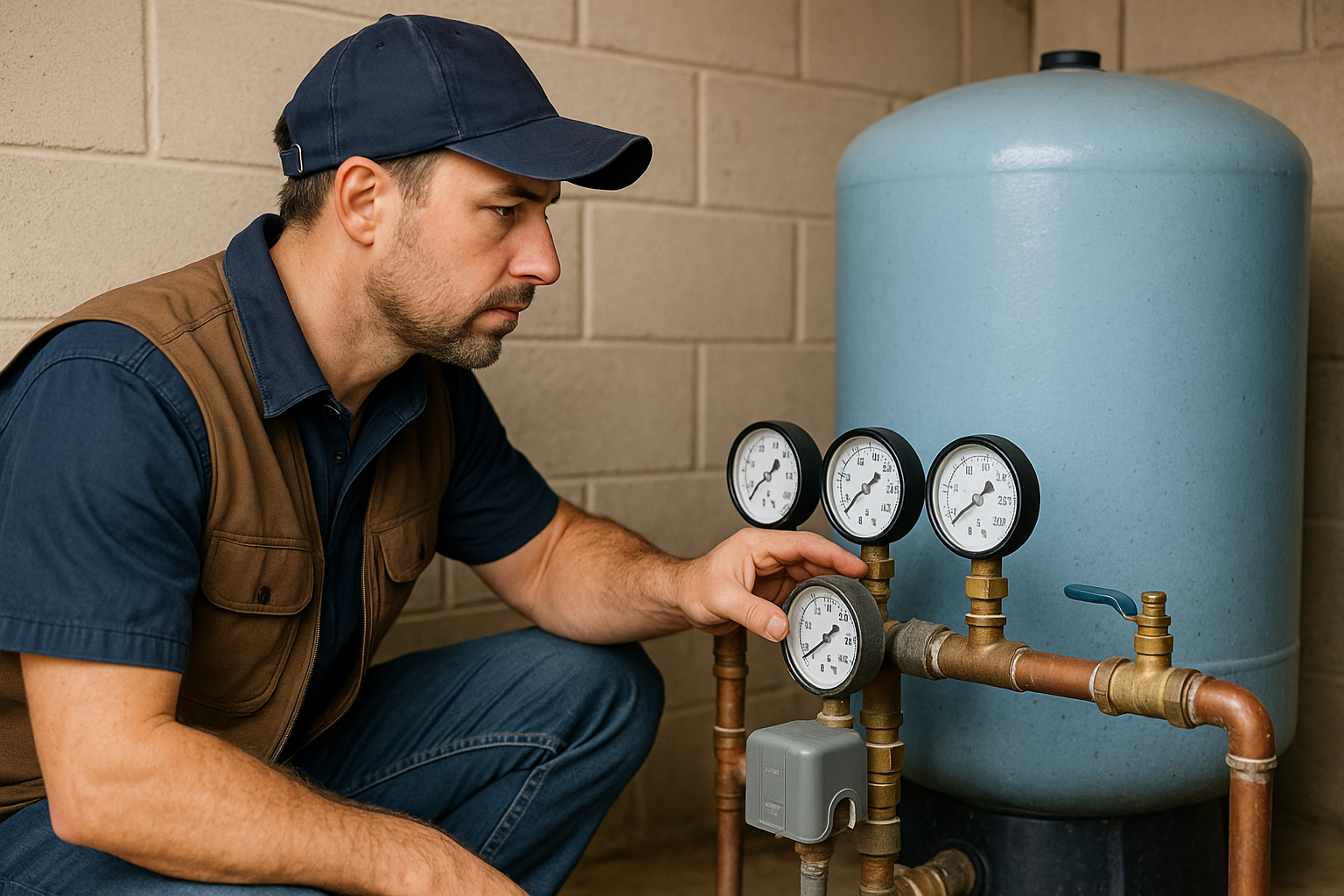
Quick test: Watch your pressure gauge during a pump cycle. If the pump runs but pressure builds very slowly (or never reaches cut-off), the pump is likely worn. If pressure builds normally but drops instantly when you open a faucet, it's probably the pressure tank.
2. The Pump Is Short-Cycling (Turning On and Off Rapidly)
You hear the pump kick on, run for 15-30 seconds, shut off, then kick on again. Over and over. This rapid cycling is one of the most damaging things that can happen to a well pump.
Each time a submersible pump starts, it draws 3-5 times its normal running amperage. That startup surge generates heat and mechanical stress. A pump designed to start maybe 6-8 times per hour can survive decades. A pump starting 30-40 times per hour will burn out in months.
The usual culprit is actually the pressure tank, not the pump. When the bladder inside your pressure tank fails, the tank can't hold an air cushion anymore. Instead of providing 10-20 gallons of water between pump cycles, it provides almost nothing — so the pump has to start up every time someone turns on a faucet.
Check this first: Tap the side of your pressure tank from top to bottom. A healthy tank sounds hollow at the top (air) and solid at the bottom (water). If it sounds solid all the way up, the bladder has failed. Replace the tank ($500-$1,200 installed) before the short-cycling destroys your pump.
3. Your Electric Bill Has Spiked (This One Sneaks Up on You)
⚠️ This is the sign most people miss — and the most expensive to ignore.
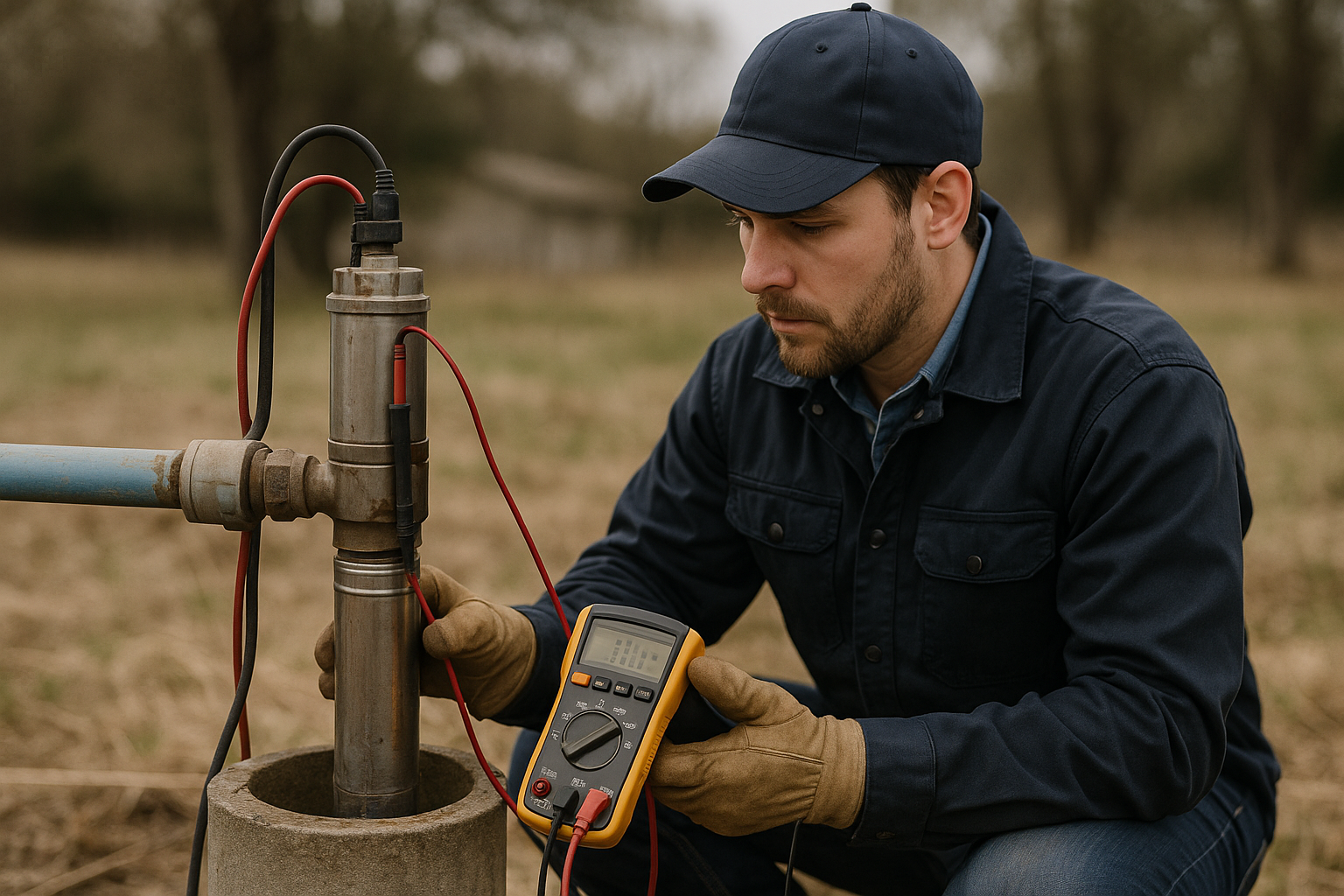
A healthy 1 HP submersible pump draws about 10-12 amps at 230V. As bearings wear, impellers erode, and motor windings degrade, the pump works harder to produce the same output. Amp draw creeps up to 14, 16, 18 amps. Your electric bill goes up $30-$80/month, and most people blame SDG&E rate increases.
We've pulled pumps that were drawing nearly double their rated amperage. That's not just wasted electricity — it's a motor running hot enough to damage the well casing and the wiring. One customer in Ramona ignored a slowly rising electric bill for two years. When the pump finally seized, the overheated wiring had fused to the drop pipe. What should have been a $3,000 pump replacement turned into a $7,500 job because we had to replace all the wiring and pipe too.
What to do: If you suspect high amp draw, a technician can measure it at the control box in about 5 minutes with a clamp meter. It's part of any routine service call.
4. You're Getting Air Spurts or Sputtering Water
You turn on the faucet and get a blast of air mixed with water, or the flow sputters and surges. This happens for two main reasons:
- Dropping water level: If your well's water level has dropped near or below the pump intake, the pump sucks air along with water. This is especially common during San Diego's dry summer months when water tables drop. We see it a lot in Julian, Ramona backcountry, and the mountain communities.
- Cracked or leaking drop pipe: The pipe connecting your pump to the surface can develop cracks, especially at threaded joints. Air enters through these cracks and mixes with the water stream.
Why this is urgent: A submersible pump is designed to be cooled by the water flowing around it. When it's sucking air, it's running dry — which causes the motor to overheat rapidly. Even brief periods of dry running can burn out the motor windings. If you're getting air in your water, don't ignore it for more than a day or two.
If the water level is the issue, the pump may need to be lowered in the well (if there's room) or the well may need deepening. If it's a pipe leak, the entire pump assembly needs to be pulled to find and fix it.
5. Sand or Sediment Is Showing Up in Your Water
Sandy or gritty water from a well that used to run clean is a serious warning sign. It typically means one of three things:
- The well screen is deteriorating. The screen at the bottom of your well casing is designed to let water in while keeping sand out. After 20-30 years, screens corrode and develop holes. Sand enters the well and gets pumped into your house.
- The pump has dropped. If the pump mounting or safety rope has failed, the pump can sink to the bottom of the well where it sits in sediment. Every time it runs, it churns up sand.
- The pump is oversized for the well. A pump that draws water faster than the well can replenish creates a vortex effect that pulls sand from the formation into the well bore.
Sand is the #1 pump killer. Those tiny grains act like liquid sandpaper on the impellers, bearings, and seals. A pump running in sandy conditions might last 2-3 years instead of 12-15. If you're seeing sand, get it diagnosed fast — the pump may still be saveable if you catch it early, but let it go and you'll need a new pump AND potentially well rehabilitation.
6. Strange Noises From the Well or Pressure Tank Area
You shouldn't hear your submersible pump — it's hundreds of feet underground, surrounded by water. If you're hearing noises, something's wrong:
- Clicking from the pressure switch: The switch contacts are engaging and disengaging rapidly (short-cycling — see #2). Could be a bad pressure tank or a pump that can't build pressure.
- Humming or buzzing from the control box: The pump is trying to start but can't. Could be a seized motor, failed capacitor, or low voltage. Turn off the breaker immediately — a stalled motor draws locked-rotor amps that can melt wiring.
- Banging or water hammer in pipes: Often caused by a failed check valve. When the pump stops, water falls back down the well and the column reverses direction, creating a shock wave. Not a pump problem per se, but the repeated hammering damages pump connections.
- Grinding or vibrating: Worn bearings in the pump motor. The pump is close to failure. Plan for replacement soon.
7. The Pump Is More Than 12-15 Years Old
Even with perfect conditions, submersible pumps have a finite lifespan. The motor windings degrade, bearings wear, and impellers erode. In our area, we typically see:
- 8-12 years: Average lifespan in wells with sand or high mineral content (common in Ramona, Alpine, mountain areas)
- 12-15 years: Average lifespan in clean wells with properly sized pressure tanks
- 15-20+ years: Possible with ideal conditions, quality pumps (Franklin, Grundfos), and good maintenance
If your pump is over 12 years old and showing any of the symptoms above, it's almost always more cost-effective to replace than repair. Pulling a pump costs $800-$1,500 just for the labor — if you pull it, find a bad motor, and have to install a new one anyway, you've paid for the pull twice.
Pro tip: If you don't know how old your pump is, check the well service records or look at the control box. Many control boxes have a date of manufacture or installation sticker. The pump is usually the same age or newer than the control box.
Repair vs. Replace: How We Decide
When we pull a pump, we assess whether repair makes sense. Here's our general rule:
| Situation | Recommendation |
|---|---|
| Pump under 5 years, minor issue (capacitor, pressure switch) | Repair |
| Pump 5-10 years, control box or wiring issue | Repair if pump tests good |
| Pump over 10 years, motor or impeller failure | Replace |
| Any age, sand damage to impellers | Replace (and fix the sand problem) |
| Any age, lightning or power surge damage | Usually replace (motor windings fried) |
What Replacement Actually Costs in San Diego County
The biggest factor is well depth — deeper wells mean more pipe, more wire, and more labor to pull and reinstall. Here are realistic 2026 prices for our area:
- Shallow well (under 150 ft): $1,500–$2,800 — includes pump, motor, pipe, wire, fittings
- Medium depth (150–300 ft): $2,500–$4,000 — most residential wells in our area fall here
- Deep well (300–500+ ft): $4,000–$6,500+ — common in Julian, Palomar Mountain, Pine Valley
- Emergency/after-hours: Add 25-50% — call during business hours if you can
We include a new pressure switch, torque arrestor, and check valve with every pump installation. These components wear out on a similar schedule to the pump, and it makes no sense to pull everything out of the well in three years to replace a $30 check valve.
How to Make Your Next Pump Last Longer
Once you've invested in a new pump, protect that investment:
- Right-size your pressure tank. A bigger tank means fewer pump cycles. We recommend minimum 44 gallons for most homes, 86 gallons for families of 4+ or properties with irrigation.
- Install a pump protection device. A Pumptec or similar device monitors amp draw and cycle rate. If the pump starts dry-running or short-cycling, it shuts down before damage occurs. Cost: $200-$400. Can save you $3,000+.
- Add a surge protector at the control box. Lightning strikes and SDG&E power surges kill well pumps constantly in our area. A whole-house surge protector plus a dedicated well pump suppressor costs $200-$500 and is cheap insurance.
- Check your pressure tank air charge twice a year. It should read 2 PSI below your cut-in pressure (28 PSI for a 30/50 system). Use a regular tire gauge on the Schrader valve at the top of the tank. Top off with a bicycle pump if low.
- Annual professional inspection. A $150-$200 checkup catches problems when they're cheap to fix instead of expensive to replace.
Think Your Well Pump Is Failing?
We diagnose well pump problems every day across San Diego, Riverside, and San Bernardino counties. Our trucks carry testing equipment and common parts for same-day diagnosis — and often same-day repair.
Call (760) 440-8520